Skip to Content Facebook Feature Image

Global economy projected to grow 2.8 pct in 2025: UN
China

China

China

Global economy projected to grow 2.8 pct in 2025: UN

2025-01-10 16:02 Last Updated At:01-11 00:37

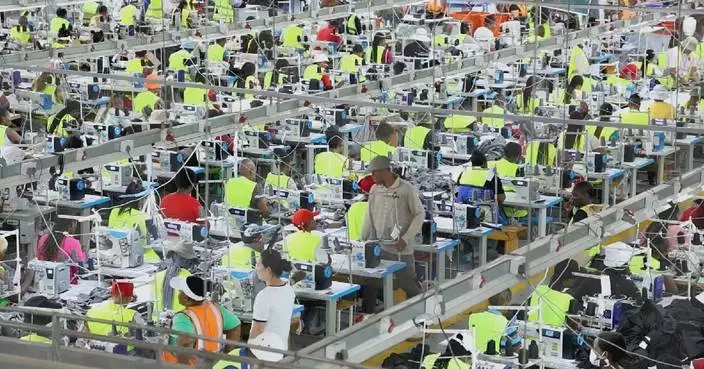
Global economic growth is projected to remain at 2.8 percent in 2025, unchanged from last year, according to a UN report released on Thursday.

Despite falling inflation, improving labor market conditions, and monetary easing, global growth is predicted to remain below the pace seen before the pandemic, and the world economy continues to face significant uncertainties, the UN World Economic Situation and Prospects 2025 report says.

More Images
Global economy projected to grow 2.8 pct in 2025: UN

Global economy projected to grow 2.8 pct in 2025: UN
Global economy projected to grow 2.8 pct in 2025: UN
Global economy projected to grow 2.8 pct in 2025: UN

Global economy projected to grow 2.8 pct in 2025: UN
Global economy projected to grow 2.8 pct in 2025: UN
Global economy projected to grow 2.8 pct in 2025: UN

Global economy projected to grow 2.8 pct in 2025: UN
According to the report, lower inflation and ongoing monetary easing in many economies could provide a modest boost to global economic activity in 2025. However, uncertainty still looms large, with risks stemming from geopolitical conflicts, rising trade tensions and elevated borrowing costs in many countries.

These challenges are particularly acute for low income and vulnerable countries, where sub-par and fragile growth threatens to further undermine progress toward the Sustainable Development Goals.

Growth in the United States is projected to moderate from 2.8 percent in 2024 to 1.9 percent in 2025, as labor markets soften and consumer spending slows.

Europe is expected to recover modestly, with gross domestic product (GDP) increasing from 0.9 percent in 2024 to 1.3 percent in 2025, supported by easing inflation and resilient labor markets, though fiscal tightening and long-term challenges, such as weak productivity growth and an aging population, continue to weigh on the economic outlook.

East Asia is forecast to grow by 4.7 percent in 2025, driven by China's projected stable growth of 4.8 percent, and supported by robust private consumption across the region.

South Asia is expected to remain the fastest-growing region, with GDP growth projected at 5.7 percent in 2025, led by India's 6.6 percent expansion.

Africa is forecast to grow modestly from 3.4 percent in 2024 to 3.7 percent in 2025, thanks to recoveries in major economies including Egypt, Nigeria, and South Africa.

Global inflation is projected to decline from 4 percent in 2024 to 3.4 percent in 2025, providing some relief to households and businesses. Major central banks are expected to further cut interest rates this year as inflationary pressures continue to ease.

Yet, inflation in many developing countries is expected to remain above recent historical averages, with one in five projected to face double-digit levels in 2025.

The report emphasizes that governments should seize any fiscal space created by monetary easing to prioritize investments in sustainable development, especially in critical social sectors.

Global economy projected to grow 2.8 pct in 2025: UN

Global economy projected to grow 2.8 pct in 2025: UN
Global economy projected to grow 2.8 pct in 2025: UN
Global economy projected to grow 2.8 pct in 2025: UN

Global economy projected to grow 2.8 pct in 2025: UN

Global economy projected to grow 2.8 pct in 2025: UN

Global economy projected to grow 2.8 pct in 2025: UN

Global economy projected to grow 2.8 pct in 2025: UN

A former television host from Taiwan, Zhai Xuan, has made a pivotal decision to leave mainstream broadcasting in order to create content that provides a better understanding of the Chinese mainland and cross-strait relations.

Zhai, a seasoned television host with over a decade of experience in Taiwan's media landscape, recently addressed an audience at an event in Beijing, where she revealed her complete transition into independent online media.

In her remarks, she articulated her aspiration to bridge what she perceives as a significant information gap between audiences on both sides of the Strait, highlighting her commitment to fostering a deeper understanding and connection through her new endeavors.

"I was really surprised by all the fake news. There were stories saying people on the mainland can't afford tea eggs or that they live in mud houses and in Taiwan, this was the main information many people received," said Zhai.

Zhai said she initially began producing online videos to challenge such perceptions while continuing her work as a television host.

In April 2025, she travelled to the mainland with her father to fulfill her late grandfather's wish to return to his hometown. The trip, which reunited family members separated since 1949, was recorded in a video series titled "Journey to Find Our Roots", drawing attention from viewers in both Taiwan and the mainland.

"Many people in Taiwan told me that after watching, they wanted to apply for a mainland travel permit immediately and go looking for their relatives. Some had long forgotten these things, but after seeing my story, they began thinking about their hometowns and family members they had never met and decided to search for their roots," Zhai shared her story at the event.

By mid-2025, Zhai said she began to feel increasing pressure amid rising political tensions and a tightening atmosphere around cross-Strait exchanges in Taiwan.

After more than 12 years in the industry, Zhai resigned from her position, believing it was the right thing to do.

"At that moment, I felt this was a major issue,not just for me, but for Chinese people on both sides of the Strait. If I backed down then, I wouldn’t be standing on the right side," said Zhai.

Since leaving television, Zhai has broadened her online programming to encompass a range of daily-life topics, including practical guidance on applying for a mainland travel permit and using commonly employed mobile applications, in addition to content that delves into historical memory and cultural connections across the Strait.

As the debate over cross-Strait relations continues in Taiwan, Zhai said she remains committed to her current path.

Former Taiwan TV host bridges cross-Strait divide via online media

Former Taiwan TV host bridges cross-Strait divide via online media

Recommended Articles