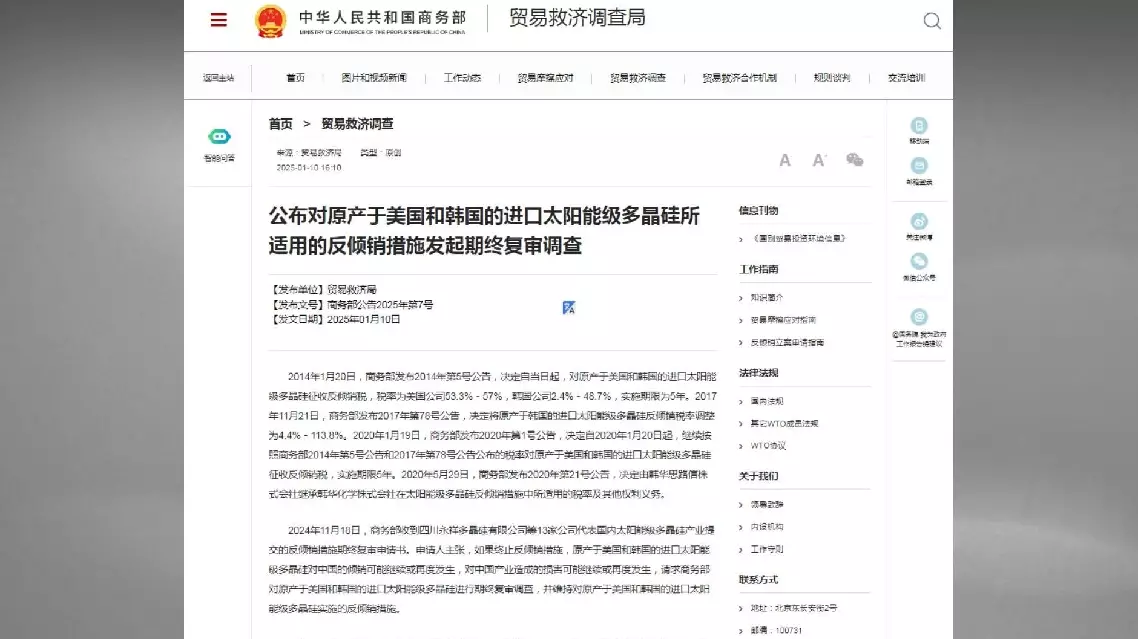
China's Ministry of Commerce announced Friday that starting from Jan. 14, 2025, it will launch an expiry review of anti-dumping measures aimed at solar-grade polysilicon originating in the United States and the Republic of Korea (ROK).
The expiry review, requested by the domestic solar-grade polysilicon industry, will determine if terminating anti-dumping measures will lead to continued dumping and harm, the ministry said in a statement.
The Customs Tariff Commission of the State Council will maintain the anti-dumping duties during the review, with scope and rates remaining unchanged, according to the ministry.
Solar-grade polysilicon is the main raw material for the production of crystalline silicon photovoltaic cells.
On Jan. 20, 2014, China imposed anti-dumping duties on the United States and ROK-originated solar-grade polysilicon, with rates ranging from 53.3 to 57 percent for U.S. companies, and 2.4 to 48.7 percent for ROK companies.
In November 2017, China adjusted the rate range of anti-dumping duties on ROK-originated solar-grade polysilicon to 4.4 to 113.8 percent. In January 2020, China extended the anti-dumping duties for another five years, according to the ministry.
China to review anti-dumping measures on solar-grade polysilicon originating in US, ROK
Iran's supreme leader demanded war reparations from the United States and Israel on Monday and vowed to escalate the country's management of the Strait of Hormuz, while President Donald Trump said he would not lift the U.S. blockade on Hormuz until Tehran agrees to a deal.
In a statement posted on his official social media account on Monday, Iran's Supreme Leader Mojtaba Khamenei said that Iran would hold accountable those responsible for attacks against the country and seek compensation for wartime losses.
He also called for a new phase in the management of the Strait of Hormuz, vowing never to abandon Iran's legitimate rights and regarding all "resistance fronts" in the region as a unified whole.
On April 9, the Iranian supreme leader outlined the three principles in a written address marking 40 days since the death of former Supreme Leader Ali Khamenei.
Also on Monday, President Trump said in his social media post that the United States will not lift its blockade on Iranian ports until a deal is reached.
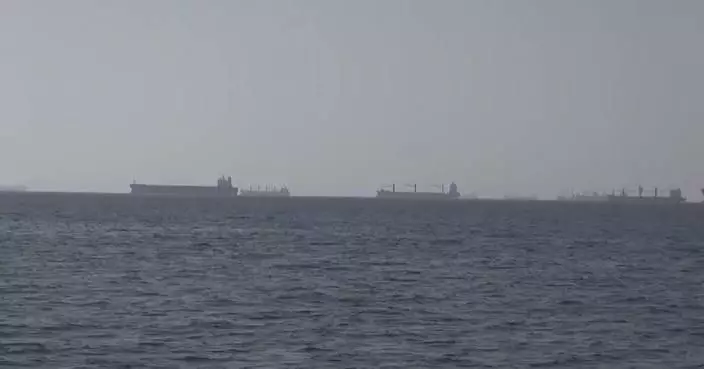
The U.S. forces have enforced a naval blockade on vessels entering and leaving Iranian ports since April 13, with the U.S. Central Command said one day later that Iran's maritime trade had been completely cut off.
Iran responded by opening the Strait of Hormuz to commercial shipping on April 17, but reversed course on the following day, resuming control of passage after the United States refused to lift its blockade.
Pakistan is now actively mediating in an effort to persuade the United States to end the blockade, a move seen as essential for Iran's participation in negotiations, a senior Iranian official said on Monday.
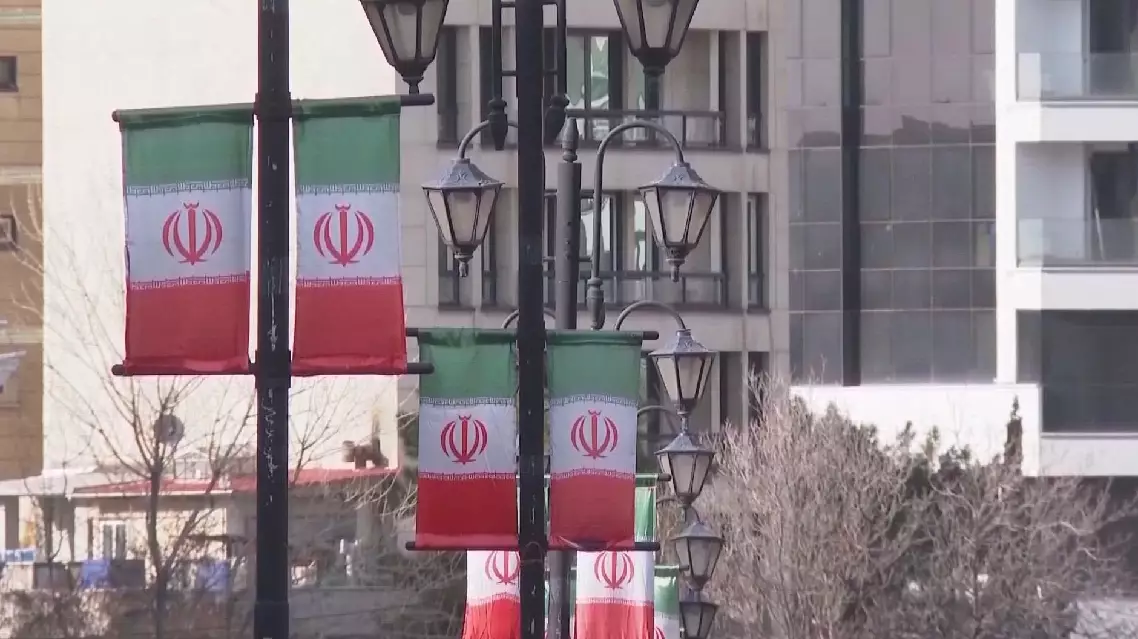
Iran reiterates core positions, US vows no let-up in blockage