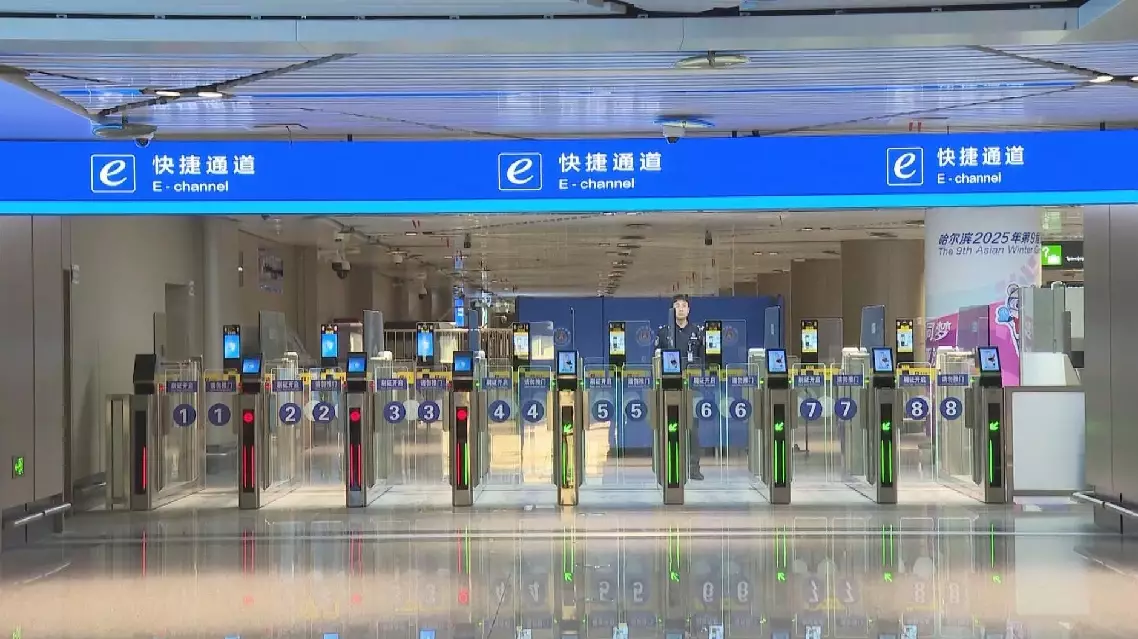
Harbin in northeast China's Heilongjiang Province, which is to host the 9th Asian Winter Games from February 7 to 14, has opened fast e-channels for inbound and outbound passengers during the upcoming travel rush for the Games and the Spring Festival.
On Friday, the first ever automated self-service lane for entries and exits in Heilongjiang officially began operation at the Harbin Taiping International Airport, allowing eligible passengers of a flight from Seoul, South Korea to enter the country after a quick passport verification.
"I feel it's very fast after I got off the plane, as if we were taking the subway, and cleared at one go. The workers and people on duty are very warm to us," said Park Ji-ying, an inbound traveler.
A total of 228 passengers enjoyed the convenient services at the airport's e-channels on the day.
"We have set up eight e-channels for inbound passengers and six for outbound ones. Before opening them, we tested the devices to make sure they operate smoothly. We also trained all the staff on how to use the e-channels and increased patrols to help passengers use the devices and ensure their clear smoothly and swiftly," said Geng Fuquan, a border inspection officer.
The upcoming Asian Winter Games marks the second time for Harbin to host the Games and the third time for China.
The Games has so far received 1,275 athlete registrations -- 755 men and 520 women -- from 34 countries and regions across Asia. This is expected to make it the edition with the highest participation of teams and athletes.
The Spring Festival, the most important traditional festival in China, falls on Jan 29.
Harbin airport opens e-channels for int'l travelers to Asian Winter Games
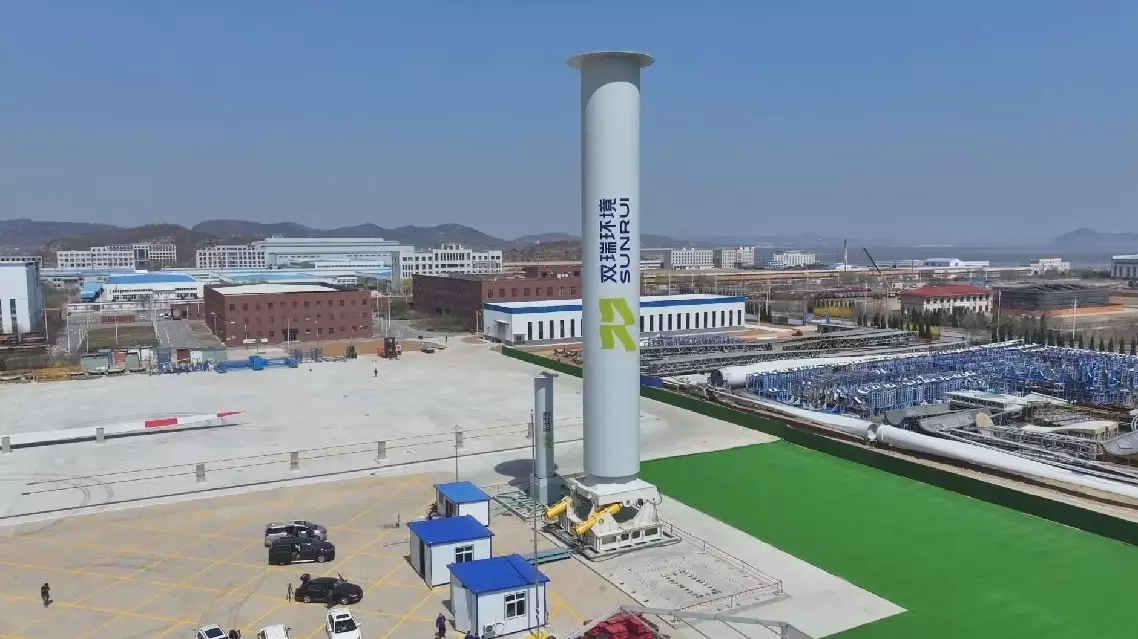
China unveiled a large wind-assisted propulsion system for ships in the coastal city of Dalian, northeast China's Liaoning Province, on Friday, marking a major leap forward for the country in the field of high-end vessel marine environmental protection equipment.
The wind-assisted propulsion system - rotating sail system (WAPS-RSS), is developed by Luoyang Ship Material Research Institute of China State Shipbuilding Corporation Limited (CSSC).
The system's rotor has diameter of 5 meters, is 35 meters high, and weighs 150 tons.
Experts say that the system can efficiently capture wind energy while the ship is sailing, providing additional thrust for the vessel.
On average, it can save fuel consumption by 5 to 25 percent for large ocean-going vessels, and lower carbon emissions accordingly.
It relies on the Magnus effect, which is much like a loop in table tennis, featuring a rapidly spinning sphere that causes the surrounding air to rotate. Pressure decreases on the side with faster airflow and increases on the side with slower airflow, creating a lateral pressure difference that generates lateral thrust.
"Standing on the deck, the powerful thrust generated by its rotation assists the ship's sailing. Our system - the world's largest rotary sail - reaches a maximum rotational speed of 180 revolutions per minute and can generate a maximum of 355 kilonewtons of thrust. Additionally, the system's intelligent control integrates multiple sensors to detect real-time wind and ship conditions. Through smart algorithms, it automatically adjusts to maintain optimal performance at all times, maximizing the utilization of wind energy," said Guo Yu, vice president of SunRui Marine Environment Engineering Company Limited under Luoyang Ship Material Research Institute.
Not only does the system's performance meet international advanced standards, but the project team has also overcome a series of engineering challenges, including the fabrication of giant composite structures, complex system integration, and intelligent coordinated control.
Compared with mainstream international technological approaches, it offers greater production efficiency and cost advantages.
Currently, the system has secured its first batch of orders and will complete actual vessel applications as scheduled.
China unveils large wind-assisted propulsion system for ships