Skip to Content Facebook Feature Image

Chinese carmakers aim to accelerate overseas expansion in 2025

China

China

China

Chinese carmakers aim to accelerate overseas expansion in 2025

2025-01-13 21:24 Last Updated At:01-14 00:27

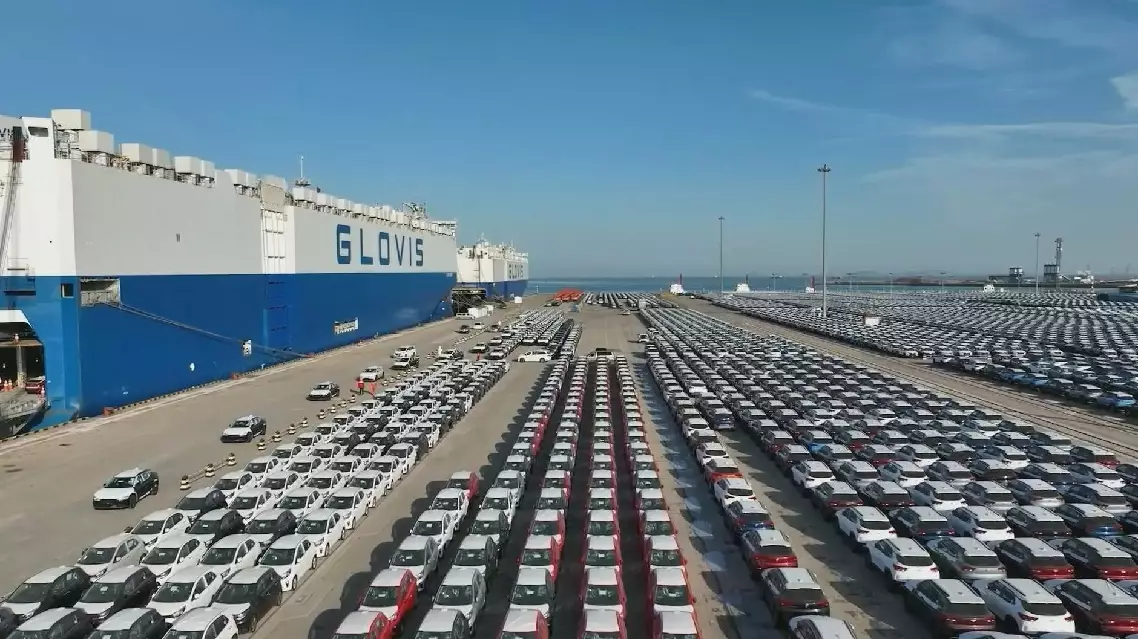
Chinese automakers are looking to expand overseas at an accelerated pace in 2025 by deploying large car carrier vessels to transport automobiles en masse, build localized manufacturing plants in new markets, and promote the export of key vehicle parts and technologies worldwide.

China's auto sector hit a new milestone in 2024, with both production and sales exceeding 31 million units, industry data showed on Monday, while the country also exported over 5.8 million vehicles, surging 19.3 percent year on year.

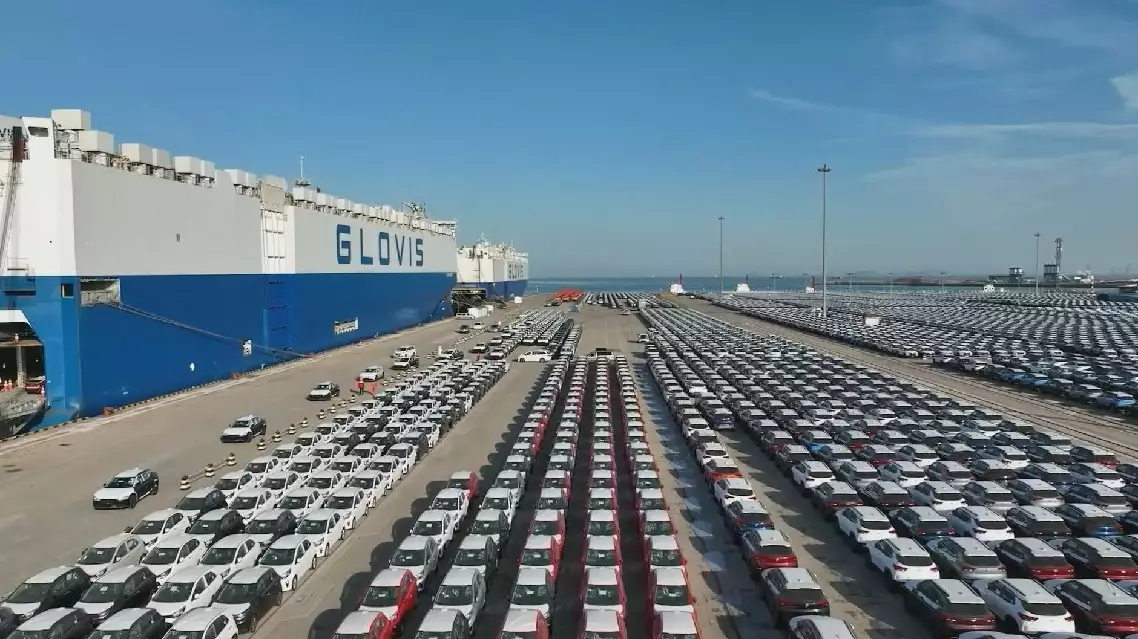
This strong growth momentum has continued into the new year, with a port in Yantai City of east China's Shandong Province already shipping off more than 10,000 commercial vehicles to the global markets within the first few days of January.

In addition, the world's largest and most environmentally-friendly car carrier ship that has the capacity for a staggering 9,100 cars was also delivered and put into operation earlier this month in Nantong City of east 's China Jiangsu Province.

In Shenzhen in the southern Guangdong Province, another new car carrier vessel launched by leading Chinese automaker BYD set sail last Tuesday. The ship, dubbed 'BYD Hefei', can carry up to 7,000 vehicles, and is a further sign of the company's ambitious expansion plans on the global markets.

"At the beginning of 2025, BYD launched its third self-built roll-on/roll-off vessel, the 'BYD Hefei,' which has greatly improved our export capabilities," said Luo Hao, assistant general manager of BYD's Branding and Public Relations Department.

Meanwhile, some Chinese carmakers are taking advantage of technological developments and the strong industrial and supply chains by shifting their focus on exporting vehicles to also building manufacturing plants abroad, allowing them to operate directly in their target markets.

In Thailand's Rayong Province, Chinese automaker Changan Automobile is speeding up the construction of its first new energy vehicle (NEV) manufacturing base, and is targeting an output of 200,000 units by 2026.

"The factory will start operation by the end of March this year. It will manufacture 100,000 units in the first year, and then increase to 200,000 units the next year," said Cai Hongwei, an employee at Changan Auto.

As Chinese new energy vehicles posted record performance, with both production and sales exceeding 10 million units for the first time in 2024, Chinese joint venture carmaker SAIC-GM-Wuling Automobile (SGMW) is cooperating with companies across the industrial chain to export NEVs key parts and technologies, helping accelerate the green transition as more motorists are increasingly turning towards electric vehicles.

Wei Wenqing, deputy secretary general of the China Association of Automobile Manufacturers (CAAM), believes Chinese automakers will continue to innovate by promoting their latest models and collaborating with partners in new markets.

"In terms of the regions, these companies will expand their operations from developed countries to developing countries. In terms of products, in addition to pure EVs, they will also launch a range of new products including plug-in hybrids and range extended electric vehicle (REEV) while supporting the export of fuel-powered cars and hybrid electric vehicles (HEVs). As for business forms and models, there will be independent development as well as collaborative and joint venture models," said Wei.
Chinese carmakers aim to accelerate overseas expansion in 2025
Chinese carmakers aim to accelerate overseas expansion in 2025
Chinese carmakers aim to accelerate overseas expansion in 2025
Chinese carmakers aim to accelerate overseas expansion in 2025

Palestine appreciates China's constructive role in promoting the political settlement of the Palestinian issue, Ambassador of Palestine to China Jawad Mohammed Qutish Awad said in Beijing on Friday.

When jointly meeting the press with visiting French President Emmanuel Macron in Beijing on Thursday, President Xi Jinping announced China will provide 100 million U.S. dollars of assistance to Palestine to help alleviate the humanitarian crisis in Gaza and support its recovery and reconstruction.

"Following two years of devastating war, over 90 percent of Gaza Strip's housing, infrastructure, hospitals, roads, and universities have been destroyed. China has consistently supported Palestine in various fields such as politics, economy, and development. This generous donation comes as timely aid for the Palestinian government and people," said the ambassador in an interview with China Central Television (CCTV).

More than 70,000 Palestinian people have been killed since the conflict in Gaza erupted on Oct 7, 2023, with millions suffering from extreme poverty and catastrophic hunger.

China has reiterated its support for the Palestinian liberation cause on multiple international occasions, firmly believing that the two-state solution remains the only realistic path to resolving the Palestinian-Israeli issue.

Through channels including the United Nations, Egypt, and Jordan, China has provided multiple batches of emergency humanitarian supplies to the Gaza Strip and extended material and financial support to the Palestinian Authority and other relevant parties. China has also emphasized that it is important to uphold the principle of "the Palestinians governing Palestine" in the post-conflict governance of Gaza.

"We attach great importance to China's support for the two-state solution. Without the establishment of the State of Palestine, regional stability cannot be achieved. Gaza must be an inalienable part of the future Palestinian state. I would also like to reiterate here that the State of Palestine firmly supports the one-China principle," Jawad said.

China, one of the first countries to recognize the State of Palestine, established the strategic partnership with Palestine in 2023.

After countries including the United Kingdom, France, and Canada recognized the State of Palestine in September this year, the number of countries in the international community recognizing the State of Palestine has reached nearly 160, accounting for over 81 percent of the United Nations member states.

An increasing number of countries are looking to advance a comprehensive and lasting ceasefire in Gaza through cooperation.

Jawad said that the China-proposed Global Governance Initiative offers the international community a more effective path to resolving the Palestinian issue.

"This initiative aligns with the strategic agreements between Palestine and China, contributing to ending Israel's occupation of Palestinian territory and establishing the State of Palestine across all Palestinian territory. Without a just resolution to the Palestinian issue, neither the world nor the Middle East can achieve stability. The key to a just resolution lies in the implementation of international law," he said.

Palestine appreciates China's role in promoting Israeli-Palestinian peace process: ambassador

Palestine appreciates China's role in promoting Israeli-Palestinian peace process: ambassador

Recommended Articles