Chinese Foreign Minister Wang Yi said on Wednesday that China has both the will and the ability to make new contributions to global marine governance.
Wang, also a member of the Political Bureau of the Communist Party of China Central Committee, made the remarks while addressing a meeting of preparatory committee for the Conference of the Parties to the Agreement on Biodiversity Beyond National Jurisdiction (BBNJ Agreement) via video link.
Wang said that the BBNJ Agreement marks the success of multilateralism, and is also a milestone of the global marine governance.
The full and effective implementation of the BBNJ Agreement is of vital importance to the common well-being of all mankind, Wang said, adding that China is a firm supporter, defender and builder of the United Nations.
In the face of a volatile international situation, China firmly upholds the central position of the United Nations and remains a pillar of multilateralism, Wang said.
Noting that China has long and profound marine civilization, Wang said China nowadays is also committed to promoting modernization featuring harmonious coexistence between humanity and nature.
Wang said China has proposed to host the Secretariat of the treaty in Xiamen, which indicates the responsibility of a major developing country.
China is willing to work with all parties to promote the full and effective implementation of the BBNJ Agreement and jointly build a more just and reasonable global marine governance, he said.
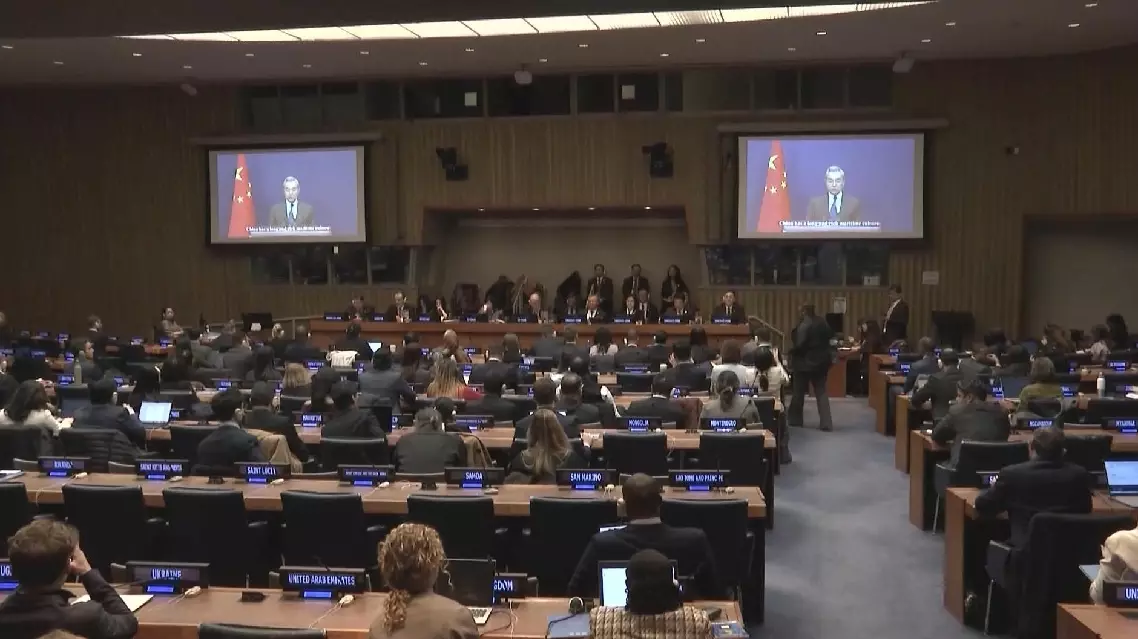
China willing to make new contributions to global marine governance: FM
Chinese Foreign Minister Wang Yi said on Thursday that both the United States and Iran have the willingness to resume negotiations, and the international community should encourage both sides to return to the negotiating table and seek effective ways for a political settlement.
China and Canada can jointly play a constructive role in this regard, said Wang, also a member of the Political Bureau of the Communist Party of China Central Committee, in a phone conversation with Canadian Foreign Minister Anita Anand at the latter's request.
Anand briefed Wang on Canada's position regarding the situation in the Middle East, noting that Canada is committed to protecting civilians in the conflict, promoting de-escalation of the situation, preventing the spillover of the conflict, and reducing its impact on the global economy as well as industrial and supply chains.
The Iranian nuclear issue bears on the international nuclear non-proliferation regime, and ensuring the safe passage through the Strait of Hormuz is in the common interests of all parties, Anand said.
Canada stands ready to work with China to push for a ceasefire and promote regional peace and stability, she added.
Wang elaborated on China's principled position, saying that the Iranian nuclear issue should be resolved through dialogue and should not be a reason for the use of force.
The abuse of force will only lead to grave repercussions, and the spillover of the war will threaten regional security and stability, he said.
The two sides also exchanged views on China-Canada relations and agreed that they should implement the outcomes of Prime Minister Mark Carney's visit to China with a positive and pragmatic attitude, resume dialogues at various levels, expand mutually beneficial cooperation, and push for the stable and healthy development of the China-Canada new strategic partnership.

U.S., Iran should be encouraged to return to negotiating table for political settlement: Chinese FM

U.S., Iran should be encouraged to return to negotiating table for political settlement: Chinese FM

U.S., Iran should be encouraged to return to negotiating table for political settlement: Chinese FM