As the Spring Festival approaches, Hunchun, a city in northeast China's Jilin province bordering Russia and the Democratic People's Republic of Korea, is witnessing a surge in sales of imported goods and domestic products amid the city's continuous efforts to boost the cross-border e-commerce industry.
At the Hunchun Northeast Asia Cross-border E-commerce Industrial Park, a diverse array of imported goods has drawn numerous consumers. "I want to make some special purchases for the Spring Festival before heading back home. There are pickled cucumbers, as well as a wide variety of biscuits and chocolates. I'd like to bring some back for my family, as they are all very delicious," said Xu Jishu, a consumer. Apart from food, imported small home appliances have also become a top choice for many consumers as holiday gifts. At a cross-border e-commerce experience store, consumers place orders through a mini-program and can receive imported goods from the bonded zone a few days later. "Our products have entered the domestic market through a cross-border e-commerce model. They are duty-free and also benefit from a certain discount on value-added tax. So, consumers can enjoy very affordable prices," said Nie Xiaojing, the store manager. In addition to numerous imported goods entering the country, many domestic products are also continuously being shipped overseas through the Hunchun Port.
"Currently, we are able to process around 12,000 orders per day, with a majority consisting of 3C products, accounting for over 60 percent of the total. Our products mainly include high-value items such as mobile phones, tablets, and robotic vacuum cleaners," said Feng Hai, general manager of the logistics department of an e-commerce company.
In recent years, Hunchun has vigorously promoted the development of the cross-border e-commerce industry by establishing the Hunchun Northeast Asia Cross-border E-commerce Industrial Park, the cross-border e-commerce supervision center, and the logistics distribution center, aiming to drive a significant increase in the cross-border e-commerce trade volume. The Hunchun Northeast Asia Cross-border E-commerce Industrial Park, with a total investment of 650 million yuan (around 88.7 million U.S. dollars) and a floor area of 115,000 square meters, was put into operation in 2022. The industrial park comprises a product exhibition center, a live-streaming base for internet celebrities, a shared makerspace, and an e-commerce incubation center. Meanwhile, the city has also been continuously improving services in logistics, warehousing, and customs clearance. "We have built a comprehensive land, rail, and air multimodal transport system for cross-border e-commerce in Hunchun, offering enterprises a range of logistics route options. While constructing the platform and logistics channels, we have concurrently developed industry-related inspection and storage facilities, attracted major e-commerce platforms to establish a presence, and achieved a record-high scale of warehouse inventory," said Li Jinhai, head of e-commerce business at the cross-border e-commerce pilot zone in Hunchun. To date, the Hunchun Northeast Asia Cross-border E-commerce Industrial Park has attracted over 160 e-commerce, logistics, and foreign trade enterprises to establish their presence. "In 2018, the annual trade volume in Hunchun reached 40 million yuan (around 5.5 million U.S. dollars). By 2023, it surpassed five billion yuan (around 682 million U.S. dollars), with an average annual growth rate of around 90 percent. From January to November 2024, we achieved a cross-border e-commerce trade volume of six billion yuan (around 818.4 million U.S. dollars)," Li said.
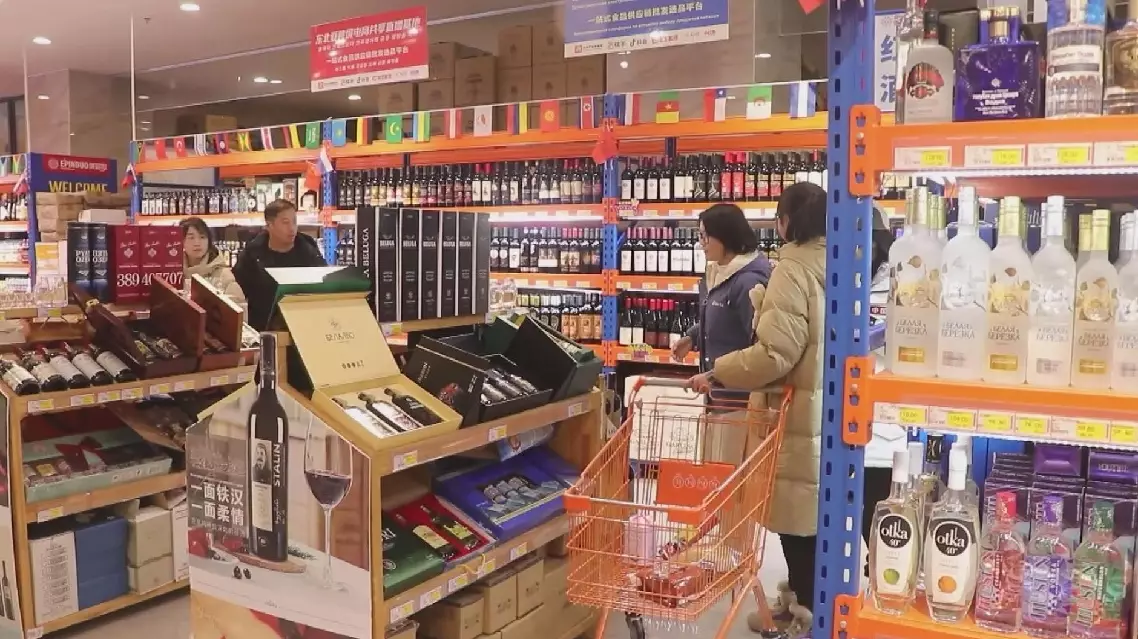
Chinese border city sees surge in cross-border e-commerce trade as Spring Festival approaches