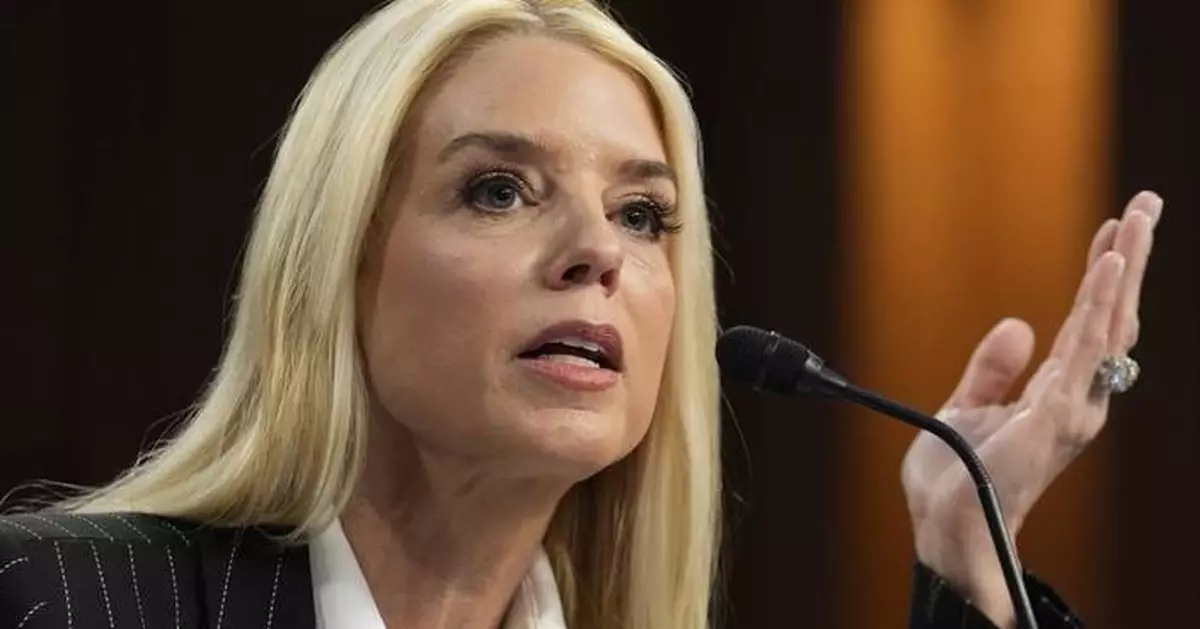
Skip to Content Facebook Feature Image

Who is Trump's attorney general pick Pam Bondi? The former prosecutor is a close Trump ally

ENT

Who is Trump's attorney general pick Pam Bondi? The former prosecutor is a close Trump ally
ENT

ENT

Who is Trump's attorney general pick Pam Bondi? The former prosecutor is a close Trump ally

2025-01-16 05:59 Last Updated At:06:02

WASHINGTON (AP) — Donald Trump's pick to lead the Justice Department, Pam Bondi, faced questions on Capitol Hill Wednesday over her loyalty to the Republican president-elect, who has vowed to use the agency to pursue revenge on his perceived political enemies.

The former Florida attorney general and corporate lobbyist told lawmakers on the Senate Judiciary Committee that politics would play no part in her decision-making as the country's chief federal law enforcement officer, but also refused to rule out the potential for investigations into Trump's adversaries.

More Images
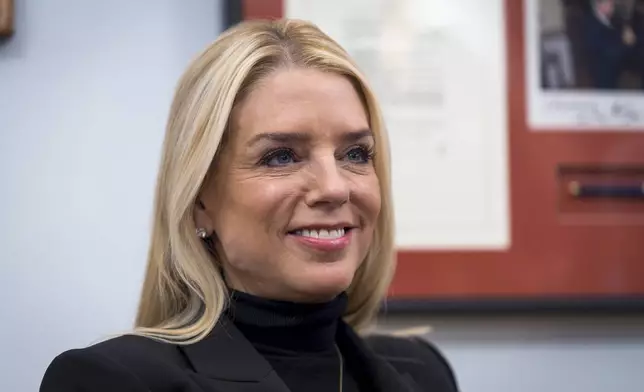
FILE - Pam Bondi, President-elect Donald Trump's nominee for Attorney General, listens during a meeting with Sen. Lindsey Graham, R-S.C., at the Capitol in Washington, Dec. 2, 2024. (AP Photo/J. Scott Applewhite, File)
FILE - Pam Bondi, President-elect Donald Trump's nominee for Attorney General, listens during a meeting with Sen. Lindsey Graham, R-S.C., at the Capitol in Washington, Dec. 2, 2024. (AP Photo/J. Scott Applewhite, File)

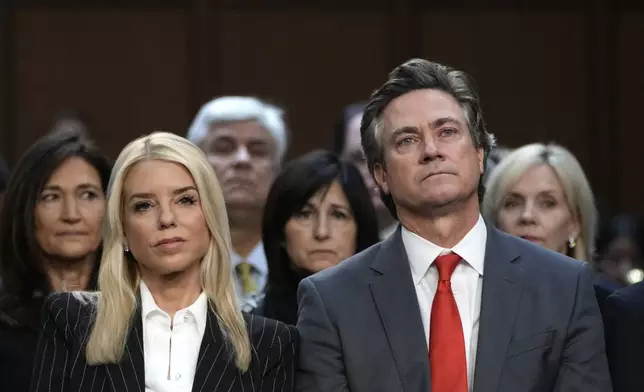
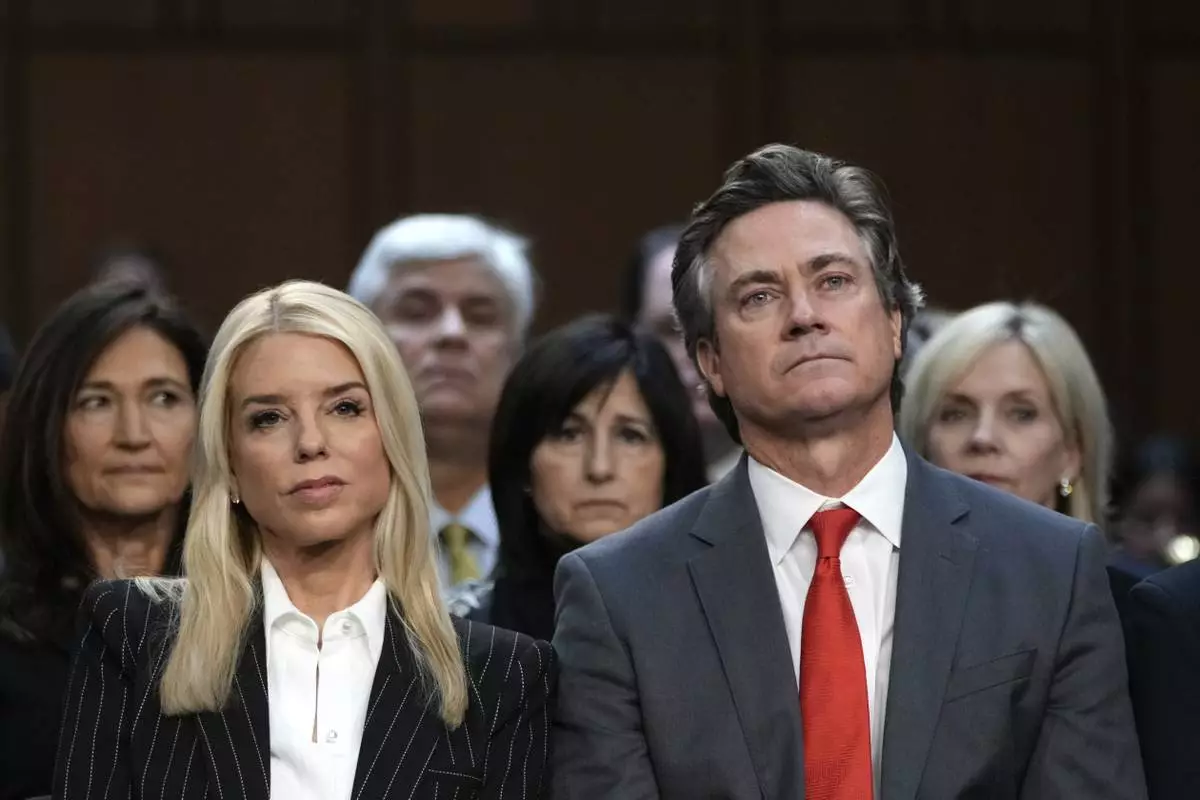
Pam Bondi, President-elect Donald Trump's choice to lead the Justice Department as attorney general, and her husband John Wakefield listen during the Senate Judiciary Committee for her confirmation hearing, at the Capitol in Washington, Wednesday, Jan. 15, 2025. (AP Photo/Ben Curtis)
Pam Bondi, President-elect Donald Trump's choice to lead the Justice Department as attorney general, and her husband John Wakefield listen during the Senate Judiciary Committee for her confirmation hearing, at the Capitol in Washington, Wednesday, Jan. 15, 2025. (AP Photo/Ben Curtis)
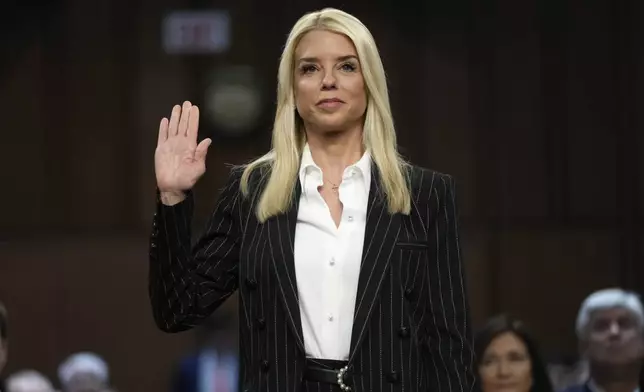
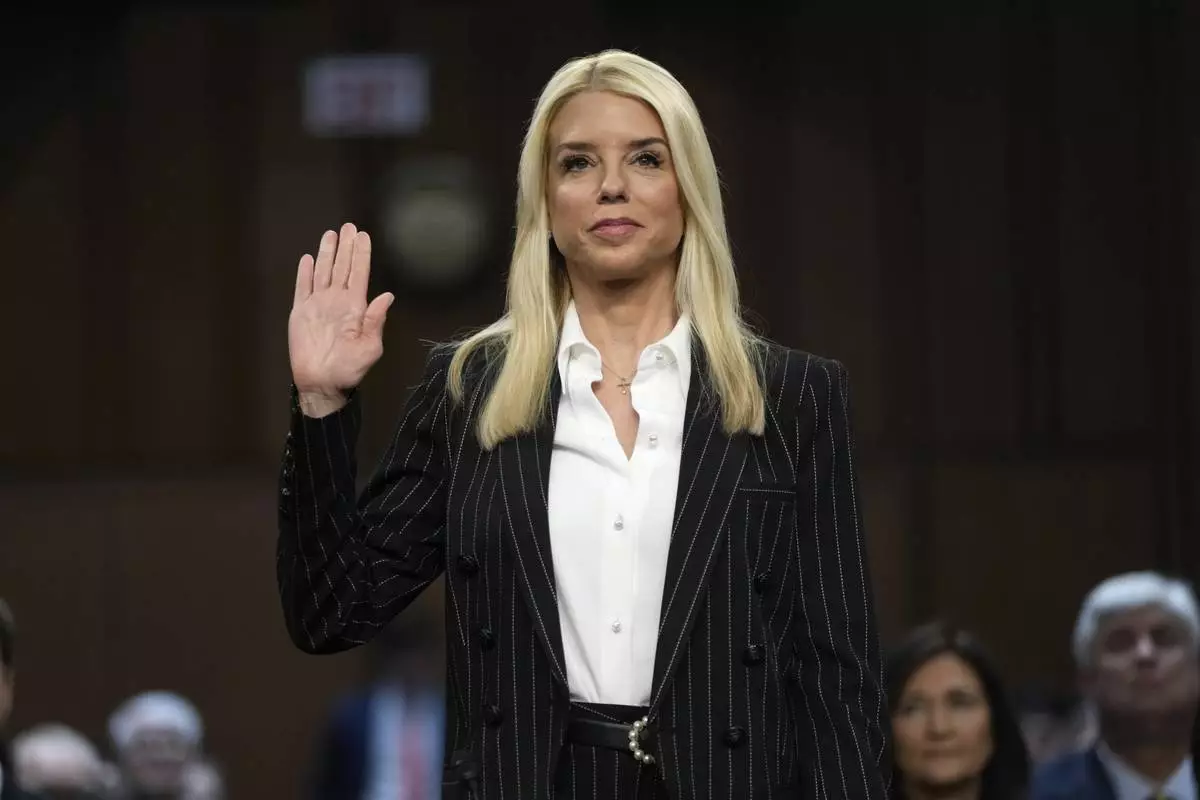
Pam Bondi, President-elect Donald Trump's choice to lead the Justice Department as attorney general, is sworn in before the Senate Judiciary Committee for her confirmation hearing, at the Capitol in Washington, Wednesday, Jan. 15, 2025. (AP Photo/Ben Curtis)
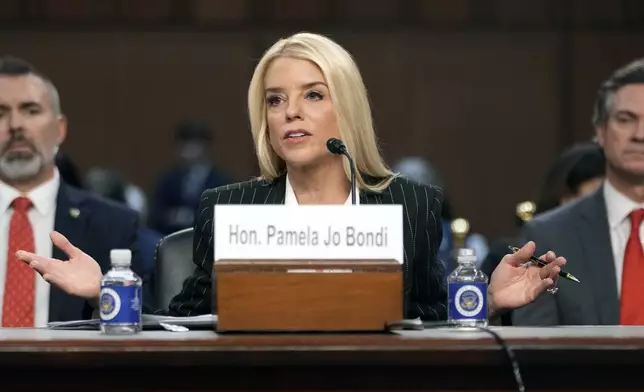
Pam Bondi, President-elect Donald Trump's choice to lead the Justice Department as attorney general, is sworn in before the Senate Judiciary Committee for her confirmation hearing, at the Capitol in Washington, Wednesday, Jan. 15, 2025. (AP Photo/Ben Curtis)
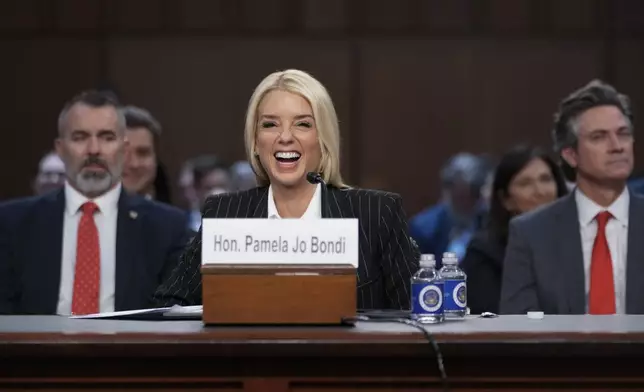
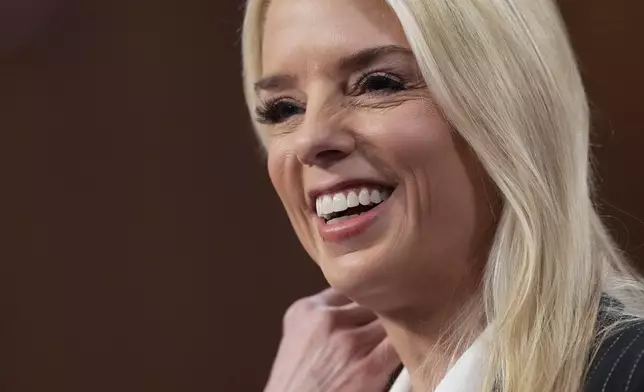
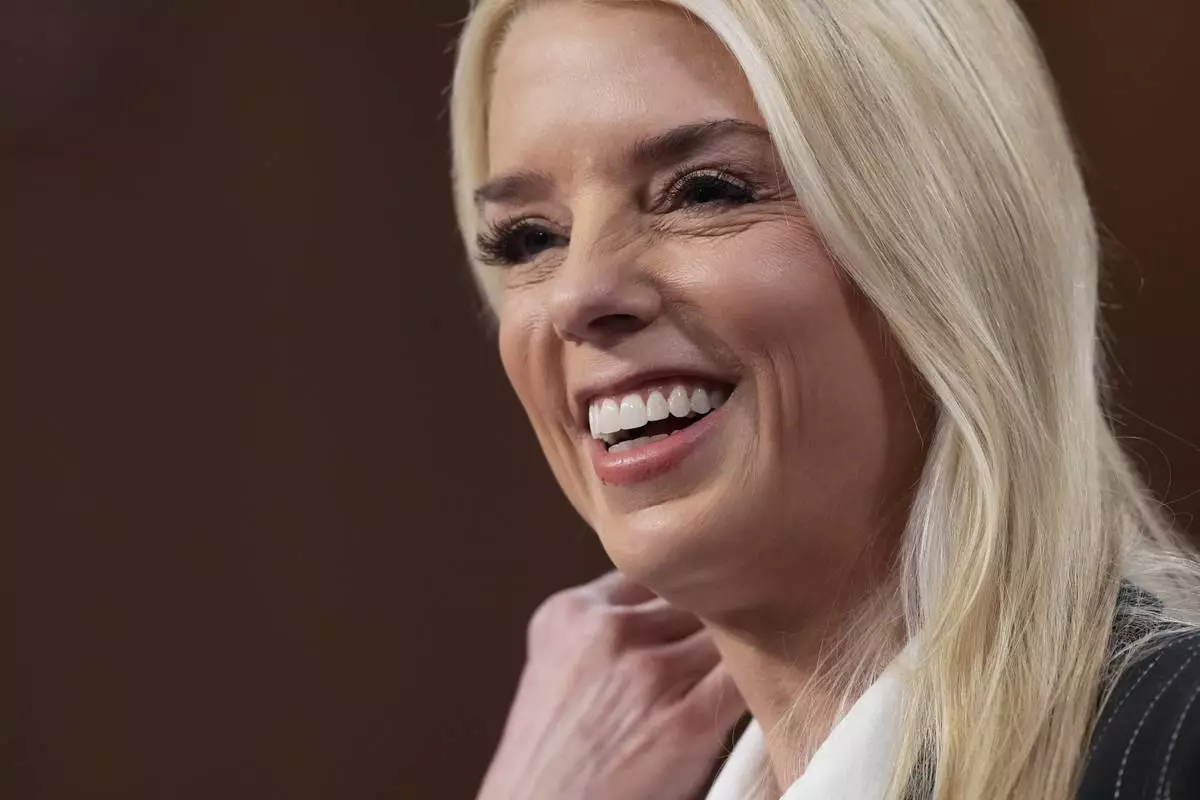
Pam Bondi, President-elect Donald Trump's choice to lead the Justice Department as attorney general, appears before the Senate Judiciary Committee for her confirmation hearing, at the Capitol in Washington, Wednesday, Jan. 15, 2025. (AP Photo/Ben Curtis)
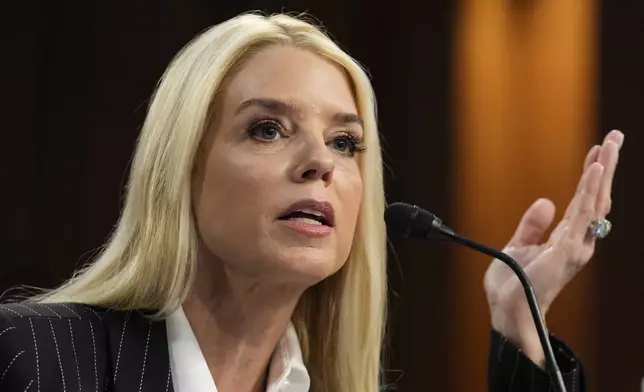
Pam Bondi, President-elect Donald Trump's choice to lead the Justice Department as attorney general, appears before the Senate Judiciary Committee for her confirmation hearing, at the Capitol in Washington, Wednesday, Jan. 15, 2025. (AP Photo/Ben Curtis)

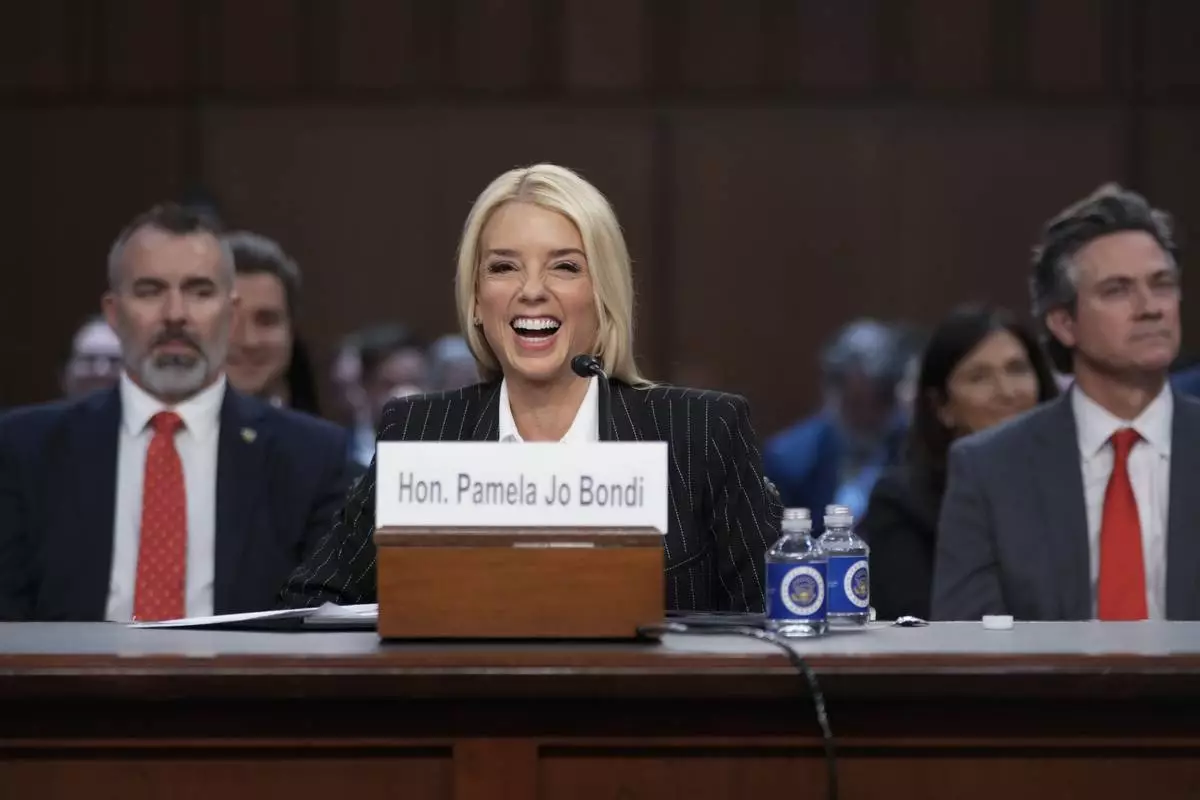
Pam Bondi, President-elect Donald Trump's choice to lead the Justice Department as attorney general, appears before the Senate Judiciary Committee for her confirmation hearing, at the Capitol in Washington, Wednesday, Jan. 15, 2025. (AP Photo/Ben Curtis)

Pam Bondi, President-elect Donald Trump's choice to lead the Justice Department as attorney general, appears before the Senate Judiciary Committee for her confirmation hearing, at the Capitol in Washington, Wednesday, Jan. 15, 2025. (AP Photo/Ben Curtis)

Pam Bondi, President-elect Donald Trump's choice to lead the Justice Department as attorney general, appears before the Senate Judiciary Committee for her confirmation hearing, at the Capitol in Washington, Wednesday, Jan. 15, 2025. (AP Photo/Ben Curtis)

Pam Bondi, President-elect Donald Trump's choice to lead the Justice Department as attorney general, appears before the Senate Judiciary Committee for her confirmation hearing, at the Capitol in Washington, Wednesday, Jan. 15, 2025. (AP Photo/Ben Curtis)

Pam Bondi, President-elect Donald Trump's choice to lead the Justice Department as attorney general, appears before the Senate Judiciary Committee for her confirmation hearing, at the Capitol in Washington, Wednesday, Jan. 15, 2025. (AP Photo/J. Scott Applewhite)

Pam Bondi, President-elect Donald Trump's choice to lead the Justice Department as attorney general, appears before the Senate Judiciary Committee for her confirmation hearing, at the Capitol in Washington, Wednesday, Jan. 15, 2025. (AP Photo/J. Scott Applewhite)

If confirmed to lead the department that charged the once and future president in two separate criminal cases, Bondi would become one of the most closely scrutinized members of Trump's cabinet.

Here's what to know about Bondi:

Bondi has been a fixture in Trump's orbit for years, and a regular defender of the president-elect on news programs amid his legal woes.

“The Department of Justice, the prosecutors will be prosecuted — the bad ones,” Bondi said in a 2023 Fox News appearance. “The investigators will be investigated.”

As Democrats repeatedly questioned Wednesday whether she would maintain a Justice Department that's independent from the White House, Bondi insisted that “no one should be prosecuted for political purposes.” But she also refused to say what she would do if the president directed her to drop a case or answer whether she would investigate Jack Smith, the Justice Department special counsel who charged Trump.

Bondi traveled to New York last May to support Trump in court while he stood trial in his hush money criminal case. Trump was sentenced last week to no punishment in that case after his jury conviction on 34 felony counts.

After Trump’s guilty verdict in that case, Bondi said during another Fox News appearance — alongside Trump’s pick for FBI director, Kash Patel — that “a tremendous amount of trust is lost in the justice system tonight.” She added: “The American people see through it.”

On a radio show last August, she compared special counsel Jack Smith to “a rabid dog” after he brought a new 2020 election interference indictment against Trump in the wake of the Supreme Court’s immunity ruling. Smith abandoned that case — and the separate classified documents case — after Trump's November victory, citing Justice Department policy not to prosecute sitting presidents.

Bondi was first elected Florida attorney general in 2010, defeating Democratic state Sen. Dan Gelber after earning the endorsement of former Republican Alaska governor and vice presidential candidate Sarah Palin.

As Florida attorney general, Bondi led a challenge brought by more than two dozen states to President Barack Obama’s health care overhaul. The U.S. Supreme Court ultimately upheld the health care law. Bondi also fought to uphold Florida's ban on same-sex marriage — arguing that marriage should be defined by each state.

One of her top priorities as attorney general was going after so-called pill mills, or clinics that hand out large amounts of prescription painkillers and helped fuel the country's opioid crisis.

“I did my best to keep Florida safe, to continue to stand up for victims of crime, and to fight the opioid crisis and the drug crisis that was not only faced Florida, but this entire country,” Bondi said Wednesday.

Bondi faced an ethics probe after she personally solicited a 2013 political contribution from Trump as her office was weighing whether to join New York in suing over fraud allegations involving Trump University.

Trump cut a $25,000 check to a political committee supporting Bondi from his family’s charitable foundation, in violation of legal prohibitions against charities supporting partisan political activities. After the check came in, Bondi’s office nixed suing Trump’s company for fraud, citing insufficient grounds to proceed.

Both Trump and Bondi denied wrongdoing, the state’s ethics commission tossed the complaints and a prosecutor assigned by then-GOP Gov. Rick Scott determined there was insufficient evidence to support bribery charges over the donation.

Before becoming Florida attorney general, Bondi spent 18 years in the Hillsborough County State Attorney’s Office, prosecuting cases “ranging from domestic violence to capital murder,” according to her bio at Ballard Partners, the lobbying firm she joined in 2019.

Democrats have raised concerns about potential conflicts of interest posed by Bondi's lobbying work for corporations and other entities that could face scrutiny by the Justice Department.

Records show that between 2019 and 2024, Bondi was registered to represent 30 clients, including businesses such as Uber and Amazon during her time at Ballard Partners, a lobbying firm headed by Brian Ballard, who has ties to Trump, according to advocacy group Public Citizen.

She led Ballard Partners' corporate regulatory compliance practice, which focuses on helping Fortune 500 companies “implement best practices that proactively address public policy challenges such as human trafficking, opioid abuse and personal data privacy,” according to her Ballard Partners bio.

She registered as a foreign agent for the government of Qatar for work related to anti-human-trafficking efforts leading up to the World Cup, held in 2022. She also represented the KGL Investment Company KSCC, a Kuwaiti firm also known as KGLI. The firm paid Ballard $300,000 in 2019 to lobby the White House, National Security Council, State Department and Congress on immigration policy, human rights and economic sanctions issues.

Beyond her lobbying work, she also served as chair of the Center for Litigation and co-chair for the Center for Law and Justice at the America First Policy Institute, a think tank set up by former Trump administration staffers to lay the groundwork for his potential second term. Her work in that role included filing a brief in the Supreme Court in support of a public high school football coach who was fired for praying on the field after games.

Bondi stepped away from lobbying in 2020 to defend Trump during his first impeachment trial against allegations that Trump abused the power of his office when he pressured Ukraine's president during a phone call to investigate then-presidential candidate Joe Biden and his son, Hunter Biden, ahead of the 2020 election.

Trump, who denied any wrongdoing, was impeached in the U.S. House of Representatives and acquitted in the U.S. Senate.

Bondi was brought on to bolster the White House’s messaging and communications. Trump and his allies sought to delegitimize the impeachment from the start, aiming to brush off the whole thing as a farce.

Bondi supported Trump's efforts to challenge his 2020 loss to Biden, traveling in the days after the election to Pennsylvania, where she claimed the campaign had evidence of “cheating.”

Bondi wouldn’t directly answer when asked Wednesday whether Trump lost the 2020 election, only going so far initially to say that Biden is the president. She later said she accepted the results of the election, but also suggested there was fraud, saying she saw “many things” on the ground in Pennsylvania.

Bondi appeared at a press conference in Philadelphia the day after the 2020 election alongside then-Trump attorney Rudy Giuliani. The former New York City mayor has since lost his law license in New York and Washington, D.C., after pursuing false claims that Trump made about his election loss.

At the press conference, Giuliani suggested that bogus ballots could be flooding in from “Mars” or nearby Camden, New Jersey — or, he said: “Joe Biden could have voted 50 times, as far as we know, or 5,000 times." Bondi said poll workers in Philadelphia were keeping Republican poll watchers too far back and preventing them from doing their jobs.

“We’ve won Pennsylvania and we want every vote to be counted in a fair way,” Bondi said.

The next day during an appearance on Fox & Friends, Bondi declared there was “evidence of cheating."

“We are not going anywhere until they declare that we won Pennsylvania,” Bondi said, alleging there were “fake ballots coming in late." But when the anchor pressed her again on those “fake ballots,” she responded: “There could be — that's the problem...We don't know.”

Bondi went on to claim that ballots were “dumped,” and that “people were receiving ballots that were dead.”
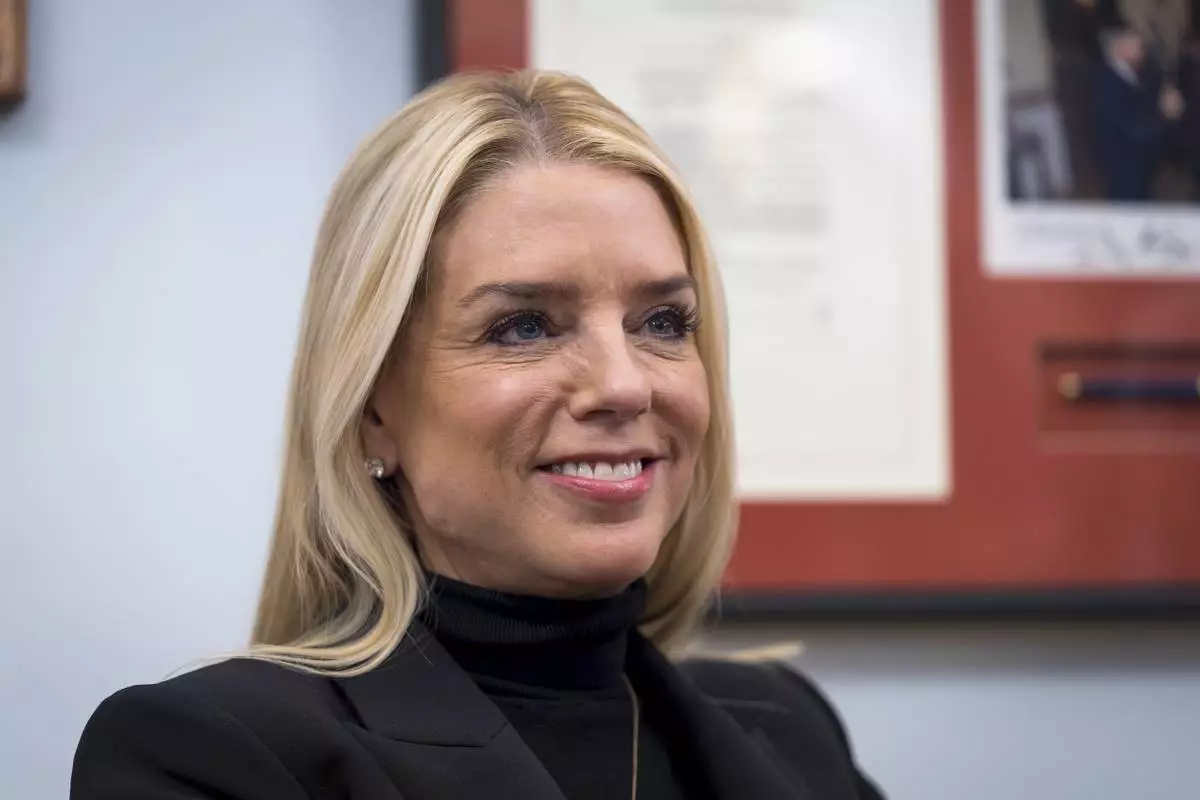
FILE - Pam Bondi, President-elect Donald Trump's nominee for Attorney General, listens during a meeting with Sen. Lindsey Graham, R-S.C., at the Capitol in Washington, Dec. 2, 2024. (AP Photo/J. Scott Applewhite, File)
FILE - Pam Bondi, President-elect Donald Trump's nominee for Attorney General, listens during a meeting with Sen. Lindsey Graham, R-S.C., at the Capitol in Washington, Dec. 2, 2024. (AP Photo/J. Scott Applewhite, File)

Pam Bondi, President-elect Donald Trump's choice to lead the Justice Department as attorney general, and her husband John Wakefield listen during the Senate Judiciary Committee for her confirmation hearing, at the Capitol in Washington, Wednesday, Jan. 15, 2025. (AP Photo/Ben Curtis)
Pam Bondi, President-elect Donald Trump's choice to lead the Justice Department as attorney general, and her husband John Wakefield listen during the Senate Judiciary Committee for her confirmation hearing, at the Capitol in Washington, Wednesday, Jan. 15, 2025. (AP Photo/Ben Curtis)
Pam Bondi, President-elect Donald Trump's choice to lead the Justice Department as attorney general, is sworn in before the Senate Judiciary Committee for her confirmation hearing, at the Capitol in Washington, Wednesday, Jan. 15, 2025. (AP Photo/Ben Curtis)

Pam Bondi, President-elect Donald Trump's choice to lead the Justice Department as attorney general, is sworn in before the Senate Judiciary Committee for her confirmation hearing, at the Capitol in Washington, Wednesday, Jan. 15, 2025. (AP Photo/Ben Curtis)
Pam Bondi, President-elect Donald Trump's choice to lead the Justice Department as attorney general, appears before the Senate Judiciary Committee for her confirmation hearing, at the Capitol in Washington, Wednesday, Jan. 15, 2025. (AP Photo/Ben Curtis)
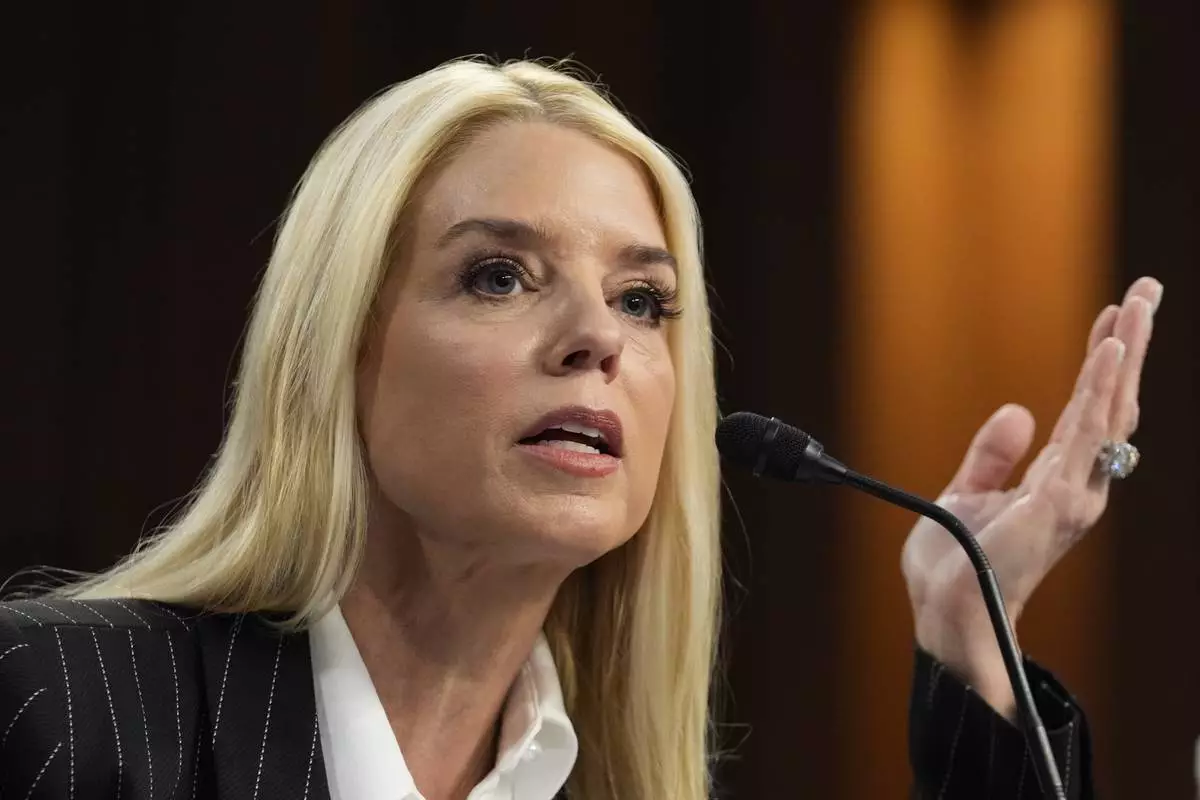
Pam Bondi, President-elect Donald Trump's choice to lead the Justice Department as attorney general, appears before the Senate Judiciary Committee for her confirmation hearing, at the Capitol in Washington, Wednesday, Jan. 15, 2025. (AP Photo/Ben Curtis)

Pam Bondi, President-elect Donald Trump's choice to lead the Justice Department as attorney general, appears before the Senate Judiciary Committee for her confirmation hearing, at the Capitol in Washington, Wednesday, Jan. 15, 2025. (AP Photo/Ben Curtis)

Pam Bondi, President-elect Donald Trump's choice to lead the Justice Department as attorney general, appears before the Senate Judiciary Committee for her confirmation hearing, at the Capitol in Washington, Wednesday, Jan. 15, 2025. (AP Photo/Ben Curtis)

Pam Bondi, President-elect Donald Trump's choice to lead the Justice Department as attorney general, appears before the Senate Judiciary Committee for her confirmation hearing, at the Capitol in Washington, Wednesday, Jan. 15, 2025. (AP Photo/Ben Curtis)

Pam Bondi, President-elect Donald Trump's choice to lead the Justice Department as attorney general, appears before the Senate Judiciary Committee for her confirmation hearing, at the Capitol in Washington, Wednesday, Jan. 15, 2025. (AP Photo/Ben Curtis)

Pam Bondi, President-elect Donald Trump's choice to lead the Justice Department as attorney general, appears before the Senate Judiciary Committee for her confirmation hearing, at the Capitol in Washington, Wednesday, Jan. 15, 2025. (AP Photo/J. Scott Applewhite)
Pam Bondi, President-elect Donald Trump's choice to lead the Justice Department as attorney general, appears before the Senate Judiciary Committee for her confirmation hearing, at the Capitol in Washington, Wednesday, Jan. 15, 2025. (AP Photo/J. Scott Applewhite)
ATLANTA (AP) — Donald Trump would not be the first president to invoke the Insurrection Act, as he has threatened, so that he can send U.S. military forces to Minnesota.

But he'd be the only commander in chief to use the 19th-century law to send troops to quell protests that started because of federal officers the president already has sent to the area — one of whom shot and killed a U.S. citizen.

The law, which allows presidents to use the military domestically, has been invoked on more than two dozen occasions — but rarely since the 20th Century's Civil Rights Movement.

Federal forces typically are called to quell widespread violence that has broken out on the local level — before Washington's involvement and when local authorities ask for help. When presidents acted without local requests, it was usually to enforce the rights of individuals who were being threatened or not protected by state and local governments. A third scenario is an outright insurrection — like the Confederacy during the Civil War.

Experts in constitutional and military law say none of that clearly applies in Minneapolis.

“This would be a flagrant abuse of the Insurrection Act in a way that we've never seen,” said Joseph Nunn, an attorney at the Brennan Center for Justice's Liberty and National Security Program. “None of the criteria have been met.”

William Banks, a Syracuse University professor emeritus who has written extensively on the domestic use of the military, said the situation is “a historical outlier” because the violence Trump wants to end “is being created by the federal civilian officers” he sent there.

But he also cautioned Minnesota officials would have “a tough argument to win” in court, because the judiciary is hesitant to challenge “because the courts are typically going to defer to the president” on his military decisions.

Here is a look at the law, how it's been used and comparisons to Minneapolis.

George Washington signed the first version in 1792, authorizing him to mobilize state militias — National Guard forerunners — when “laws of the United States shall be opposed, or the execution thereof obstructed.”

He and John Adams used it to quash citizen uprisings against taxes, including liquor levies and property taxes that were deemed essential to the young republic's survival.

Congress expanded the law in 1807, restating presidential authority to counter “insurrection or obstruction” of laws. Nunn said the early statutes recognized a fundamental “Anglo-American tradition against military intervention in civilian affairs” except “as a tool of last resort.”

The president argues Minnesota officials and citizens are impeding U.S. law by protesting his agenda and the presence of U.S. Immigration and Customs Enforcement officers and Customs and Border Protection officers. Yet early statutes also defined circumstances for the law as unrest “too powerful to be suppressed by the ordinary course” of law enforcement.

There are between 2,000 and 3,000 federal authorities in the Minneapolis-St. Paul metro area, compared to Minneapolis, which has fewer than 600 police officers. Protesters' and bystanders' video, meanwhile, has shown violence initiated by federal officers, with the interactions growing more frequent since Renee Good was shot three times and killed.

“ICE has the legal authority to enforce federal immigration laws,” Nunn said. “But what they're doing is a sort of lawless, violent behavior” that goes beyond their legal function and “foments the situation” Trump wants to suppress.

“They can't intentionally create a crisis, then turn around to do a crackdown,” he said, adding that the Constitutional requirement for a president to “faithfully execute the laws” means Trump must wield his power, on immigration and the Insurrection Act, “in good faith.”

Courts have blocked some of Trump's efforts to deploy the National Guard, but he'd argue with the Insurrection Act that he does not need a state's permission to send troops.

That traces to President Abraham Lincoln, who held in 1861 that Southern states could not legitimately secede. So, he convinced Congress to give him express power to deploy U.S. troops, without asking, into Confederate states he contended were still in the Union. Quite literally, Lincoln used the act as a legal basis to fight the Civil War.

Nunn said situations beyond such a clear insurrection as the Confederacy still require a local request or another trigger that Congress added after the Civil War: protecting individual rights. Ulysses S. Grant used that provision to send troops to counter the Ku Klux Klan and other white supremacists who ignored the 14th and 15th amendments and civil rights statutes.

During post-war industrialization, violence erupted around strikes and expanding immigration — and governors sought help.

President Rutherford B. Hayes granted state requests during the Great Railroad Strike of 1877 after striking workers, state forces and local police clashed, leading to dozens of deaths. Grover Cleveland granted a Washington state governor's request — at that time it was a U.S. territory — to help protect Chinese citizens who were being attacked by white rioters. President Woodrow Wilson sent troops to Colorado in 1914 amid a coal strike after workers were killed.

Federal troops helped diffuse each situation.

Banks stressed that the law then and now presumes that federal resources are needed only when state and local authorities are overwhelmed — and Minnesota leaders say their cities would be stable and safe if Trump's feds left.

As Grant had done, mid-20th century presidents used the act to counter white supremacists.

Franklin Roosevelt dispatched 6,000 troops to Detroit — more than double the U.S. forces in Minneapolis — after race riots that started with whites attacking Black residents. State officials asked for FDR's aid after riots escalated, in part, Nunn said, because white local law enforcement joined in violence against Black residents. Federal troops calmed the city after dozens of deaths, including 17 Black residents killed by local police.

Once the Civil Rights Movement began, presidents sent authorities to Southern states without requests or permission, because local authorities defied U.S. civil rights law and fomented violence themselves.

Dwight Eisenhower enforced integration at Central High School in Little Rock, Arkansas; John F. Kennedy sent troops to the University of Mississippi after riots over James Meredith's admission and then pre-emptively to ensure no violence upon George Wallace's “Stand in the Schoolhouse Door” to protest the University of Alabama's integration.

“There could have been significant loss of life from the rioters” in Mississippi, Nunn said.

Lyndon Johnson protected the 1965 Voting Rights March from Selma to Montgomery after Wallace's troopers attacked marchers' on their first peaceful attempt.

Johnson also sent troops to multiple U.S. cities in 1967 and 1968 after clashes between residents and police escalated. The same thing happened in Los Angeles in 1992, the last time the Insurrection Act was invoked.

Riots erupted after a jury failed to convict four white police officers of excessive use of force despite video showing them beating a Rodney King, a Black man. California Gov. Pete Wilson asked President George H.W. Bush for support.

Bush authorized about 4,000 troops — but after he had publicly expressed displeasure over the trial verdict. He promised to “restore order” yet directed the Justice Department to open a civil rights investigation, and two of the L.A. officers were later convicted in federal court.

President Donald Trump answers questions after signing a bill that returns whole milk to school cafeterias across the country, in the Oval Office of the White House, Wednesday, Jan. 14, 2026, in Washington. (AP Photo/Alex Brandon)

President Donald Trump answers questions after signing a bill that returns whole milk to school cafeterias across the country, in the Oval Office of the White House, Wednesday, Jan. 14, 2026, in Washington. (AP Photo/Alex Brandon)

Recommended Articles