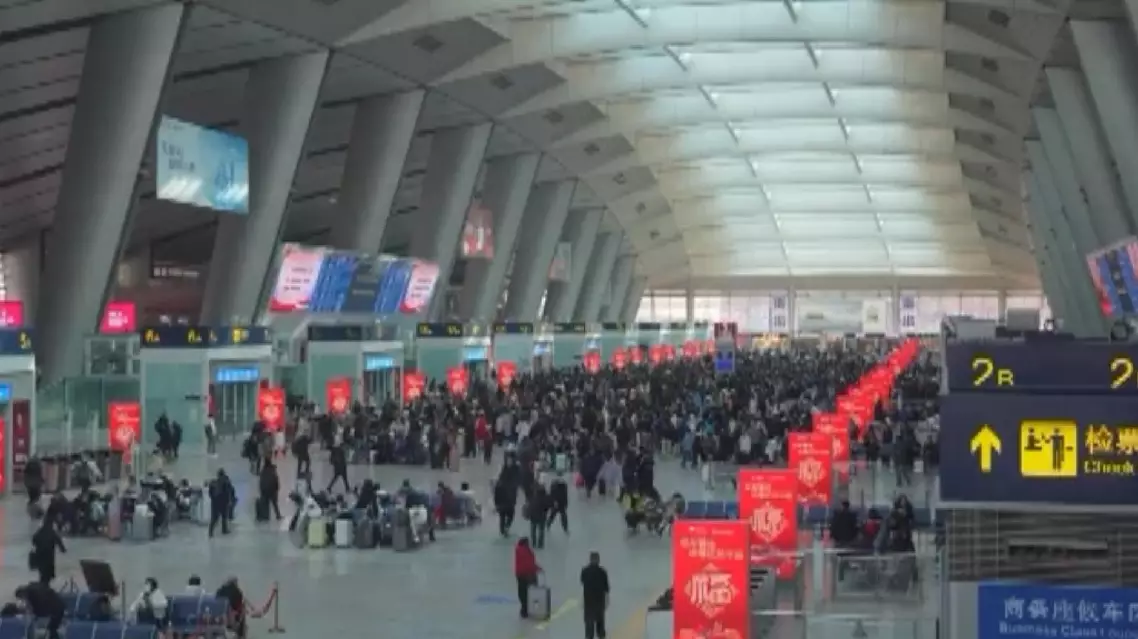
China's railway stations and airports nationwide have rolled out multiple measures to facilitate the traveling of passengers during this year's Spring Festival travel season.
The Spring Festival, China's most important traditional holiday, falls on Jan 29 this year. The Spring Festival travel rush, or chunyun, the world's largest annual human migration known for its high transportation demand as millions return home for family reunions, kicked off on Tuesday.
The country's railway network is expected to handle 11.6 million passenger trips on Thursday, or the third day of the travel rush, with 608 additional passenger trains scheduled to meet the demand.
Passenger flows will be especially huge in major cities such as Shanghai, Beijing, Guangzhou and Shenzhen, on Thursday.
China Railway Beijing Group is expected to transport 1 million passengers on the day.
The Beijing South Railway Station, one of the city's major train hubs, has renovated and upgraded the departure hall for Beijing-Tianjin intercity trains, increasing the waiting area by approximately 260 square meters for passengers.
Moreover, China Railway Guangzhou Group is expected to transport 1.795 million passengers on Thursday. In order to continuously facilitate the travel of passengers between the mainland and Hong Kong, the Shenzhen North Railway Station and the Futian Station have comprehensively optimized the software for gate machines to improve efficiency.
Furthermore, the Hami railway station in northwest China's Xinjiang Uygur Autonomous Region has relocated the security checkpoints to the entrance of the waiting hall and established a green channel, making passenger travel smoother and more convenient.
The Yingtan railway station in east China's Jiangxi Province has added free shuttle buses from the train station to the bus station between 04:00 and 07:00 every day before the eve of the Chinese Lunar New Year.
"We have placed visible signs at the exit to help passengers quickly locate the boarding point of the free shuttle bus. We have arranged staff to assist passengers in carrying large luggage and provide services for passengers," said Wang Zhenhua, a staff member of the Yingtan railway station.
In civil aviation, it is estimated that a total of 18,690 flights will be operated on Thursday, transporting a total of 2.2 million passengers.
In the 40-day period, the average daily number of flights across China will reach 18,500, an increase of 8.4 percent year on year.
The scheduled flights at the Beijing Capital International Airport and Beijing Daxing International Airport will rise by over 5 percent during the travel rush.
This year marks China's first chunyun after United Nations Educational, Scientific and Cultural Organization (UNESCO) inscribed the Spring Festival on the Representative List of the Intangible Cultural Heritage of Humanity in December last year.
China rolls out measures to facilitate passenger travel during Spring Festival travel rush