|
- Attending the World Economic Forum Annual Meeting 2025 for the third consecutive year
- Participating in the Oil & Gas Governors session and other discussions, focusing on energy transition and transportation cooperation
- Introducing an Intelligent Future Shipyard with AI integration in collaboration with Palantir
SEOUL, South Korea, Jan. 23, 2025 /PRNewswire/ -- HD Hyundai Executive Vice Chairman Chung Kisun attended the World Economic Forum Annual Meeting 2025 ("Davos Forum") in Davos, Switzerland, where he introduced the future of K-shipbuilding and discussed cooperation in the energy sector.
The Davos Forum serves as a global platform where leaders from politics, business, and academia gather to address and find solutions to pressing global challenges. This year's event, themed "Collaboration for the Intelligent Age," takes place from January 20 to 24. Chung's participation marks his third consecutive year at the forum, following his first attendance in 2023.
During the forum, he took part in the Oil & Gas Governors, and Supply Chain & Transport Governors meetings consecutively, focusing on cooperation plans for realizing a Multi-Fuel Future, which includes energy transition and transportation, as well as optimizing the building and operating of Software-Defined Vessels through digital technology.
These two governors' meetings bring together CEOs from leading global companies, including A.P. Moller-Maersk, PSA International, Shell, and TotalEnergies.
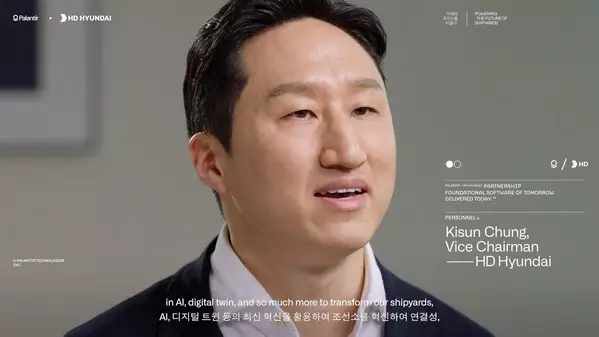
Chung also unveiled the blueprint for the Future of Shipyard (FOS) project through a promotional video by the global big data company, Palantir Technologies ("Palantir"). The FOS is an advanced future shipyard that implements digital technologies such as data, virtual and augmented reality, robotics, automation, and artificial intelligence.
This video, showcased at Palantir's booth on Davos Promenade, featured interviews with Chung and other HD Hyundai executives. It provided a glimpse of how cutting-edge digital technologies—including collaboration with Palantir—could transform the shipyard of the future.
"For many decades now, HD Hyundai has been leading the world's shipbuilding industry with the most innovative technologies." said Executive Vice Chairman Chung. "(We are) drawing on the latest innovation in AI, digital twins, and so much more to transform our shipyards, unlocking a whole new level of productivity and safety."
Since 2021, HD Hyundai has been driving the digital transformation of its shipbuilding business through the FOS project. This initiative focuses on enhancing on-site productivity using advanced technologies, with the goal of ultimately realizing an Intelligent Autonomous Operating Shipyard with minimal human intervention. HD Hyundai plans to complete the FOS project by 2030, with the goal of achieving a 30% improvement in productivity and a 30% reduction in greenhouse gas emissions.
- Attending the World Economic Forum Annual Meeting 2025 for the third consecutive year
- Participating in the Oil & Gas Governors session and other discussions, focusing on energy transition and transportation cooperation
- Introducing an Intelligent Future Shipyard with AI integration in collaboration with Palantir
SEOUL, South Korea, Jan. 23, 2025 /PRNewswire/ -- HD Hyundai Executive Vice Chairman Chung Kisun attended the World Economic Forum Annual Meeting 2025 ("Davos Forum") in Davos, Switzerland, where he introduced the future of K-shipbuilding and discussed cooperation in the energy sector.
The Davos Forum serves as a global platform where leaders from politics, business, and academia gather to address and find solutions to pressing global challenges. This year's event, themed "Collaboration for the Intelligent Age," takes place from January 20 to 24. Chung's participation marks his third consecutive year at the forum, following his first attendance in 2023.
During the forum, he took part in the Oil & Gas Governors, and Supply Chain & Transport Governors meetings consecutively, focusing on cooperation plans for realizing a Multi-Fuel Future, which includes energy transition and transportation, as well as optimizing the building and operating of Software-Defined Vessels through digital technology.
These two governors' meetings bring together CEOs from leading global companies, including A.P. Moller-Maersk, PSA International, Shell, and TotalEnergies.
Chung also unveiled the blueprint for the Future of Shipyard (FOS) project through a promotional video by the global big data company, Palantir Technologies ("Palantir"). The FOS is an advanced future shipyard that implements digital technologies such as data, virtual and augmented reality, robotics, automation, and artificial intelligence.
This video, showcased at Palantir's booth on Davos Promenade, featured interviews with Chung and other HD Hyundai executives. It provided a glimpse of how cutting-edge digital technologies—including collaboration with Palantir—could transform the shipyard of the future.
"For many decades now, HD Hyundai has been leading the world's shipbuilding industry with the most innovative technologies." said Executive Vice Chairman Chung. "(We are) drawing on the latest innovation in AI, digital twins, and so much more to transform our shipyards, unlocking a whole new level of productivity and safety."
Since 2021, HD Hyundai has been driving the digital transformation of its shipbuilding business through the FOS project. This initiative focuses on enhancing on-site productivity using advanced technologies, with the goal of ultimately realizing an Intelligent Autonomous Operating Shipyard with minimal human intervention. HD Hyundai plans to complete the FOS project by 2030, with the goal of achieving a 30% improvement in productivity and a 30% reduction in greenhouse gas emissions.
** The press release content is from PR Newswire. Bastille Post is not involved in its creation. **
HD Hyundai Executive Vice Chairman Chung Kisun Discusses 'Multi-Fuel Future' with Global Leaders in Davos
|
SINGAPORE, Jan. 16, 2026 /PRNewswire/ -- Kerry, a global leader in taste and nutrition, has released its 2026 Supplements Taste Charts for Asia Pacific and the Middle East, highlighting the region's evolving taste preferences and the rise of flavour‑forward, lifestyle‑led supplements and sports nutrition.
Across Asia Pacific, Middle East & Africa (APMEA), supplements are increasingly viewed as part of daily wellbeing rather than an occasional health support. Consumers are focused on benefits such as sleep, immunity, digestion, stress management, energy and emotional balance, with taste and texture now strongly influencing continued purchase and long term use.
The global supplements market is projected to reach US$107 billion by 2029 with APMEA continuing to show strong momentum. China, India, Southeast Asia and the Middle East are driving adoption, supported by rising health awareness, busier lifestyles and growing interest in personalised nutrition.
Flavour‑Forward Trends Redefining Supplements
Consumers are moving away from traditional pills toward more flavour-forward formats such as gummies, chews, drink mixes, dissolving strips and powder blends. Here, flavour plays a critical role in masking functional bitterness, reinforcing emotional cues and signalling naturality or efficacy. Three major flavour movements stand out across Asia Pacific and the Middle East:
Simplicity Amplified
Consumers are gravitating toward transparency and ingredient authenticity. Flavours inspired by whole foods, botanicals, fermented notes, and lightly‑sweet or sour profiles signal purity and nutrient‑dense simplicity. Popular flavours include citrus, yuzu, ginger, turmeric, matcha, elderflower, cultured dairy, and yogurt. These pair naturally with today's lifestyle-friendly formats where the flavours enhance a product's perceived health benefits.
Category Crashers
As mealtimes blur and routines shift, consumers aren't sticking to traditional food, beverage, or supplement boundaries. Category Crashers spotlights the emergence of hybrid products that break the mould: savoury energy bars, confectionery-inspired supplement formats, coffee‑infused condiments and more. These hybrids are about creative formats and unexpected pairings that reflect how people eat today.
Maximalist Flavour
Maximalism takes centre stage in 2026, spurred by younger consumers who want bold, layered flavours that deliver high sensory impact. Dessert‑style profiles, sour intensities, spicy‑accented formats, and flavour stacks such as tiramisu passionfruit or brownie chocolate create memorable, intense taste experiences. This trend reinforces supplements as lifestyle treats rather than functional obligations.
Within these trends, sports nutrition continues to broaden beyond athletes to active consumers who expect flavour to match function. Simplicity Amplified is seen in refreshing citrus hydration blends, botanically‑infused recovery options, and natural dairy flavours in high‑protein systems; Category Crashers bring café‑style profiles, soda‑inspired electrolytes and fruity energy shots; and Maximalist Flavour is evident in extreme sour or spicy pre‑workouts, and multi‑layered profiles in protein shakes.
"Consumers across APMEA are demanding more from their proactive health products, not only clinically supported benefits, but also flavours that excite," said Olivier De Salmiech, Vice President, Health & Therapies, Kerry Asia Pacific, Middle East & Africa. "When products taste great, has science-backed benefits, and integrate naturally into everyday life, they become wellness rituals consumers look forward to."
SINGAPORE, Jan. 16, 2026 /PRNewswire/ -- Kerry, a global leader in taste and nutrition, has released its 2026 Supplements Taste Charts for Asia Pacific and the Middle East, highlighting the region's evolving taste preferences and the rise of flavour‑forward, lifestyle‑led supplements and sports nutrition.
Across Asia Pacific, Middle East & Africa (APMEA), supplements are increasingly viewed as part of daily wellbeing rather than an occasional health support. Consumers are focused on benefits such as sleep, immunity, digestion, stress management, energy and emotional balance, with taste and texture now strongly influencing continued purchase and long term use.
The global supplements market is projected to reach US$107 billion by 2029 with APMEA continuing to show strong momentum. China, India, Southeast Asia and the Middle East are driving adoption, supported by rising health awareness, busier lifestyles and growing interest in personalised nutrition.
Flavour‑Forward Trends Redefining Supplements
Consumers are moving away from traditional pills toward more flavour-forward formats such as gummies, chews, drink mixes, dissolving strips and powder blends. Here, flavour plays a critical role in masking functional bitterness, reinforcing emotional cues and signalling naturality or efficacy. Three major flavour movements stand out across Asia Pacific and the Middle East:
Simplicity Amplified
Consumers are gravitating toward transparency and ingredient authenticity. Flavours inspired by whole foods, botanicals, fermented notes, and lightly‑sweet or sour profiles signal purity and nutrient‑dense simplicity. Popular flavours include citrus, yuzu, ginger, turmeric, matcha, elderflower, cultured dairy, and yogurt. These pair naturally with today's lifestyle-friendly formats where the flavours enhance a product's perceived health benefits.
Category Crashers
As mealtimes blur and routines shift, consumers aren't sticking to traditional food, beverage, or supplement boundaries. Category Crashers spotlights the emergence of hybrid products that break the mould: savoury energy bars, confectionery-inspired supplement formats, coffee‑infused condiments and more. These hybrids are about creative formats and unexpected pairings that reflect how people eat today.
Maximalist Flavour
Maximalism takes centre stage in 2026, spurred by younger consumers who want bold, layered flavours that deliver high sensory impact. Dessert‑style profiles, sour intensities, spicy‑accented formats, and flavour stacks such as tiramisu passionfruit or brownie chocolate create memorable, intense taste experiences. This trend reinforces supplements as lifestyle treats rather than functional obligations.
Within these trends, sports nutrition continues to broaden beyond athletes to active consumers who expect flavour to match function. Simplicity Amplified is seen in refreshing citrus hydration blends, botanically‑infused recovery options, and natural dairy flavours in high‑protein systems; Category Crashers bring café‑style profiles, soda‑inspired electrolytes and fruity energy shots; and Maximalist Flavour is evident in extreme sour or spicy pre‑workouts, and multi‑layered profiles in protein shakes.
"Consumers across APMEA are demanding more from their proactive health products, not only clinically supported benefits, but also flavours that excite," said Olivier De Salmiech, Vice President, Health & Therapies, Kerry Asia Pacific, Middle East & Africa. "When products taste great, has science-backed benefits, and integrate naturally into everyday life, they become wellness rituals consumers look forward to."
** The press release content is from PR Newswire. Bastille Post is not involved in its creation. **

Kerry Launches 2026 Supplements Taste Charts: Defining the Next Era of Flavour in Supplements and Sports Nutrition