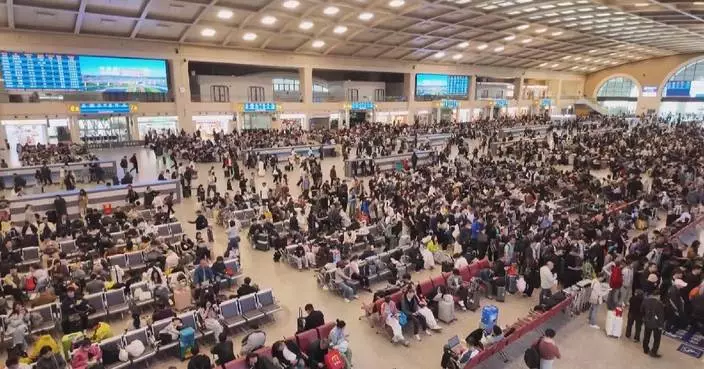
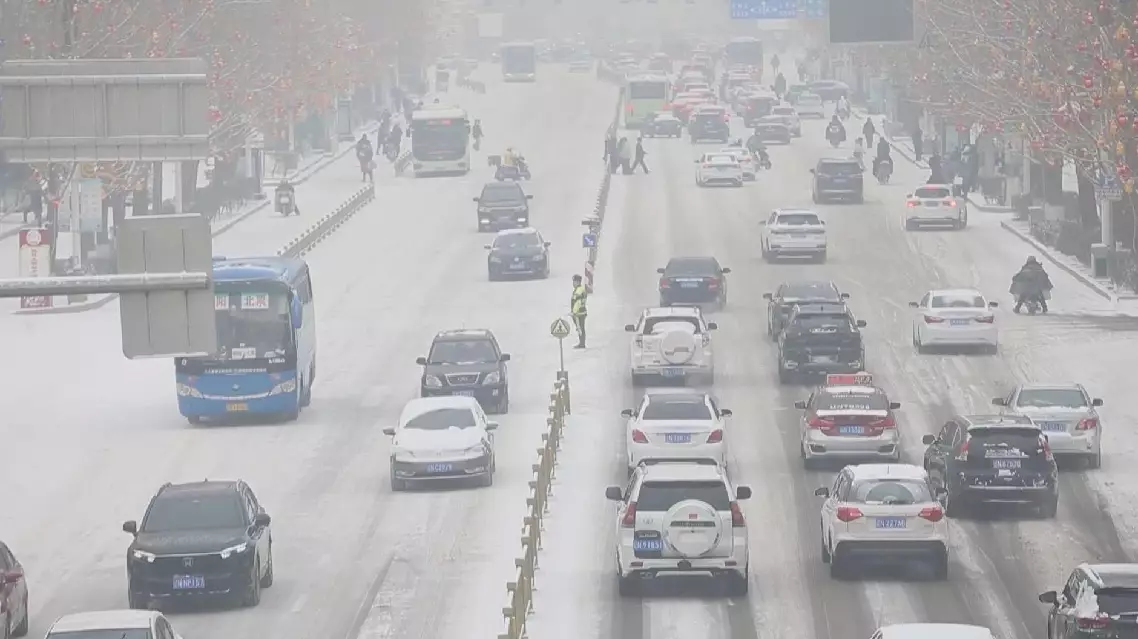
Heavy snow due to a cold snap swept across many parts of China on Sunday, disturbing traffic and prompting swift actions from local authorities to deal with it.
In northeast China's Liaoning Province, snow began falling in its western regions on Sunday morning, with some areas in Chaoyang City recording snow depths of five centimeters to 10 centimeters.
While local authorities immediately dispatched workers to clear snow in the urban areas, agricultural experts were also dispatched to guide farmers to reinforce greenhouses to mitigate the impact on crops.
The capital city Shenyang also experienced heavy snow, triggering an orange-level alert for snow removal.
Sanitation crews mobilized personnel and equipment to clear roads, while power companies in the cities of Liaoyang and Huludao conducted patrols on critical power lines to prevent ice damage.
The cold front is forecast to persist until January 29.
Due to the cold snap and strong winds, sea travel between Liaoning and east China's Shandong Province has also been disrupted.
Passenger ferries on routes from Liaoning's Dalian City to Shandong's Yantai and Weihai cities were suspended on Sunday, affecting 17 vessels.
Services are expected to gradually resume from January 30.
In north China's Hebei Province, the provincial meteorological bureau issued a yellow warning on strong winds and the cold front on Sunday.
In Guangping County, Handan City, temperatures dropped to minus seven degrees and visibility declined to under 20 meters due to a dense fog.
Traffic police intensified patrols to ensure safe road conditions.
In Feixiang District of Handan City, agricultural authorities dispatched technicians to help farmers reinforce more than 12,133 hectares of greenhouses to protect their vegetables.
In Fengnan District of Tangshan City, timely snow removal operations ensured smooth travel for residents.
Shandong cities, including Dezhou and Rizhao, also saw snow on Sunday.
Expressways in Dezhou were quickly cleared overnight by maintenance crews, who also ramped up patrols to ensure safe travel during the Spring Festival travel rush.
In southwest China's Guizhou Province, icy conditions caused by snow and freezing rain disrupted travel on multiple expressways in Bijie City.
Sections of the highways in Weining County were significantly impacted by snow and ice on Sunday.
Local highway patrols imposed temporary traffic controls, increased road inspections, and collaborated with emergency teams for de-icing operations.
So far, all expressways in Bijie have reopened to the traffic.
Heavy snow, cold front disrupt traffic across China, local authorities respond with prompt actions
The United Arab Emirates' (UAE) exit from the Organization of the Petroleum Exporting Countries (OPEC) and the broader OPEC+ is unlikely to jolt oil markets in the short term, but sets the stage for lower prices once the Iran conflict ends and Gulf exports resume, experts said.
Effective Friday, the UAE formally withdrew from OPEC in a move poised to reshape global oil markets. The decision came amid heightened geopolitical tensions driven by the ongoing Iran conflict.
The UAE Energy Minister Suhail Al Mazrouei said the timing was chosen to cause the least market disruption. But analysts say the exit reflects the UAE's long-simmering frustrations over production quotas that no longer align with its capacity.
"It gives the UAE flexibility to move from a quota within OPEC of 3.3 million barrels a day to 5 million barrels a day in 2027. It won't radically change the pricing. It will make more energy available. So, it will take some of the price pressures off," said John Defterios, senior advisor for APCO Worldwide, a global advisory firm, and also senior fellow at the Center for Energy and Materials of the World Economic Forum.
While immediate market impact remains muted amid wartime volatility, experts anticipate meaningful shifts once regional stability returns.
"It has no impact right now, because obviously oil prices right now depend on the state of the war and whether exports can start freely through the Gulf and so on. But assume, once the war is over and a normal transit resumes, I would expect the UAE will move quickly to increase production and try to refill some of that storage that was drained. And that should mean, in general, lower prices for oil importers, for oil consumers. In the longer term, yes, I think also probably it means lower prices," said Robin Mills, CEO of Qamar Energy, a Dubai-based independent consultancy company.
The UAE's departure highlights structural tensions within OPEC+. As a low-cost producer with billions invested in upstream expansion, Abu Dhabi increasingly chafed against collective quotas.
However, other members, including Iraq and Kazakhstan, also sought higher production allowances.
"This pressure has been building up for some time. But Saudi Arabia was also in a difficult position. If it agreed to grant higher production levels to the UAE, then it would have to grant them to Iraq as well. Kazakhstan wanted more [allowance as well]. Everybody wants special treatment," said Mills.
Strategically, the move aligns with the UAE's broader vision to diversify its economy.
"They made this announcement ahead of a very important forum, Make It In the Emirates, which displays what the UAE is doing in terms of diversification outside of oil and gas. So, they want that revenue from oil and gas -- the extra 50 billion dollars a year to go into greater diversification. It's advanced manufacturing, it's artificial intelligence, it's the next wave of financial services, and it is trade," said Defterios.
The exit also signals a broader recalibration of legacy energy institutions in a world confronting new climate imperatives, geopolitical fragmentation, and energy transition pressures.
"I do think it shows definitely a world in which there's a new energy reality, there's a new climate reality, there's a new geopolitical reality. And these legacy institutions have to adapt. And if they don't, then of course, their members will either leave or at least won't take them seriously," said Mills.

UAE's OPEC exit long expected, may ease oil prices after Iran war ends: experts