Skip to Content Facebook Feature Image

China's national museum celebrates Year of Snake with new exhibition

China

China

China

China's national museum celebrates Year of Snake with new exhibition

2025-01-31 21:06 Last Updated At:21:37

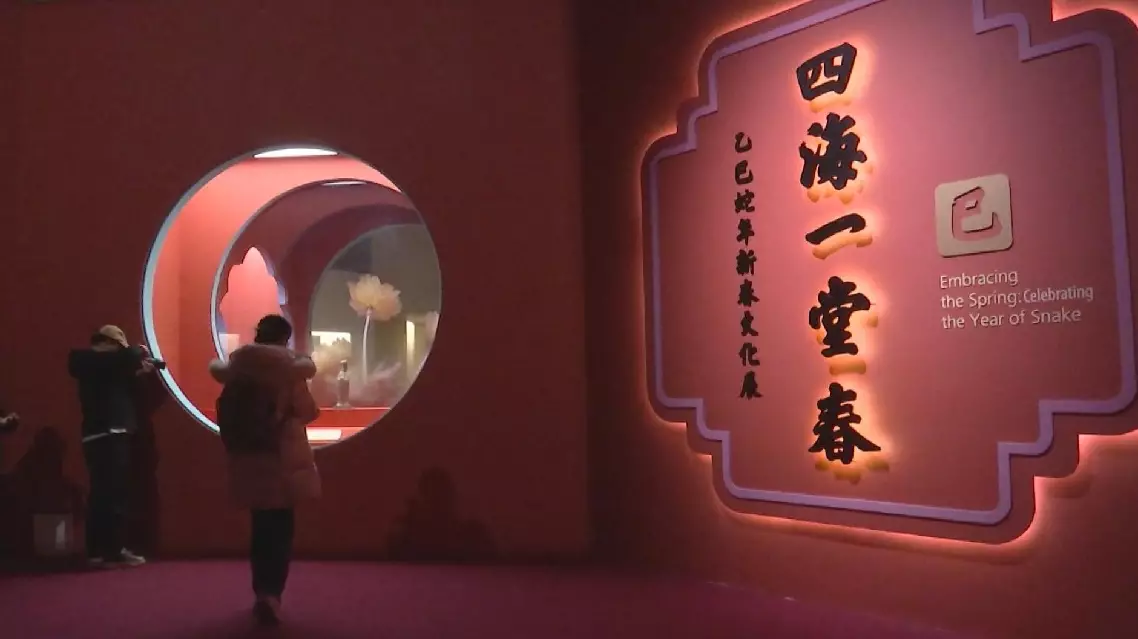
The National Museum of China unveiled a new exhibition in honor of the Year of the Snake, showcasing over 200 exceptional artifacts from its extensive collection.

The 2025 Spring Festival, or the Chinese New Year's Day, fell on Wednesday, ushering in the Year of the Snake. The zodiac snake ranks the sixth in the cycle of 12 zodiac animals on the Chinese lunar calendar.

The immersive display highlights the rich cultural significance of the Spring Festival and offers visitors a deeper understanding of the symbolism and artistic traditions associated with the holiday.

A focal point of the exhibition is a Tang Dynasty (618-907) artwork depicting the mythological figures Fuxi and Nvwa, revered as the ancestors of the Chinese people.

"The serpent-like lower body is intertwined in a spiral structure, representing the continuity of life. The concept of yin and yang [describing an opposite but interconnected, self-perpetuating cycle] are [is] encapsulated in this artwork, reflecting the Chinese understanding of the universe in ancient times," Zhuge Yingliang, the exhibition curator, explained. The exhibition also highlights the frequent appearance of serpents in ancient Chinese art, particularly during the Shang and Zhou Dynasties (1600-771 B.C.), where serpentine motifs were often used on bronze vessels. These motifs symbolized reproduction, wisdom and strength.

"The serpent pattern on the wings of the owl vessel carries the connotations of rising power, imbuing it with greater strength," said Zhuge.

Another standout artifact is a Qing Dynasty (1644-1911) porcelain vase, renowned for its vibrant glazes in yellow, blue, green and red, creating vivid color blocks reminiscent of fireworks.

This piece radiates the festive spirit of the Chinese New Year and represents people's best wishes for lasting prosperity and grandeur.

"In Chinese culture, lanterns symbolize good fortune. The imagery which looks like vibrant fireworks is attached to this porcelain piece. During the Qianlong period [the Qianlong reign (1735-1796) of the Qing Dynasty], we often see more figurative patterns, while such abstract and contemporary designs are rare on porcelain. This artifact allows us to transcend time," said Zhuge.

The exhibition, officially opened on Jan 22, spans a wide range of categories, including bronze, jade, ceramics, and gold and silver cultural relics, showcasing the artistic achievements of Chinese culture.
China's national museum celebrates Year of Snake with new exhibition

China's national museum celebrates Year of Snake with new exhibition

U.S. stocks ended mixed on Friday as investors digested hotter-than-expected inflation data amid ongoing geopolitical uncertainties.

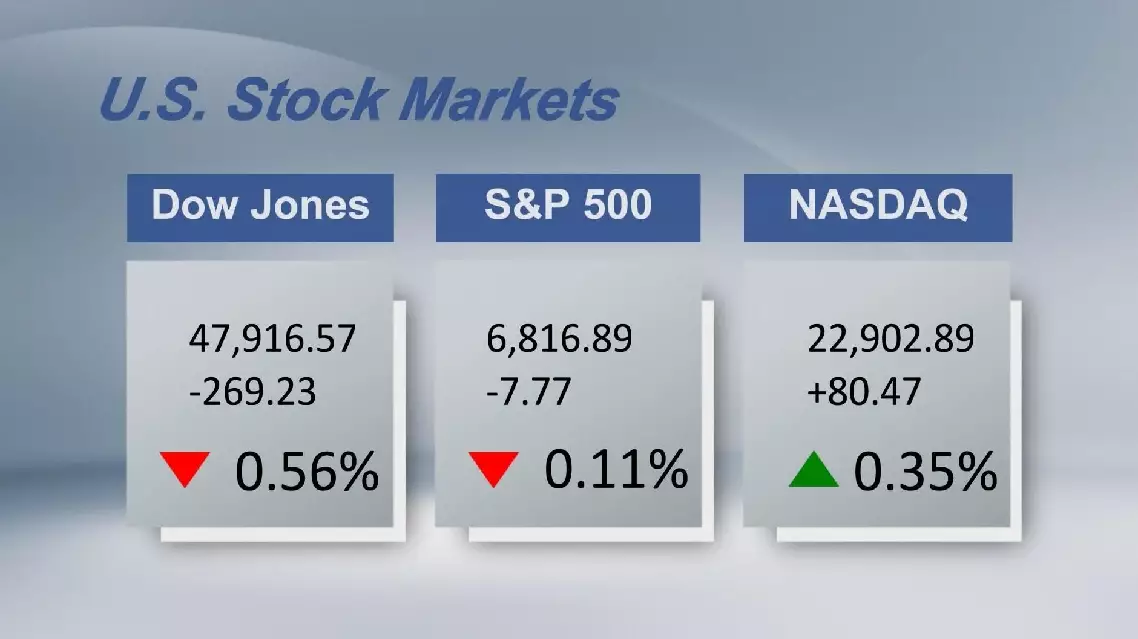
The Dow Jones Industrial Average fell 0.56 percent to 47,916.57. The S and P 500 slipped 0.11 percent to 6,816.89. The Nasdaq Composite Index rose 0.35 percent to 22,902.89.

Seven of the 11 primary S and P 500 sectors closed lower. Consumer staples and health care led the declines, falling 1.43 percent and 1.33 percent, respectively. Technology and materials were the top performers, advancing 0.76 percent and 0.64 percent.

The U.S. consumer price index (CPI) jumped 3.3 percent in March from a year earlier, representing nearly a full percentage point increase from February's annual pace, according to the Bureau of Labor Statistics. The energy index surged 10.9 percent in March, propelled by a 21.2-percent jump in gasoline prices, which alone accounted for nearly three quarters of the monthly increase across all items.

The core CPI, which excludes volatile food and energy components to measure underlying inflation, increased more modestly, rising 0.2 percent for the month and 2.6 percent year over year.

White House Deputy Press Secretary Kush Desai stated that the economy "remains on a solid trajectory," while acknowledging that food and gas prices have risen. National Economic Council Director Kevin Hassett described the current situation as "a temporary energy disruption," adding that the economic effects of the Iran conflict are "a temporary distraction that will very, very quickly go away."

However, Kathy Bostjancic, chief economist at Nationwide, argued that even if a long-lasting deal to end the war is reached and the Strait of Hormuz is fully reopened, "it would take months for oil, gasoline, diesel and other commodity supplies to snap back to pre-war levels and thus for prices to settle back to pre-conflict levels."

Meanwhile, the University of Michigan's preliminary April consumer sentiment index fell sharply to a record low of 47.6, down from 53.3 in March and well below analysts' expectations of 52.0, reflecting growing public concern over the impact of the Iran war on household finances.

Shares of the "Magnificent Seven" technology giants were mostly lower on the day. Nvidia stood out as the strongest performer, rising 2.57 percent.

Investors are now turning their attention to the upcoming U.S.-Iran talks scheduled for this weekend.

U.S. stocks close mixed after shocking inflation data

U.S. stocks close mixed after shocking inflation data

Recommended Articles