State-funded tourism projects are helping the residents of an underdeveloped village built on an 800-meter-high cliff in Southwest China's Sichuan Province embark on a path to prosperity.
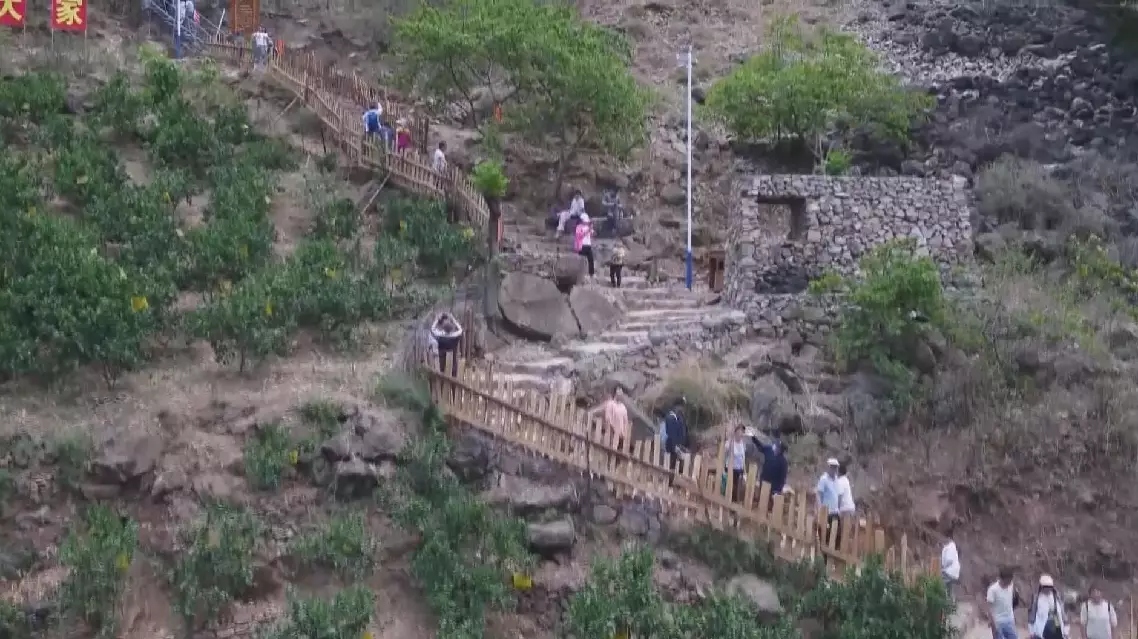
Situated at an altitude of 1,600 meters, the "Cliff Village", formerly known as Atulie'er Village, in the Liangshan Yi autonomous prefecture in Zhaojue County of Sichuan once required its residents to climb a vertical cliff using a 218-step vine ladder to reach their cliff-high adobe homes.
In 2016, stories about the village made headlines, quickly drawing widespread attention to the village and its residents.
As China was conducting a poverty alleviation campaign at the time, the village became a focus of this national strategy.
At the end of 2016, the vine ladder was replaced by a 2,556-step steel ladder. More facilities were built and services introduced, including towers providing 4G communications signals, and banking services to assist farmers.
Since May 2020, a total of 1,219 villagers from 282 households have been relocated into buildings in a centralized resettlement site in the county seat of Zhaojue, as part of China's poverty alleviation program.
The past several years has witnessed extraordinary changes to the life of many villagers.
One of them is Labo, who was born in 1994 in the village. After China Central Television (CCTV) reported the story of the cliff village in 2016, its unique landscape captured the attention of tourists and tourism operators, attracting many visitors to the village. Labo signed contracts with two firms focusing on tourism operation after the village decided to take advantage of its unique geological location, which all of a sudden turned out to be a "gold mine", to develop cultural tourism in 2017.
Labo also learned skateboarding and skiing last year, and his company sent him to work at a ski resort outside the village in winter to learn business knowhow. Labo now earns 4,000 yuan (around 556.58 U.S. dollars) per month, along with additional subsidies. Labo says he is satisfied with his current career.
"Many people told me that my job is what they dream of. This is truly my dream job, because I can work in the ski resort when it is open, and I can also go back to the village and work there in the rest of the year," he said.
For Labo, receiving tourists is the most important part of his job. He now serves as the leading official in charge of the safety control work and the chief of the tour guide team for the cultural and tourism project in the village, responsible for managing and training six team members.
"If you slow down, the rope will follow you. If you slip by accident, it will immediately catch you. So, you have to check the device every time you're with a tourist," said Labo, as he demonstrated the safety ropes tied to people to ensure their safety while descending the ladder.
The phase one of "Sky Valley," one of the village's tourism programs, is set to complete construction during this year's Spring Festival holiday season running from January 28 to February 4.
The program provides 101 guest rooms, authentic music performances and cuisine unique to the Yi ethnic minority group for visitors to stay over at the village.
Local tour agencies organized over 100 villagers to return to the village to see how much it has changed. These firms also want to take this opportunity to hire more villagers to help improve employment as residents return home for family reunion during the Spring Festival.
"Local firms first need to focus on improving employment, and only then will residents' incomes increase. So, we will prioritize hiring people from the village for construction or operational work," said Buge Zihe from a local tourism-focused firm.
As a part of the project, an old school in the village has been converted into a tourist reception center, offering hot spring and accommodation for visitors.
"Only when I saw that landmark ladder did I recognize my village and then my school, which has changed a lot. It's amazing. As we haven't been back to the village for quite many years, we can see so big changes here," said Jiba Zili, a villager. Xiongti, a villager who used to work as a migrant worker in south China's economically developed Guangdong Province, returned to the village at the end of 2023 after he heard that the cultural project of the village had begun construction. Now by working part-time for the local cultural and tourism enterprise, he can earn 200 yuan (around 27.83 U.S. dollars) a day.
"I had to work in other places only because I didn't have many choices. If there were jobs available in the village, I would stay here to work all the time. It's much more convenient," he said.
After a day's work, Xiongti sat beside with his wife and children around the dinner table, enjoying the togetherness.
"My father works hard and can eat a lot. He has great strength," said Yang Fang, Xiongti's daughter.
"Doing manual labor is very tiring at times, but I can't blame anyone because it's my own fault for not working harder at school. I can't read, so this is the kind of work I'm limited to. I told my children that I set a bad example and encouraged them to work hard. I told them that if they do well in school, I'll buy them whatever they want," said Xiongti.
Pacha Youge is the Party secretary of Guli township of Zhaojue County and also served as the Party secretary in Cliff Village. Over the past nine years, he has witnessed the changes of the village's industry and life of the residents here.
"Even though you have moved out of the village to the county seat. Your land or your hometown is still in the village. In the future, you can still make contribution to your village's development," he said.
To promote rural tourism, a local state-owned tourism developer invested 330 million yuan (about 45.92 million U.S. dollars) to build a popular tourist destination out of the village taking advantage of its unique landscape. Over 14,000 visitors have reached the village since the entry into trial operation of the themed tour project known as the "Sky Valley".
Now that the Cliff Village has been included onto the list of the first batch of national-level key tourism villages, those with strong ties to the village have expressed greater hopes and aspirations for its future.
"I want to go to high school and then proceed to study at university," said Jike Xixia, a villager.
"I want to earn more money, and then run a beauty store, because every girl loves makeup," said Jiba Hexi, another villager.
"Next year, if there are more projects for the village, I plan to build a small house there and offer visitors some of our Yi ethnic minority group's special cuisine," said Xiongti.
"I have been staying in this place for nine consecutive years, but my wish for the place remains unchanged, that is to make people's live better," said Pacha Youge.
Tourism leads path to prosperity for cliff dwellers in southwest China's Sichuan