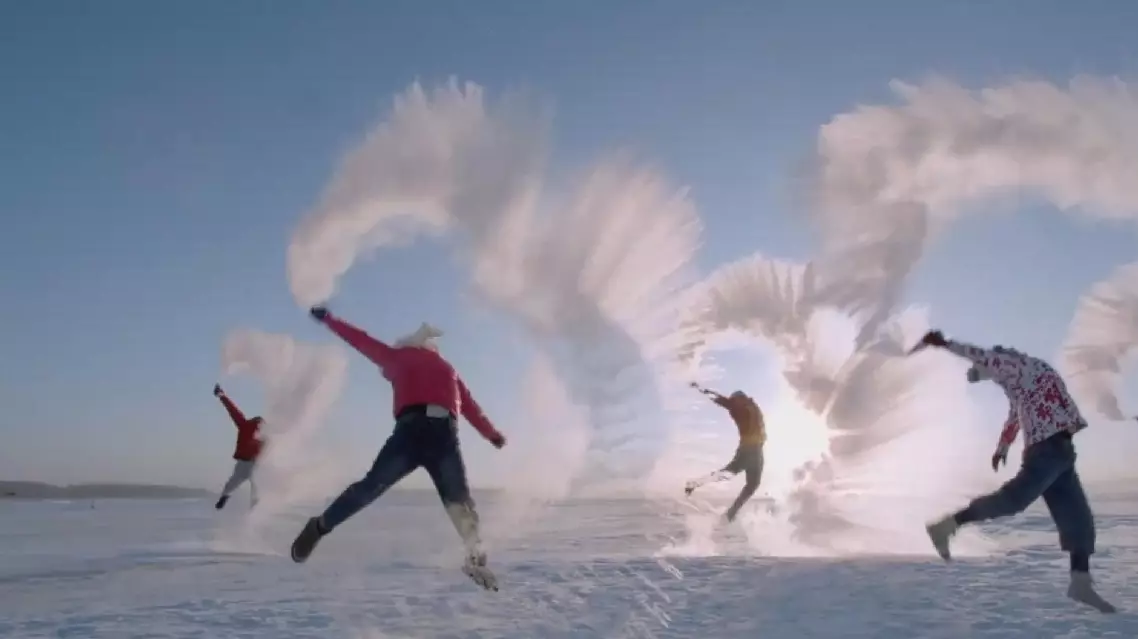
President Xi Jinping's passion and support for ice and snow sports have driven a boom of the sports across the country over the past decade.
Modern winter sports emerged in China during the turn of the 19th to 20th centuries with northeastern city Harbin becoming the first Chinese city embracing the introduction of the sports from Europe.
The city with a long-standing tradition in winter sports and numerous Winter Olympic champions will host the 9th Asian Winter Games on Feb 7, 2025.
Old photographs displayed in the Harbin Museum evidence the city's rich history in winter sports. Among these photos is one taken in 1935 at China's first ski resort, the Yuquan Beiji Ski Resort, located in Harbin's Acheng District.
"This is an athlete from Harbin. Look at the character 'Ha' here. This photo was taken during the first National Skiing Championship in 1957. With a long winter season lasting nearly five months, Harbin literally turns into a land of snow then. No matter it's adults or children, people would all go out to enjoy themselves on the ice and snow. General Secretary Xi (of the Communist Party of China Central Committee) once said it is necessary to realize the goal of getting 300 million people involved in ice and snow sports. Harbin has always taken the lead in this regard," said Yan Jinli, director of the archives development department at Harbin Archives Bureau.
President Xi has been a strong advocate for the development of winter sports in China.
He first proposed the vision to engage 300 million people in ice and snow activities when he attended the opening ceremony of the Sochi Winter Olympics in Russia in Feb 2014. Since its implementation, the initiative has been regarded by the international sports community as the largest-scale promotion of winter sports in human history.
"Winter sports used to be engaged largely within the northeast. If the sports can be promoted beyond the region, it would probably drive the engagement of 200 to 300 million people [in ice and snow activities]," Xi said when visiting the Chinese delegation to the Sochi Winter Olympics.
Since the 18th National Congress of the Communist Party of China, Xi has attached great importance to the development of winter sports in China. For the country to successfully host the 2022 Beijing Winter Olympics, he made five inspection tours to the competition zones, emphasizing the importance of seizing the opportunity of hosting the Games to promote winter sports across China.
The legacy of the Beijing 2022 Winter Olympics has continued to inspire millions of people to engage in ice and snow activities. Since 2022, 313 million people nationwide have participated in winter sports activities, representing 22.13 percent of the population.
"The preparation and hosting of the Beijing Winger Olympics and Paralympics have pushed forward the leap-frog development of China's ice and snow sports, which have extended from the northeast to cover people across the country. A new era of ice and snow sports in China and the world at large has unfolded," Xi said at the Beijing 2022 Winter Olympics and Paralympics review and awards ceremony on April 8, 2022.
"It is truly a great era that allows this younger generation of athletes to unite and fully demonstrate themselves, as well as create a future together," said Wu Dajing, a Chinese short track speed skater.
Yabuli Ski Resort, nestled in the mountains near Harbin, is renowned for its dense forests, thick snow, and magnificent landscape. It became renowned by hosting the 1996 Asian Winter Games, and the 2025 Asian Winter Games will return to this venue.
"I have already bought the tickets for the long-track speed skating. I will watch the long-track speed skating and the short-track speed skating by then," said a resident in Harbin.
"I think it's not just a grand event for residents in Harbin, but also for all the Chinese people. I'm really proud of it," said another resident.
With a history spanning a century, ice and snow sports have already ingrained in Harbin's cultural landscape. In Harbin, more than 15 percent of the local population routinely participate in ice and snow sports at various venues citywide all year round, ranking first in China.
"We are all skating enthusiasts here. The oldest ones are 86 or 87 years old, and the youngest are three or four years old. I think I'm in the middle in terms of age," said a skating enthusiast.
"By participating in the national fitness campaign, we get to stay fit both physically and mentally. It also ignites a passion among us, inspiring us to chase our dreams," said another skating enthusiast.
Xi's advocacy has not only boosted the winter sports, but also contributed to building a strong sports nation in the new era.
"We must aim at building up people's physique, improving their physical health and raising their living standards, and fully leverage the important role of sports in advancing people's well-rounded development. We will raise awareness of sports and fitness among our people, the young people in particular. We will promote the country's overall strength and competitiveness in international competitive sports, and step up efforts to build China into a country strong on sports," said Xi at the Beijing 2022 Winter Olympics and Paralympics review and awards ceremony on April 8, 2022.
Xi's support drives winter sports boom across China