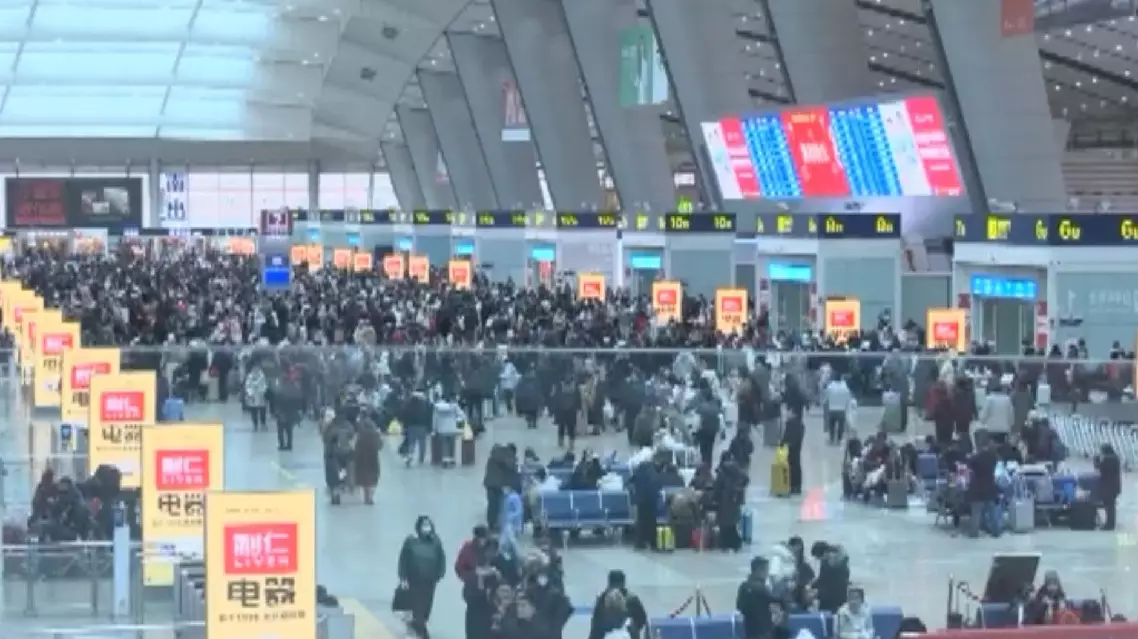
China is witnessing a surge in passenger trips nationwide on Tuesday, as this year's Spring Festival holiday running from Jan 28 to Feb 4 is coming to an end.
The Spring Festival, marking the start of the Chinese New Year, is China's grandest traditional festival featuring family reunion.
At the end of the holiday season, people's return journeys will unexceptionally lead to a significant increase in all railway, highway, air and waterway passenger flow. The country's railway system is estimated to handle 16.9 million passenger trips on Tuesday, with 2,196 additional trains scheduled to accommodate the surge.
According to the official railway ticket-booking app 12306, the passenger flow from Beijing, Shanghai, Guangzhou, Zhengzhou and other cities is relatively large.
A total of 24 million vehicles were on the road as of 11:00 on Tuesday. The country's transport departments have taken measures to enhance road network management, emergency response, congestion relief and other work to ensure the safety and orderly travel of passengers.
In the aviation sector, a total of 18,806 flights are scheduled across the country for Tuesday.
Over the first 21 days of the Spring Festival travel rush, China's civil aviation sector has operated an average of 18,653 flights per day, an 8.08-percent increase year on year. The average daily passenger volume has reached 2.2639 million trips, up 6.27 percent compared to last year.
The 40-day travel period, known as "chunyun" in Chinese, began on Jan 14. It is China's biggest annual human migration.
According to the information of pre-sale tickets from the Beijing Railway Bureau, nearly 490,000 passengers are expected to depart from Beijing on Tuesday, and various train stations under China Railway Beijing Bureau Group are expected to transport approximately 1.21 million passengers.
To increase the passenger transportation capacity, the Beijing South Railway Station, one of the city's major train hubs, scheduled over 30 temporary trains on Tuesday. During the period of peak passenger flow on Tuesday morning, 19 high-speed trains were dispatched within one hour.
Starting from Monday, the highway network in north China's Hebei Province has been experiencing a peak in return traffic.
It is estimated that the traffic volume on Hebei's highways will exceed 3.2 million vehicles on Tuesday. To facilitate the traffic flow, traffic police have deployed hundreds of drones to command and divert traffic in congested sections.
In addition, many places in central China's Henan Province also experienced a peak in return traffic on Monday. the Zhengzhou East Railway Station in the provincial capital city of Zhengzhou saw 186,000 passenger departures on the day, an increase of 28.8 percent compared with the same day of last year.
Transportation departments in east China's Jiangsu Province predicted that the province on Tuesday will experience a peak during the Spring Festival travel rush, with the traffic volume on highways expected to reach as high as 4.18 million vehicles.
"I drove for five hours from Lianyungang City to here. It's still 17 hours away from Guangzhou City. There was a prompt on my phone's navigation about how many charging piles there are. We chose a service area to charge based on the number of charging piles available. I think it's very convenient," said Li Changfei, a car owner from Guangzhou.
East China's Zhejiang Province is also experiencing a surge in return traffic, leading to temporary traffic congestions at some expressway sections.
In the south of the country, the Qiongzhou Strait also saw a peak of the Spring Festival return travel on Monday.
Monitoring data showed that from 00:00 to 16:00 on Monday, a total of 230 ro-ro passenger ships had crossed the Qiongzhou Strait, transporting 23,400 vehicles and approximately 97,800 passengers.
In order to meet passenger demand for sea crossings, the local maritime transportation administration has taken a slew of measures, including opening additional routes and adding more berths, to meet transport demand to the greatest extent.
The highway authorities in northeast China's Jilin Province dynamically releases travel service information in real-time and has also launched a livestreaming program to provide real-time updates on road conditions to guide drivers to avoid congested road sections.
China witnesses increasing passenger flow as Spring Festival holiday to end