High-tech facilities have been set up at the Main Media Center (MPC) for the upcoming 9th Asian Winter Games, ensuring media workers from around the world can deliver high-quality coverage of the event which is set to open in Harbin of northeast China's Heilongjiang Province on Friday.
The week-long Games promises to be the largest ever edition of the regional sports event, with 1,270 competitors from 34 countries and regions set to take part, and reporters from all over the globe are descending on China's "ice city" for the winter sports extravaganza.
The MPC's Main News Center has a public work space which can accommodate up to 156 accredited journalists, while the International Broadcast Center, which has an area of over 10,000 square meters, will serve as the core technical area for live broadcast agencies and official rights-holders of various media outlets who are reporting on the Games.
Cutting-edge technology has also been deployed to help deliver better overall coverage, with special artificial intelligence software helping provide interviews in multiple languages.
"As you can see, the screen shows a host broadcasting in Russian. This is the first time we use AI technology to realize multilingual distribution of single-language programs in the history of Asian Winter Games, satisfying the needs of domestic and foreign journalists," said Lyu Zhuangzhi, the center's operations director, as he showed off the facilities.
The media center has also launched a cloud-based broadcasting service for rights holders, allowing media personnel to work remotely, helping to reduce costs while also improving efficiency.
"The most important service provided to the broadcasting rights holders during this event is the cloud broadcasting service. It enables them to watch or edit the event's signal directly from home or their home country via the 'cloud' without the trouble of traveling to and from the sites. This is the biggest highlight of the service we offer," said Liu Wei from the media operations department of the Executive Committee for the Asian Winter Games.
Meanwhile, away from the main media work spaces, various exhibition booths featuring local cultural elements have been set up in the corridors and leisure areas of the media center to allow visiting reporters to experience the artistic and cultural charm of Harbin.
One of the booths is showcasing hundreds of vinyl records that demonstrate the city's long-standing musical tradition, with Harbin being known as a place where eastern and western music cultures have combined over the last century and UNESCO even dubbing it as a "city of music."
"These music collections on display, including the gramophones, showcase the rich cultural heritage of Harbin. By viewing these items, visitors will discover that Harbin is also a city with a profound musical culture," said Yi Jun, a music collector.
Another local feature at the media center is the unique practice of ice prints, highlighting the cultural and artistic charm of the famous "ice city." This art form involves using a template to carve creative designs onto an ice block with knives and other handmade tools, and then transferring the finished print onto rice paper. In recent years, this unique art form has gained increasing attention worldwide.
Zhu Xiaodong, the founder of this ice printmaking practice and deputy secretary general of Heilongjiang Art Design Association, said the best period to create these ice prints spans from the beginning of December through to February each year. He added that most of the creative process needs to be completed outdoors, with artists braving Harbin's notoriously extreme winter temperatures.
"I've created many Asian Winter Games-themed ice prints ahead of the grand sports event. Ice prints originated in the cold places in northern China where the unique climate conditions make it possible to use ice as a medium for creating these works," said Zhu.
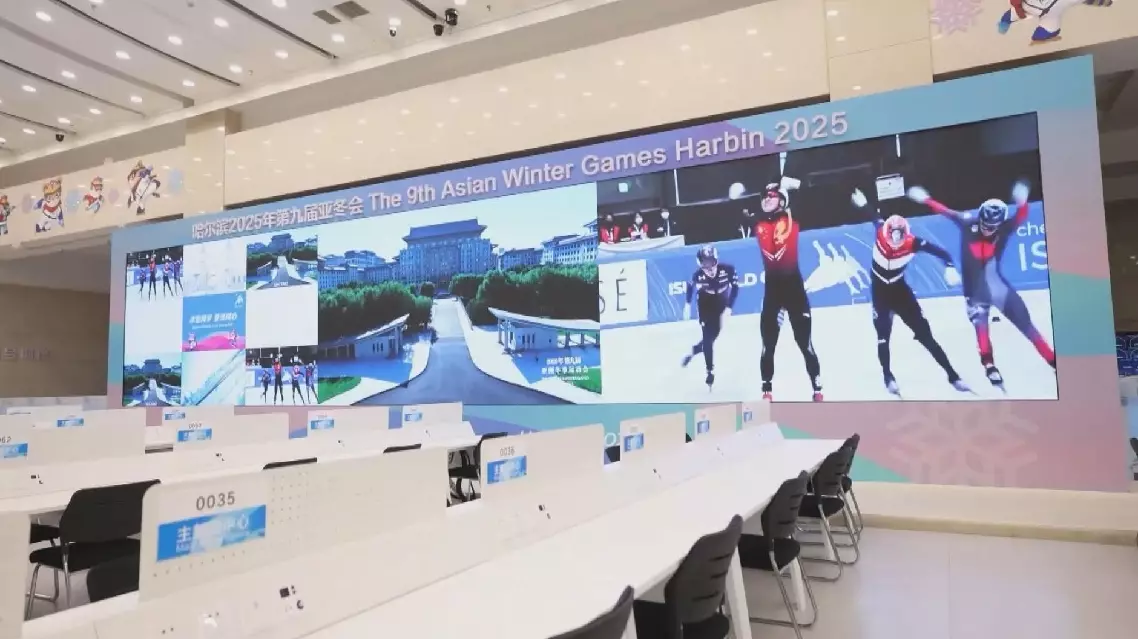
High-tech facilities, cultural elements featured at main media center for 9th Asian Winter Games