A Chinese research team has successfully developed an air-ground dual-purpose unmanned aerial vehicle (UAV) weighing only 300 grams, equivalent to the weight of an apple, showing promising potential in future Mars exploration.
The UAV can take off at any time, traverse obstacles, and boasts superb endurance, according to the research team from the School of Astronautics of Harbin Institute of Technology. It is of vital significance for scientific exploration of Mars, the team added.
Targeting special mission scenarios such as Mars exploration, the dual-purpose UAV is designed to be lightweight, compact, capable of takeoff and landing in a flexible way, and with minimal power consumption. The team has solved a series of technical challenges.
"On the ground, it mainly rolls by shifting its center of gravity. In the air, it relies on a pair of contra-rotating coaxial rotors, controlled by a steering engine to adjust the forward direction, to control torque and force, ultimately achieving stable flight," said Zhu Yimin, Ph.D candidate of School of Astronautics, Harbin Institute of Technology.
The research team has developed multiple models of air-ground dual-mode robots with different configurations, moving by rolling close to the ground, saving power, reducing energy consumption, and achieving a flight endurance time of more than six times that of drones of the same size.
"In terms of its future prospects, we hope that China can achieve Mars exploration through the air-ground dual-purpose unmanned aerial vehicle so as to have longer endurance and more time for observation. Our second goal is for such machines to be suitable for construction in many underground spaces and for exploring unknown underground spaces. We also need robotic means for inspection and environmental detection. We have now materialized all these functions," said Zhang Lixian, professor of School of Astronautics, Harbin Institute of Technology.
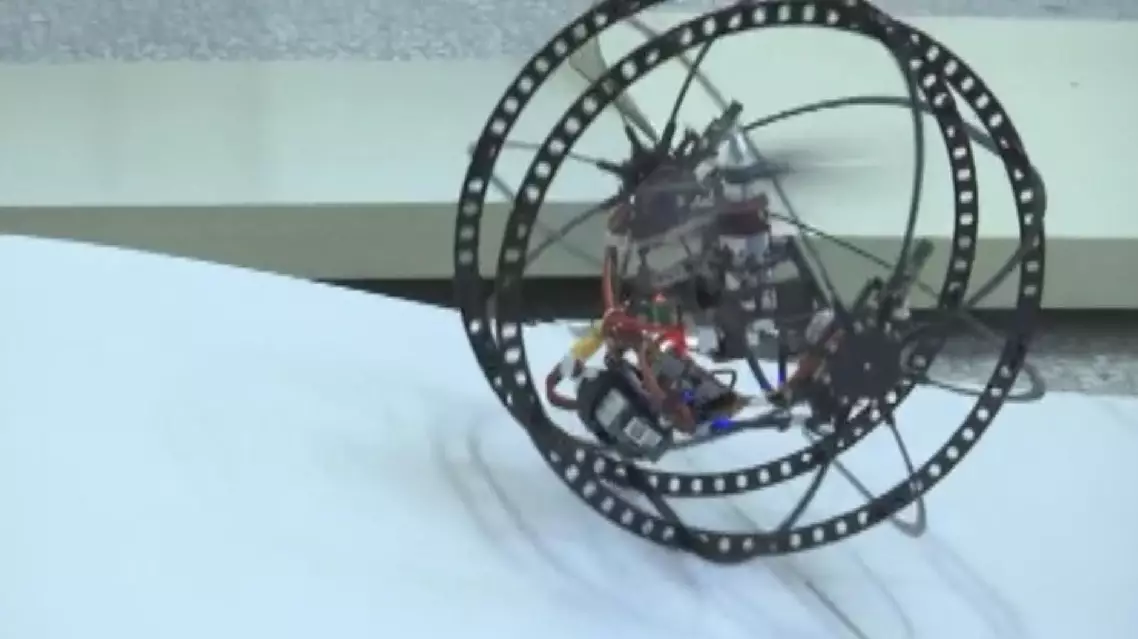
China successfully develops air-ground dual-purpose drone for scientific exploration of Mars