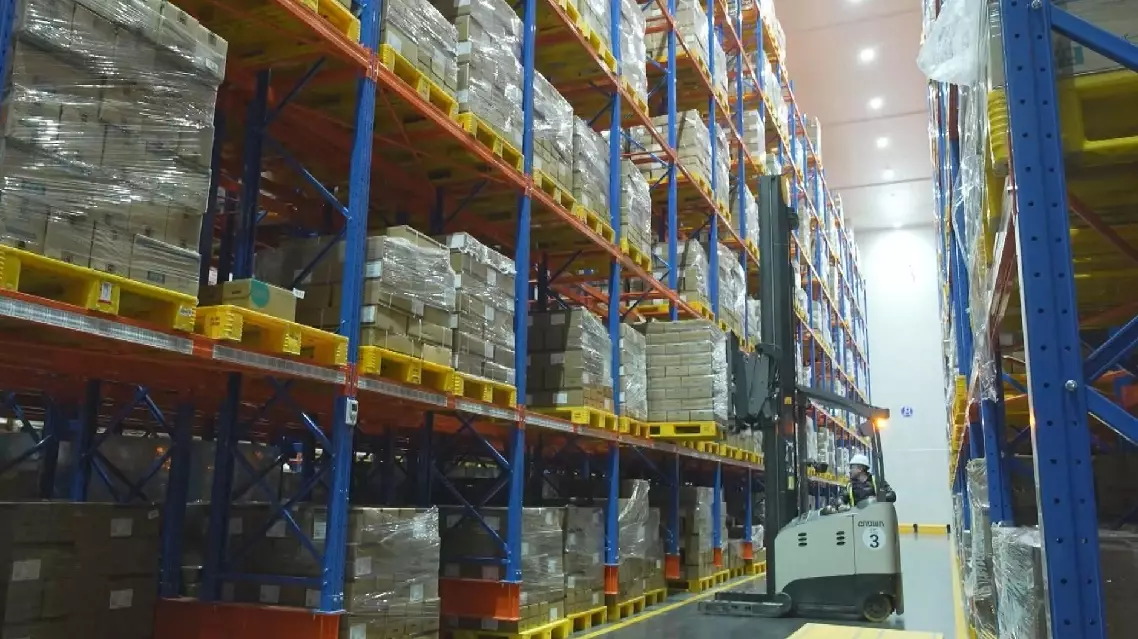
China’s cold chain logistics sector continues to expand, demonstrating a strong recovery that has further enriched the variety of food available to consumers.
According to the latest data from the China Federation of Logistics and Purchasing, the country’s demand for cold chain logistics in 2024 reached 365 million tons, marking a 4.3 percent year-on-year increase.
Fueled by the growth of the catering industry and fresh food e-commerce, market demand has rebounded, providing a strong boost to the recovery momentum of the cold chain logistics sector.
As the eight-day Spring Festival holiday came to an end, a cold chain center in Changzhou City, east China's Jiangsu Province, is bustling once again.
As one of the largest cold chain logistics hubs in the Yangtze River Delta, the center-- launched last year-- supplies tens of thousands of fresh food items to the market through an integrated online and offline model.
Meanwhile, fresh seafood and other imported food items continue to flow steadily into the Chinese market through enhanced international logistics channels.
China’s first regular chartered flight for fresh products between Europe and China was launched in mid-January 2025 with the arrival of flight O3144, which carried 35 tons of Norwegian salmon to Ezhou Huahu International Airport in central China's Hubei Province.
Thanks to China’s efficient air and ground cold chain transport network, the salmon can be rapidly distributed across the country.
The new "rail plus cold chain" model is also gaining momentum.
Since the China-Laos Railway opened in late 2021, an increasing volume of tropical fruits, such as bananas and durians from Southeast Asia, has been entering the Chinese market.
In 2024, demand for cold chain logistics along the cross-border railway surged, with the total volume of fruit and vegetable imports and exports reaching 260,000 tons -- a remarkable 175 percent year-on-year increase.
China's cold chain logistics expands amid strong recovery, enhancing food variety for consumers