Skip to Content Facebook Feature Image

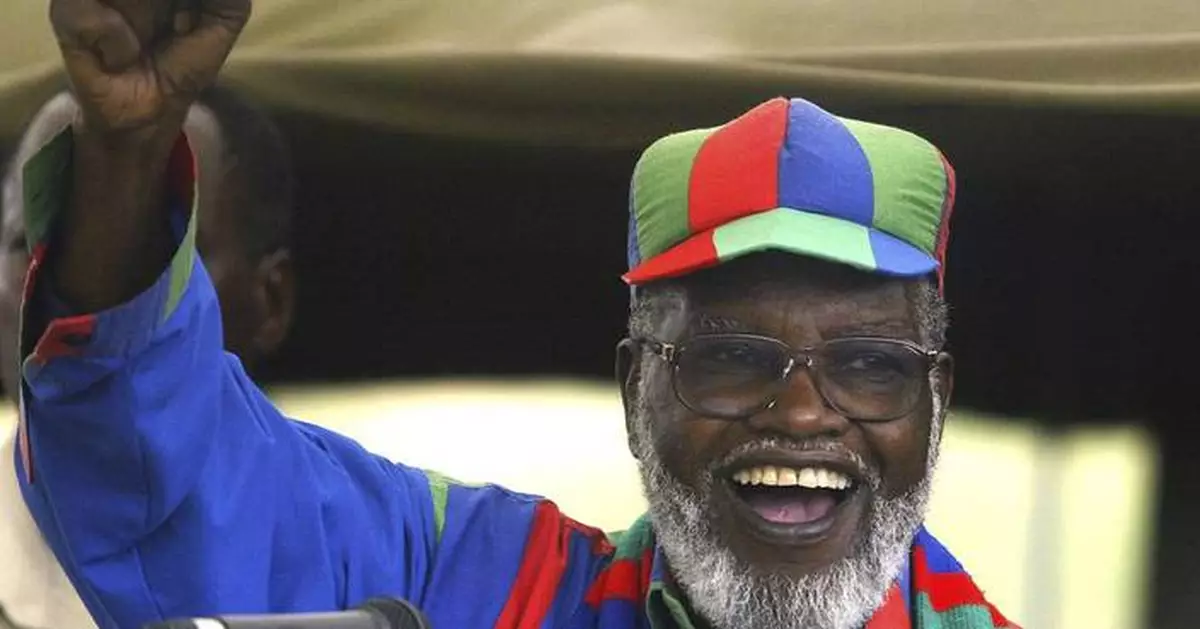
Sam Nujoma, Namibia's fiery freedom fighter and first president, dies aged 95

News

Sam Nujoma, Namibia's fiery freedom fighter and first president, dies aged 95
News

News

Sam Nujoma, Namibia's fiery freedom fighter and first president, dies aged 95

2025-02-09 19:44 Last Updated At:19:50

OSHAKATI, Namibia (AP) — Sam Nujoma, the fiery, white-bearded freedom fighter who led Namibia to independence from apartheid South Africa in 1990 and served as its first president for 15 years, coming to be known as the father of his nation, has died. He was 95.

Nujoma's death was announced Sunday by current Namibian President Nangolo Mbumba, who said Nujoma died on Saturday night after being hospitalized in the capital, Windhoek.

More Images
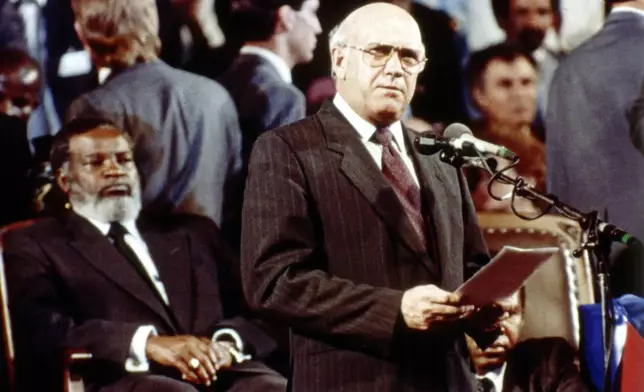
FILE - South African President F.W. de Klerk delivers his speech in Windhoek, Namibia, March 21, 1990, where he handed over Namibia to Namibian President Sam Nujoma, seated left, during an independence ceremony. (AP Photo/John Parkin, File)
FILE - South African President F.W. de Klerk delivers his speech in Windhoek, Namibia, March 21, 1990, where he handed over Namibia to Namibian President Sam Nujoma, seated left, during an independence ceremony. (AP Photo/John Parkin, File)

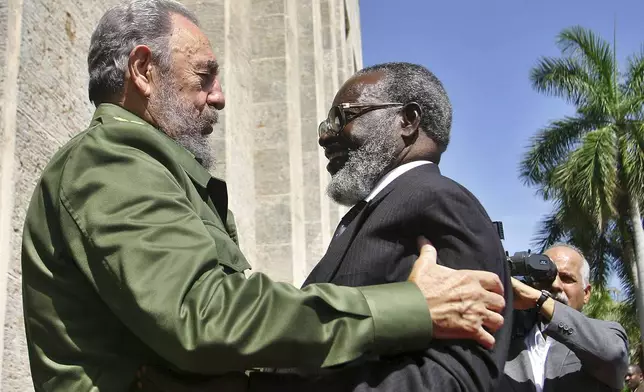
FILE - Cuban President Fidel Castro, left, hugs Namibian President Sam Nujoma during an official welcome ceremony in the state council in Havana, Cuba, June 23, 2004. (Sven Creutzmann/Pool Photo via AP, File)
FILE - Cuban President Fidel Castro, left, hugs Namibian President Sam Nujoma during an official welcome ceremony in the state council in Havana, Cuba, June 23, 2004. (Sven Creutzmann/Pool Photo via AP, File)

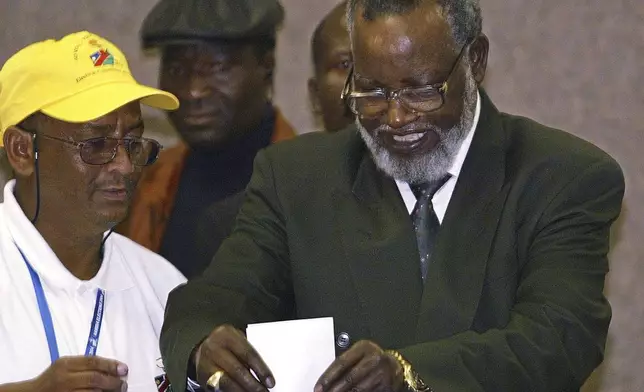
FILE - Namibian President Sam Nujoma, right, casts his vote as an unidentified election worker looks on during the Day 1 of the 2004 elections in Windhoek, Namibia, Nov. 15, 2004. (AP Photo/Themba Hadebe, File)
FILE - Namibian President Sam Nujoma, right, casts his vote as an unidentified election worker looks on during the Day 1 of the 2004 elections in Windhoek, Namibia, Nov. 15, 2004. (AP Photo/Themba Hadebe, File)

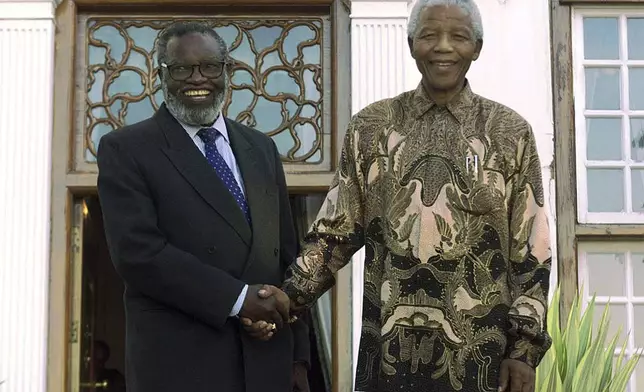
FILE - South African President Nelson Mandela, right, shakes hands with Namibian President Sam Nujoma at the presidential residence in Pretoria, South Africa, June 1, 1999, on the eve of the country's second all-race elections. (AP Photo/Jean-Marc Bouju, File)
FILE - South African President Nelson Mandela, right, shakes hands with Namibian President Sam Nujoma at the presidential residence in Pretoria, South Africa, June 1, 1999, on the eve of the country's second all-race elections. (AP Photo/Jean-Marc Bouju, File)

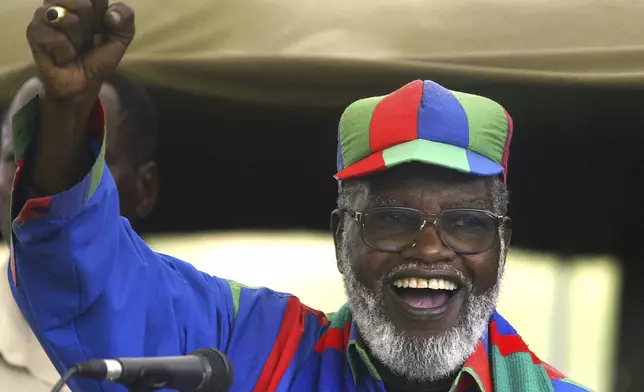
FILE - Namibian and ruling Swapo party President Sam Nujoma speaks during an election rally in Windhoek, Namibia, Nov. 13, 2004. (AP Photo/Themba Hadebe, File)

FILE - Namibian and ruling Swapo party President Sam Nujoma speaks during an election rally in Windhoek, Namibia, Nov. 13, 2004. (AP Photo/Themba Hadebe, File)

"The foundations of the Republic of Namibia have been shaken," Mbumba said in a statement. “Over the past three weeks, the Founding President of the Republic of Namibia and Founding Father of the Namibian Nation was hospitalized for medical treatment and medical observation due to ill health."

"Unfortunately, this time, the most gallant son of our land could not recover from his illness," Mbumba added. He said Nujoma “marshalled the Namibian people during the darkest hours of our liberation struggle.”

Nujoma was the last of a generation of African leaders who brought their countries out of colonial or white minority rule that included South Africa’s Nelson Mandela, Zimbabwe’s Robert Mugabe, Zambia’s Kenneth Kaunda, Tanzania’s Julius Nyerere and Mozambique’s Samora Machel.

He was revered in his arid, sparsely populated homeland in southwest Africa as a charismatic father figure who steered it to democracy and stability after long colonial rule by Germany and a bitter war of independence from South Africa.

He spent nearly 30 years in exile as the leader of Namibia's independence movement before returning for Parliamentary elections in late 1989, the first democratic vote in the country. He was elected president by lawmakers months later in 1990 as Namibia's independence was confirmed.

South African President Cyril Ramaphosa said Nujoma led Namibia's independence movement “against the seemingly unshakeable might of colonial and apartheid authorities and forces” and spurred the anti-apartheid movement in South Africa on its own final steps to freedom.

“Sam Nujoma inspired the Namibian people to pride and resistance that belied the size of the population,” Ramaphosa said. “Namibia’s attainment of independence from South Africa in 1990 ignited in us the inevitability of our own liberation.”

Many Namibians also credited Nujoma's leadership for the process of national reconciliation after the deep divisions caused by the independence war and South Africa's policies of dividing the country into ethnically based regional governments, with separate education and health care for each race.

Even political opponents praised Nujoma — who was branded a Marxist and accused of ruthless suppression of dissent while in exile — for establishing a democratic Constitution and involving white businessmen and politicians in government after independence.

Despite his pragmatism and nation-building at home, Nujoma often hit foreign headlines for his fierce anti-Western rhetoric. At a United Nations conference in Geneva in 2000, Nujoma stunned delegates when he claimed AIDS was a man-made biological weapon. He also occasionally waged a verbal war on homosexuality, calling gays “idiots” and branding homosexuality a “foreign and corrupt ideology.”

He once banned all foreign television programs, declaring they had corrupted the youth of Namibia.

Nujoma built ties with North Korea, Cuba, Russia and China, some of which had supported Namibia's liberation movement by providing arms and training.

But he balanced that with outreach to the West, and Nujoma was the first African leader to be hosted at the White House by former U.S. President Bill Clinton in 1993. Clinton called Nujoma “the George Washington of his country” and “a genuine hero of the world’s movement toward democracy.”

Nujoma also advocated for the advancement of women in a largely patriarchal region, saying “there is no shortage of competent and experienced African women to lead the way forward.” Namibia elected its first female president last year and President-elect Netumbo Nandi-Ndaitwah's term is due to start next month.

Nujoma grew up in a rural, impoverished family, the eldest of 11 children. His early life revolved around looking after cattle and the cultivation of land. He attended a mission school and worked in a general store and then a whaling station on the coast, before a job in Windhoek as a cleaner for South African Railways.

He was arrested following a political protest in 1959 and fled the territory shortly after his release to go into exile in Tanzania. There, he helped establish the South West African People’s Organization and was named its president in 1960. SWAPO has been Namibia's ruling party since 1990, and Nujoma ultimately led it for 47 years until stepping down in 2007.

When South Africa refused to heed a 1966 U.N. resolution ending the mandate it had been given over the German colony of South West Africa after World War I, Nujoma launched SWAPO’s guerrilla campaign.

“We started the armed struggle with only two sub-machine guns and two pistols,” Nujoma once said. “I got them from Algeria, plus some rounds of ammunition.”

SWAPO never achieved military victory in an independence war that lasted more than 20 years, but Nujoma won wide political support during his exile, leading to the U.N. declaring SWAPO the sole representative of the Namibian people and South Africa ultimately withdrawing from the country.

As he mixed with world leaders, Nujoma was aware of his humble roots and lack of education. After leaving school early to work, he later attended night school, largely to improve his English. He said he dedicated his life to his country's liberation.

“Others got their education while I led the struggle,” he said.

Mutsaka reported from Harare, Zimbabwe, and Imray from Cape Town, South Africa.

AP Africa news: https://apnews.com/hub/africa

FILE - South African President F.W. de Klerk delivers his speech in Windhoek, Namibia, March 21, 1990, where he handed over Namibia to Namibian President Sam Nujoma, seated left, during an independence ceremony. (AP Photo/John Parkin, File)

FILE - South African President F.W. de Klerk delivers his speech in Windhoek, Namibia, March 21, 1990, where he handed over Namibia to Namibian President Sam Nujoma, seated left, during an independence ceremony. (AP Photo/John Parkin, File)

FILE - Cuban President Fidel Castro, left, hugs Namibian President Sam Nujoma during an official welcome ceremony in the state council in Havana, Cuba, June 23, 2004. (Sven Creutzmann/Pool Photo via AP, File)

FILE - Cuban President Fidel Castro, left, hugs Namibian President Sam Nujoma during an official welcome ceremony in the state council in Havana, Cuba, June 23, 2004. (Sven Creutzmann/Pool Photo via AP, File)

FILE - Namibian President Sam Nujoma, right, casts his vote as an unidentified election worker looks on during the Day 1 of the 2004 elections in Windhoek, Namibia, Nov. 15, 2004. (AP Photo/Themba Hadebe, File)

FILE - Namibian President Sam Nujoma, right, casts his vote as an unidentified election worker looks on during the Day 1 of the 2004 elections in Windhoek, Namibia, Nov. 15, 2004. (AP Photo/Themba Hadebe, File)

FILE - South African President Nelson Mandela, right, shakes hands with Namibian President Sam Nujoma at the presidential residence in Pretoria, South Africa, June 1, 1999, on the eve of the country's second all-race elections. (AP Photo/Jean-Marc Bouju, File)

FILE - South African President Nelson Mandela, right, shakes hands with Namibian President Sam Nujoma at the presidential residence in Pretoria, South Africa, June 1, 1999, on the eve of the country's second all-race elections. (AP Photo/Jean-Marc Bouju, File)

FILE - Namibian and ruling Swapo party President Sam Nujoma speaks during an election rally in Windhoek, Namibia, Nov. 13, 2004. (AP Photo/Themba Hadebe, File)
FILE - Namibian and ruling Swapo party President Sam Nujoma speaks during an election rally in Windhoek, Namibia, Nov. 13, 2004. (AP Photo/Themba Hadebe, File)
MINNEAPOLIS (AP) — Federal agents carrying out immigration arrests in Minnesota's Twin Cities region already shaken by the fatal shooting of a woman rammed the door of one home Sunday and pushed their way inside, part of what the Department of Homeland Security has called its largest enforcement operation ever.

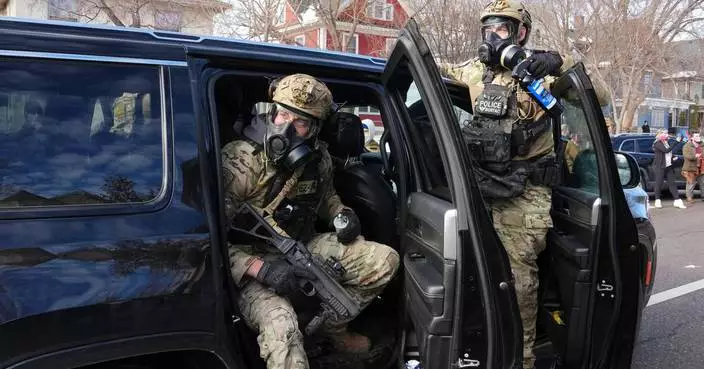
In a dramatic scene similar to those playing out across Minneapolis, agents captured a man in the home just minutes after pepper spraying protesters outside who had confronted the heavily armed federal agents. Along the residential street, protesters honked car horns, banged on drums and blew whistles in attempts to disrupt the operation.

Video of the clash taken by The Associated Press showed some agents pushing back protesters while a distraught woman later emerged from the house with a document that federal agents presented to arrest the man. Signed by an immigration officer, the document — unlike a warrant signed by a judge — does not authorize forced entry into a private residence. A warrant signed by an immigration officer only authorizes arrest in a public area.

Immigrant advocacy groups have conducted extensive “know-your-rights” campaigns urging people not to open their doors unless agents have a court order signed by a judge.

But within minutes of ramming the door in a neighborhood filled with single-family homes, the handcuffed man was led away.

More than 2,000 immigration arrests have been made in Minnesota since the enforcement operation began at the beginning of December, said Homeland Security spokesperson Tricia McLaughlin.

Homeland Security Secretary Kristi Noem told Fox News on Sunday that the administration would send additional federal agents to Minnesota to protect immigration officers and continue enforcement.

The Twin Cities — the latest target in President Donald Trump’s immigration enforcement campaign — is bracing for what is next after 37-year-old Renee Good was shot and killed by an immigration officer on Wednesday.

“We’re seeing a lot of immigration enforcement across Minneapolis and across the state, federal agents just swarming around our neighborhoods,” said Jason Chavez, a Minneapolis city councilmember. “They’ve definitely been out here.”

Chavez, the son of Mexican immigrants who represents an area with a growing immigrant population, said he is closely monitoring information from chat groups about where residents are seeing agents operating.

People holding whistles positioned themselves in freezing temperatures on street corners Sunday in the neighborhood where Good was killed, watching for any signs of federal agents.

More than 20,000 people have taken part in a variety of trainings to become “observers” of enforcement activities in Minnesota since the 2024 election, said Luis Argueta, a spokesperson for Unidos MN, a local human rights organization .

“It’s a role that people choose to take on voluntarily, because they choose to look out for their neighbors,” Argueta said.

The protests have been largely peaceful, but residents remained anxious. On Monday, Minneapolis public schools will start offering remote learning for the next month in response to concerns that children might feel unsafe venturing out while tensions remain high.

Many schools closed last week after Good’s shooting and the upheaval that followed.

While the enforcement activity continues, two of the state’s leading Democrats said that the investigation into Good's shooting death should not be overseen solely by the federal government.

Minneapolis Mayor Jacob Frey and U.S. Sen. Tina Smith said in separate interviews Sunday that state authorities should be included in the investigation because the federal government has already made clear what it believes happened.

“How can we trust the federal government to do an objective, unbiased investigation, without prejudice, when at the beginning of that investigation they have already announced exactly what they saw — what they think happened," Smith said on ABC’s "This Week."

The Trump administration has defended the officer who shot Good in her car, saying he was protecting himself and fellow agents and that Good had “weaponized” her vehicle.

Todd Lyons, acting director of U.S. Immigration and Customs Enforcement, defended the officer on Fox News Channel’s “The Sunday Briefing.”

"That law enforcement officer had milliseconds, if not short time to make a decision to save his life and his other fellow agents,” he said.

Lyons also said the administration’s enforcement operations in Minnesota wouldn't be needed “if local jurisdictions worked with us to turn over these criminally illegal aliens once they are already considered a public safety threat by the locals.”

The killing of Good by an ICE officer and the shooting of two people by federal agents in Portland, Oregon, led to dozens of protests in cities across the country over the weekend, including New York, Los Angeles, Washington D.C. and Oakland, California.

Contributing were Associated Press journalists Giovanna Dell’Orto in Minneapolis; Thomas Strong in Washington; Bill Barrow in Atlanta; Christopher Weber in Los Angeles; and John Seewer in Toledo, Ohio.

A woman gets into an altercation with a federal immigration officer as officers make an arrest Sunday, Jan. 11, 2026, in Minneapolis. (AP Photo/John Locher)

A woman gets into an altercation with a federal immigration officer as officers make an arrest Sunday, Jan. 11, 2026, in Minneapolis. (AP Photo/John Locher)

A federal immigration officer deploys pepper spray as officers make an arrest Sunday, Jan. 11, 2026, in Minneapolis. (AP Photo/John Locher)

A federal immigration officer deploys pepper spray as officers make an arrest Sunday, Jan. 11, 2026, in Minneapolis. (AP Photo/John Locher)

A family member, center, reacts after federal immigration officers make an arrest Sunday, Jan. 11, 2026, in Minneapolis. (AP Photo/John Locher)

A family member, center, reacts after federal immigration officers make an arrest Sunday, Jan. 11, 2026, in Minneapolis. (AP Photo/John Locher)

Bystanders are treated after being pepper sprayed as federal immigration officers make an arrest Sunday, Jan. 11, 2026, in Minneapolis. (AP Photo/John Locher)

Bystanders are treated after being pepper sprayed as federal immigration officers make an arrest Sunday, Jan. 11, 2026, in Minneapolis. (AP Photo/John Locher)

A family member reacts after federal immigration officers make an arrest Sunday, Jan. 11, 2026, in Minneapolis. (AP Photo/John Locher)

A family member reacts after federal immigration officers make an arrest Sunday, Jan. 11, 2026, in Minneapolis. (AP Photo/John Locher)

Federal agents look on after detaining a person during a patrol in Minneapolis, Minn., Sunday, Jan. 11, 2026. (Christopher Katsarov/The Canadian Press via AP)

Federal agents look on after detaining a person during a patrol in Minneapolis, Minn., Sunday, Jan. 11, 2026. (Christopher Katsarov/The Canadian Press via AP)

Bystanders react after a man was detained by Immigration and Customs Enforcement (ICE) agents during a traffic stop, Sunday, Jan. 11, 2026, in Robbinsdale, Minn. (AP Photo/John Locher)

Bystanders react after a man was detained by Immigration and Customs Enforcement (ICE) agents during a traffic stop, Sunday, Jan. 11, 2026, in Robbinsdale, Minn. (AP Photo/John Locher)

People stand near a memorial at the site where Renee Good was fatally shot by an ICE agent, Sunday, Jan. 11, 2026, in Minneapolis. (AP Photo/Jen Golbeck)

People stand near a memorial at the site where Renee Good was fatally shot by an ICE agent, Sunday, Jan. 11, 2026, in Minneapolis. (AP Photo/Jen Golbeck)

A man looks out of a car window after being detained by Immigration and Customs Enforcement (ICE) agents during a traffic stop, Sunday, Jan. 11, 2026, in Robbinsdale, Minn. (AP Photo/John Locher)

A man looks out of a car window after being detained by Immigration and Customs Enforcement (ICE) agents during a traffic stop, Sunday, Jan. 11, 2026, in Robbinsdale, Minn. (AP Photo/John Locher)

Border Patrol agents detain a man, Sunday, Jan. 11, 2026, in Minneapolis. (AP Photo/Adam Gray)

Border Patrol agents detain a man, Sunday, Jan. 11, 2026, in Minneapolis. (AP Photo/Adam Gray)

People shout toward Border Patrol agents making an arrest, Sunday, Jan. 11, 2026, in Minneapolis. (AP Photo/Adam Gray)

People shout toward Border Patrol agents making an arrest, Sunday, Jan. 11, 2026, in Minneapolis. (AP Photo/Adam Gray)

Demonstrators protest outside the White House in Washington, Saturday, Jan. 10, 2026, against the Immigration and Customs Enforcement agent who fatally shot Renee Good in Minneapolis. (AP Photo/Jose Luis Magana)

Demonstrators protest outside the White House in Washington, Saturday, Jan. 10, 2026, against the Immigration and Customs Enforcement agent who fatally shot Renee Good in Minneapolis. (AP Photo/Jose Luis Magana)

Minneapolis Mayor Jacob Frey holds a news conference on Saturday, Jan. 10, 2026, in Minneapolis. (AP Photo/Jen Golbeck)

Minneapolis Mayor Jacob Frey holds a news conference on Saturday, Jan. 10, 2026, in Minneapolis. (AP Photo/Jen Golbeck)

Protesters react as they visit a makeshift memorial during a rally for Renee Good, who was fatally shot by an ICE officer earlier in the week, Saturday, Jan. 10, 2026, in Minneapolis. (AP Photo/John Locher)

Protesters react as they visit a makeshift memorial during a rally for Renee Good, who was fatally shot by an ICE officer earlier in the week, Saturday, Jan. 10, 2026, in Minneapolis. (AP Photo/John Locher)

Recommended Articles