Skip to Content Facebook Feature Image

Goma airport bears scars of intense fighting as M23 advances

China

China

China

Goma airport bears scars of intense fighting as M23 advances

2025-02-09 21:14 Last Updated At:22:57

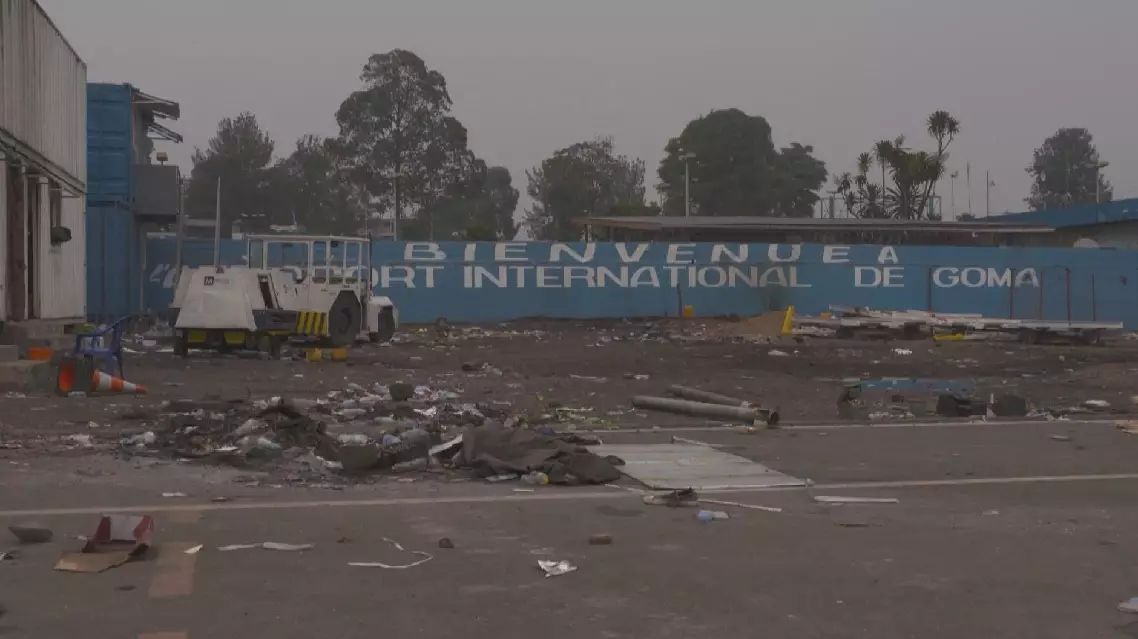
The fierce clashes between the government of the Democratic Republic of the Congo (DRC) and the March 23 Movement (M23) armed group have left Goma International Airport littered with remnants of battle, underscoring the destruction of an escalating turmoil in the African country.

On Jan 27, the M23 claimed control of Goma, the capital of North Kivu Province and an important transportation hub in eastern DRC, in the worst escalation in more than 10 years.

Now, hundreds of Congolese soldiers remain detained at a military base near the Goma airport.

The facility, now under M23 control, bears stark evidence of combat: a damaged Su-25 attack aircraft with its engine lying detached on a hangar floor, dozens of helmets piled up in a corner of the airport, gutted military trucks and aircraft on the runways, as well as guns, bulletproof vests and rocket shells that are scattered all over the airport.

M23 forces have seized a large number of vehicles and heavy weaponry at the airport, with some arms already redeployed to frontlines as the group pushes southward.

The United Nations has repeatedly called for the reopening of the airport for humanitarian aid as the conflict has created a dire humanitarian situation in the region, but it seems unlikely in the near term.

The M23 is now advancing along Lake Kivu toward Bukavu, the capital of South Kivu Province, roughly 200 kilometers from Goma.

The M23 group has captured Nyabibwe, a mineral-rich town in South Kivu, placing their forces within 100 kilometers of Bukavu.

Along the route, many Congolese military bases have been destroyed, with hastily discarded ammunition, including grenades, large-caliber bullets and artillery shells, in surrounding areas indicating chaotic retreats by government troops.

As fighting shifts toward Bukavu, life in Goma has begun a tentative recovery. Markets and shops have reopened, and traffic congestion has returned to some roads. At the border crossing between Goma and Rwanda, long queues of trucks await clearance to deliver supplies, hinting at fragile economic resumption.

At the request of the DRC government, the UN peacekeeping mission in the DRC, commonly known as MONUSCO, withdrew its nearly 13,000 armed peacekeepers from the country in 2024.

Although the Southern African Development Community has later sent nearly 3,000 armed personnel to fill in the peacekeeping gap, but shorthanded mission fails to cover many areas in eastern DRC.
Goma airport bears scars of intense fighting as M23 advances
Goma airport bears scars of intense fighting as M23 advances

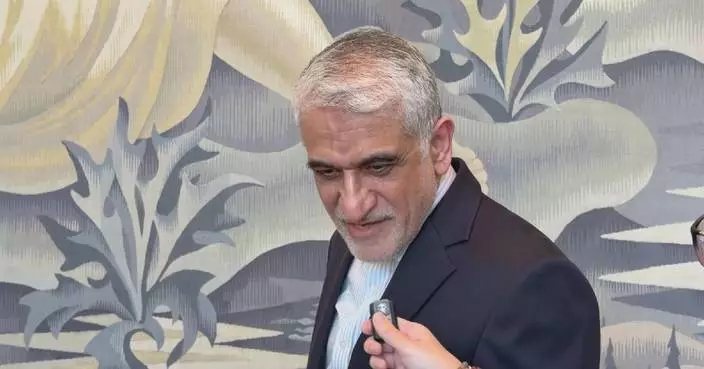
The Iranian government is focusing on public concerns and maintaining stable supplies of essential goods amid recent protests, Iranian President Masoud Pezeshkian said in a televised interview on Sunday.

In the city of Karaj, northwest of the capital Tehran, daily life has largely continued as normal. A video filmed by a local resident on Sunday shows food stores open and grocery shelves fully stocked.

"This is the block near my home, and there are some food stores here. Daily life continues here. Last night we did not see many protests in Karaj. Right now the city is very safe. This is a grocery store close to my home. All the food is available; nothing is in shortage. Here are noodles and different types of beans. Here are dairy products, cheese, and yogurt. I also checked other grocery stores and didn't see any shortages. Everything is available," said local resident Ali Reza.

Iranian officials have described recent disturbances as acts orchestrated by the "enemy," including some carried out by well-trained and armed "terrorists." The incidents have caused casualties among security personnel and civilians, as well as property damage.

The Secretary of Iran's Supreme National Security Council Ali Larijani has directed authorities to severely punish the "terrorists."

Meanwhile, Iran's police chief Ahmad-Reza Radan said on Sunday that the police had raised alert levels and arrested several leaders of the troublemakers during the operations on Saturday.

President Pezeshkian noted in the interview that the normal demands of the Iranian people are reasonable and justified, but they must realize that triggering riots and carrying out terrorist acts are the enemy's attempts to undermine the country. He urged the public to remain vigilant.

Also on Sunday, Iranian Parliament Speaker Mohammad Baqer Qalibaf warned that Tehran would regard U.S. and Israeli bases and facilities in the Middle East as "legitimate targets" if Washington takes military action against Iran. His remarks followed media reports saying U.S. President Donald Trump is "seriously considering authorizing a strike" against Iran.

Iranian state media reported that at least 109 members of Iran's security forces have been killed in clashes since the protests began 14 days ago. Meanwhile, human rights groups based outside the country said the number of protesters killed has exceeded 200, though the figure could not be independently verified.

The protests initially erupted over a sharp depreciation of the rial and sweeping subsidy reforms. Iranian authorities have blamed the unrest on foreign-linked agents and sanctions imposed by the United States.

Iranian president says government focusing on ensuring supplies amid protests

Iranian president says government focusing on ensuring supplies amid protests

Recommended Articles