The ongoing Asian Winter Games put Hong Kong men's ice hockey team into fierce competitions with top players around the world and helped members improve through tough losses, said the team leader recently in an interview in host city Harbin.
Speaking to China Global Television Network (CGTN), Wang Tsan Lam, leader of Hong Kong, China men's ice hockey team, said the intense races tested the team's capability and showed how much they can improve.
Wang's team on Tuesday lost quarterfinals to Kazakhstan after competing in fierce matches in 9th Asian Winter Games, which opened Friday in Harbin, capital of northeast China's Heilongjiang Province.
"Going up against these tough opponents, like some of the top players in the world, really teaches me a lot and shows how much I can prove and get better on the game. And for our team, I think it helps us bond because through these like these tough losses we can bounce back and learn more," said Wang.
Coach of the team Carey Durant said despite the loss, the team still gained impressive success in the large-scale international sports event and the remarkable achievements came from strict implementation of the preset criteria.
"We just set some criteria and some goals down and we stuck by them. And we knew exactly what we wanted to do, and we did it. And you know, I'll tell you that's made a world difference for us in the success that we've had here," he said.
Speaking about the development of winter sports in Hong Kong, the special administrative region located in south China, Wang said he has been witnessing the fast growth of his team and the increasing popularity of winter sports among the region's residents.
"Teams like us, Hong Kong, China, are performing better at a higher level, at a bigger stage. And that's what's showing the people in Hong Kong, China, what this sport is about and what is the potential if you play the sport. So, it's really driving people to try it out. And winter sports are great because they're very fun and these team sports also build a lot of skills like cooperation. And I think it's come into the eyes of more people, so that's what makes a difference," he said.

Tough opponents help me get better: Hong Kong ice hockey team
U.S. stocks ended mixed on Friday as investors digested hotter-than-expected inflation data amid ongoing geopolitical uncertainties.
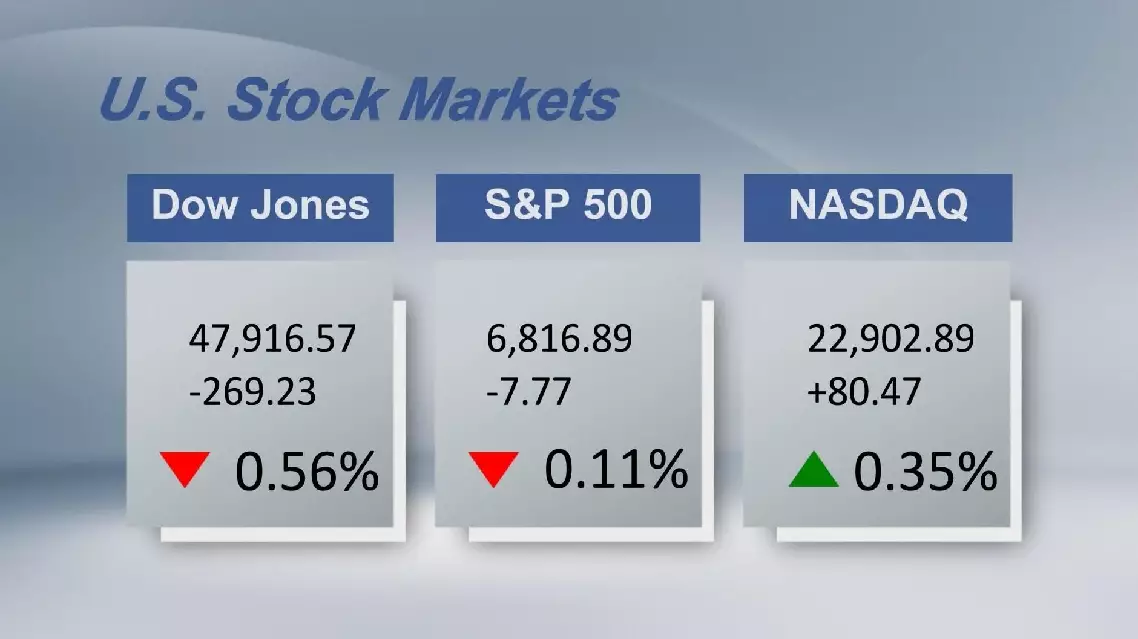
The Dow Jones Industrial Average fell 0.56 percent to 47,916.57. The S and P 500 slipped 0.11 percent to 6,816.89. The Nasdaq Composite Index rose 0.35 percent to 22,902.89.
Seven of the 11 primary S and P 500 sectors closed lower. Consumer staples and health care led the declines, falling 1.43 percent and 1.33 percent, respectively. Technology and materials were the top performers, advancing 0.76 percent and 0.64 percent.
The U.S. consumer price index (CPI) jumped 3.3 percent in March from a year earlier, representing nearly a full percentage point increase from February's annual pace, according to the Bureau of Labor Statistics. The energy index surged 10.9 percent in March, propelled by a 21.2-percent jump in gasoline prices, which alone accounted for nearly three quarters of the monthly increase across all items.
The core CPI, which excludes volatile food and energy components to measure underlying inflation, increased more modestly, rising 0.2 percent for the month and 2.6 percent year over year.
White House Deputy Press Secretary Kush Desai stated that the economy "remains on a solid trajectory," while acknowledging that food and gas prices have risen. National Economic Council Director Kevin Hassett described the current situation as "a temporary energy disruption," adding that the economic effects of the Iran conflict are "a temporary distraction that will very, very quickly go away."
However, Kathy Bostjancic, chief economist at Nationwide, argued that even if a long-lasting deal to end the war is reached and the Strait of Hormuz is fully reopened, "it would take months for oil, gasoline, diesel and other commodity supplies to snap back to pre-war levels and thus for prices to settle back to pre-conflict levels."
Meanwhile, the University of Michigan's preliminary April consumer sentiment index fell sharply to a record low of 47.6, down from 53.3 in March and well below analysts' expectations of 52.0, reflecting growing public concern over the impact of the Iran war on household finances.
Shares of the "Magnificent Seven" technology giants were mostly lower on the day. Nvidia stood out as the strongest performer, rising 2.57 percent.
Investors are now turning their attention to the upcoming U.S.-Iran talks scheduled for this weekend.
U.S. stocks close mixed after shocking inflation data