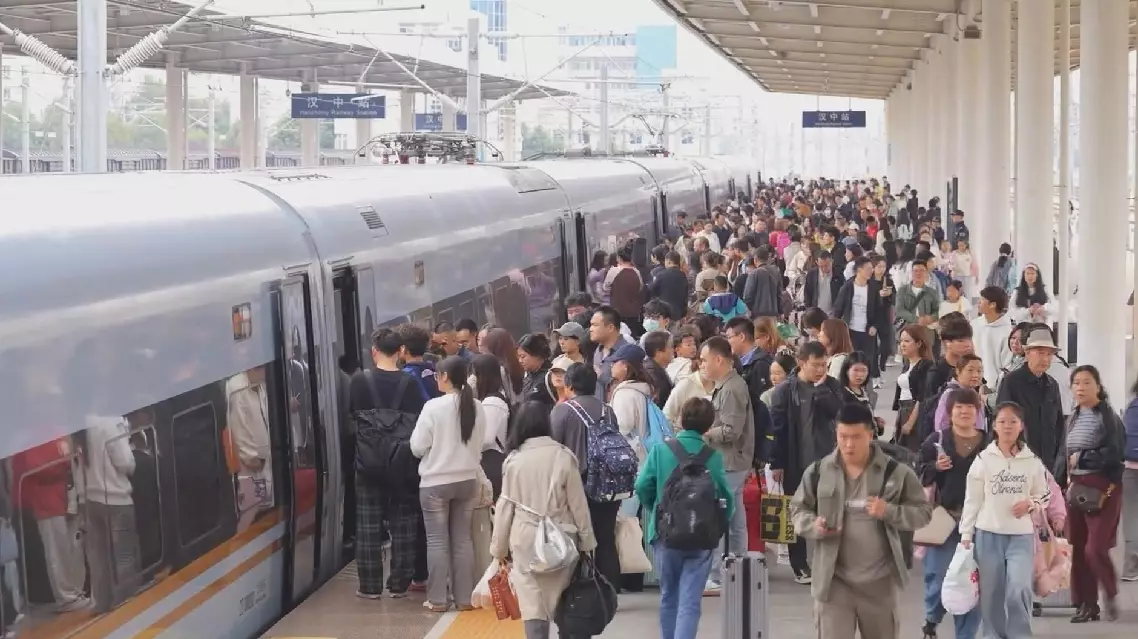
China's advanced transportation network has played a pivotal role in facilitating the travel rush during the eight-day Spring Festival holiday, ensuring smooth and efficient journeys for millions across the country.
During the holiday period from Jan. 28 to Feb. 4, China recorded over 2.3 billion inter-regional trips. This total included approximately 96.12 million railway trips, 2.2 billion road trips, 9.35 million waterway trips, and 18.29 million air trips.
"The high-speed rail, subway, and airport are all well connected, and that's really convenient," said a tourist from Shenzhen, Guangdong Province, in southern China.
To ensure efficiency and safety, authorities implemented a series of measures aimed at maintaining smooth and orderly travel.
"To ensure smooth travel for over 2.3 billion passenger trips during the Spring Festival holiday, we have formulated 30 measures to guarantee safety and service during this major holiday. We are making every effort to implement them, ensuring overall smooth and orderly transportation operations," said Wang Xiuchun, deputy director of the Transport Services Department at the Ministry of Transport.
China's vast highway system, now stretching approximately 5.5 million kilometers - including over 190,000 kilometers of expressways, the largest in the world - has become the backbone of mass mobility, supporting over 2.1 billion road trips during this year's Spring Festival holiday.
The Shenzhen-Zhongshan Link, a high-speed transportation corridor connecting cities within the Guangdong-Hong Kong-Macao Greater Bay Area, has become a hallmark of infrastructure innovation, significantly reducing travel time across the Pearl River Estuary and accelerating regional integration. Since its launch in 2024, the megaproject has spurred cross-city travel, with Zhongshan experiencing a surge in vehicles from Hong Kong, Shenzhen, and Dongguan during the holiday period.
"We arrived at Shenzhen Airport, and we took the Shenzhong Link back to Zhongshan, and it was really, really fast," said a tourist from Australia.
China's extensive railway network has greatly improved travel convenience. By the end of last year, the country's total railway operating mileage exceeded 160,000 kilometers, including a world-leading 48,000-kilometer high-speed rail system that continues to redefine domestic connectivity.
"In the past, traveling took up most of my trip time, but now it's different. The Shanghai–Suzhou–Huzhou high-speed rail is right at my doorstep, making it incredibly convenient to travel to Shanghai and Suzhou. My personal radius has expanded significantly," said a tourist from east China's Zhejiang Province.
China's aviation sector has expanded its reach to 260 transport airports, supporting more than 15,000 daily flights. During this year's holiday travel peak, daily civil aviation passenger numbers soared to a record 2.48 million, highlighting the sector's strong capacity to meet surging demand.
The integration of smart infrastructure has further enhanced the travel experience. The national railway ticketing system now processes over 20 million transactions daily, while ultra-fast charging stations in expressway service areas reduce electric vehicle charging time for a 200-kilometer range from 30 minutes to just three minutes. Meanwhile, AI-powered air traffic control systems have improved flight punctuality to 94 percent, ensuring seamless operations amid heavy air traffic.
"The busy yet orderly Spring Festival travel rush has become a unique scene interwoven with festival celebrations, family visits, and tourism, deeply involving China's 1.4 billion people. The extensive and well-connected transportation network has reshaped people's perception of time and space, transforming travel patterns while supporting the growing demand for pleasant journeys and cultural tourism consumption. This reflects the vitality and stability of China's growing economy," said Li Liancheng, deputy director of the Comprehensive Transportation Research Institute at the National Development and Reform Commission.
China’s advanced transport network ensures seamless travel during Spring Festival rush