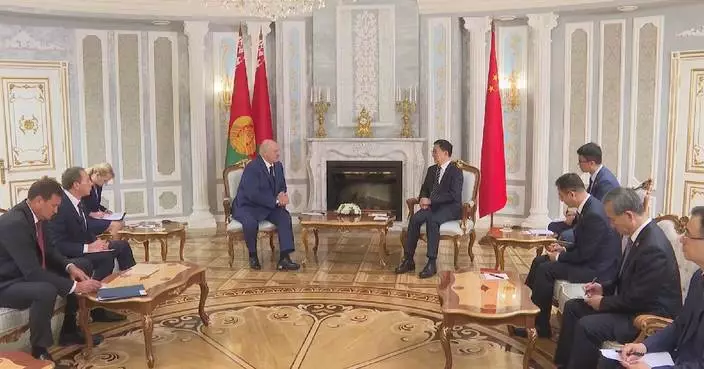
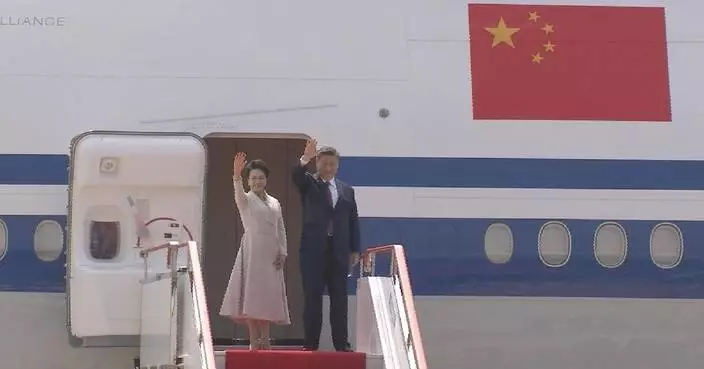
The massive production complex of BASF in Zhanjiang City in south China's Guangdong Province has become a major symbol of China-Germany cooperation and green power utilization.
The company on Thursday put the multibillion-euro site into full operation, marking the largest single investment project wholly owned by a German enterprise in China.
With an investment of 8.7 billion euros, the integrated site covers about 4 square kilometers, the company said. Industry analysts say the project underscores BASF's long-term commitment to expanding in China as the country continues to promote high-standard opening up.
Unlike traditional plants, it runs entirely on green power, using 100 percent renewable electricity and fully electric-driven compressors for its core steam cracker.
"By utilizing 100 percent of the renewable energy, our products made in Zhanjiang contribute also significantly to the lower carbon product footprint. Our current product footprint for such a site like ours will probably be around 4 million tons of CO2. And today, we are at 1.7 million tons of CO2," said Haryono Lim, president of Mega Projects Asia at BASF.
Cutting carbon emissions by more than half, the Zhanjiang site is setting new benchmarks for sustainable chemical production.
"We wanted to distinctively move to South China to participate in the strong growth around the Pearl River Delta and in Guangdong Province. And then, of course, Zhanjiang offers great opportunities with its good infrastructure, deep-sea harbor, and great support by the local government," said Markus Kamieth, CEO of BASF.
The local government's support has been key to the company's growth in the region, and the project is now driving broader green ambitions.
"BASF's full operation boosts the region's low-carbon hydrogen transition by developing the hydrogen value chain to attract related industries, supplying low-cost green power from offshore wind and solar, driving green upgrades in local petrochemicals and steel, and helping build a national pilot zone for zero-carbon industrial parks," said Yang Jiedong, director of the Administrative Committee of Zhanjiang Economic and Technological Development Zone.
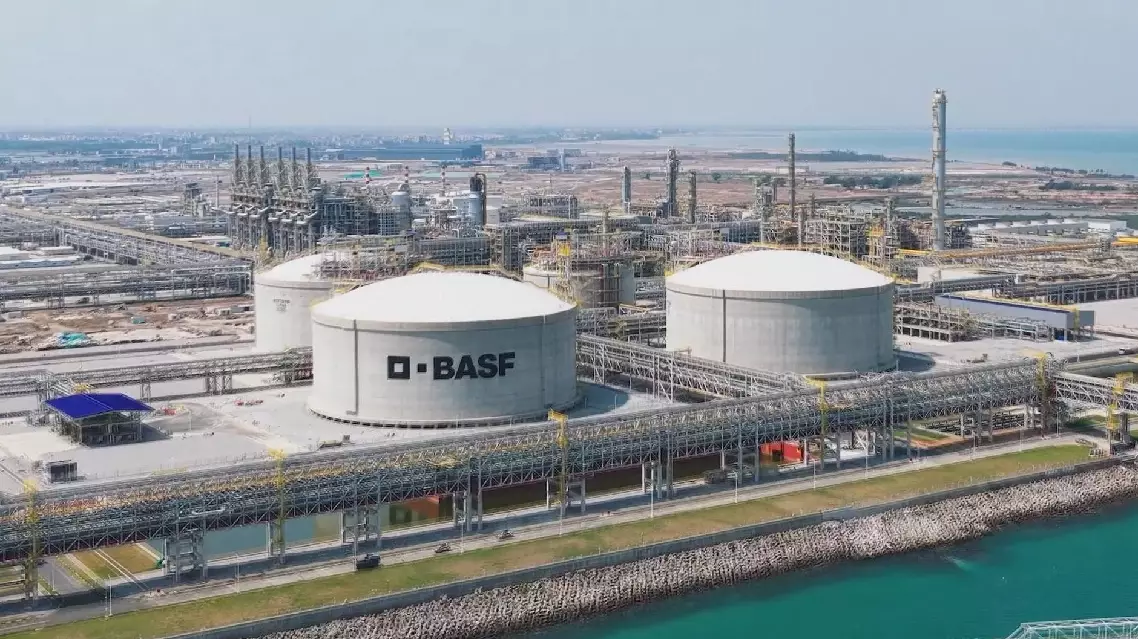
BASF Zhanjiang production complex goes fully green, using 100 percent renewable electricity

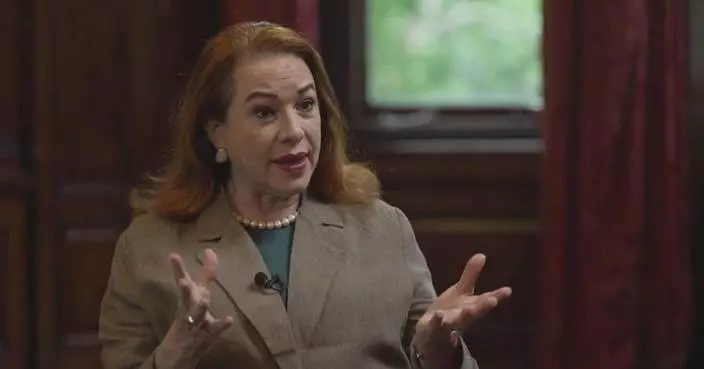
World Energy Council Secretary General Angela Wilkinson has called for greater cooperation, as geopolitical tensions add uncertainty to the market, and praised China's efforts in prompting global energy resilience.
Speaking to China Global Television Network, she said she thinks although the current situation feels very acute, it is not as severe as it would have been maybe 20 years ago in terms of energy, because energy supply is becoming more diversified.
She emphasized that China's cooperation with other countries has helped strengthen energy security and overall sustainability.
"We've always talked about for 20 years the need to balance security, affordability and sustainability, The triangle or what we call the trilemma, right? And what we know now is that those trade-offs are real and they're getting sharper and they're shifting. So when we've come through two decades where people have really wanted to frame energy policy in terms of climate. And the need for clean and green power. But now we're talking about the need to have rebalancing world energy leadership, so China's cooperation with many other countries changes how those countries can balance security, affordability and sustainability," she said.
Wilkinson highlighted China's efforts to diversify its energy imports and build a new power system at remarkable speed and scale. She said China is not only managing its own system security but also considering how it can contribute to global stability.
"China has diversified the imports that it's make. It's built a new power system at speed and scale. And I think China manages the whole system security and it's looking at how does it contribute to the security of the world so that it can continue to grow and flourish. You can't grow and flourish in a world of war," she said.
Wilkinson used a vivid analogy to explain whether the current crisis would accelerate the transition to renewables or reinforce reliance on coal.
"New power systems and the existing energy system is the mosquito and the elephant. The current capacity of renewables is like the mosquito. The existing system is like the elephant, but the mosquito relies on the elephant for its blood. And it's going to for a long time. These are codependent systems. As the new power systems scale across the world, then we will see naturally a fall off or a shift in supplies," she said.
Wilkinson also expressed her concern over humanity.
She said that as an entire species, people have forgotten just how dependent they are on energy. And it is not just about technology or money or an industry or a commodity, but actually the modern foundation of all societies.
World Energy Council chief highlights China’s role in global energy resilience