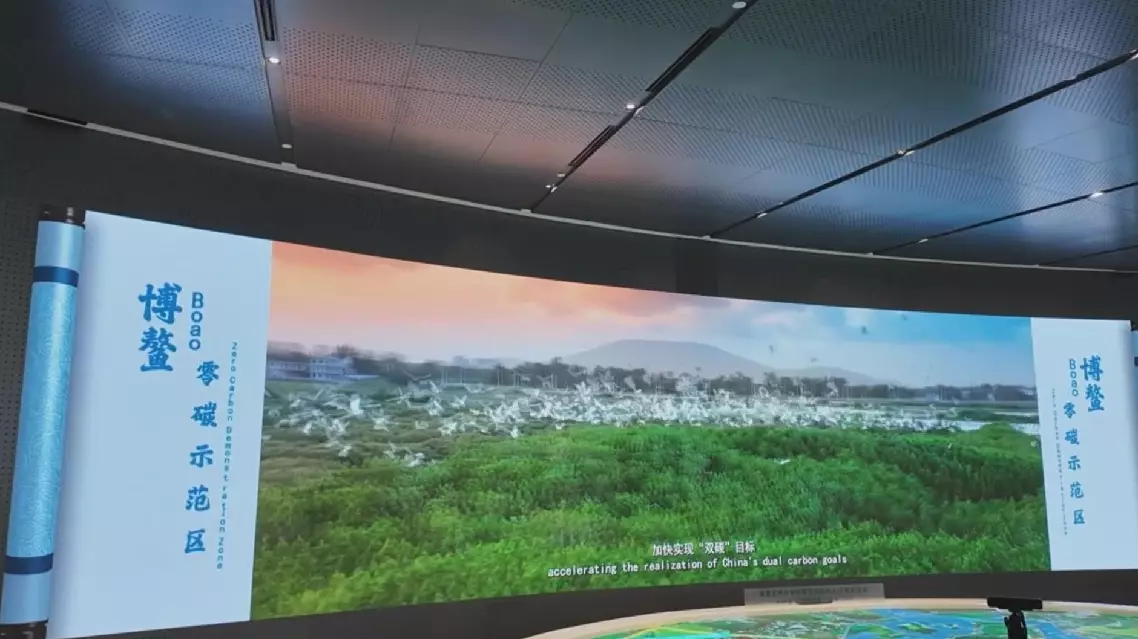
A special zero-carbon zone set up around the coastal town of Boao in south China's tropical island province of Hainan has been serving as a real-world lab demonstrating China’s strategies and solutions for achieving a greener, cleaner future to guests at the Boao Forum for Asia (BFA) Annual Conference.
The four-day BFA conference, themed "Shaping a Shared Future: New Dynamics, New Opportunities, New Cooperation", is set to wrap up on Friday after gathering around 2,000 representatives from over 60 countries and regions around the world. The forum has been putting its words into action with a full suite of carbon reduction measures showcased by the Boao Zero-Carbon Demonstration Zone, a project which was launched in 2022 as a joint initiative between China's Ministry of Housing and Urban-Rural Development and the Hainan provincial government.
Encompassing 18 renovation projects across eight categories, including green buildings, renewable energy use and green transportation, the zero-carbon zone is well-equipped with high-tech solutions which combine artificial intelligence with green concepts.
Some of these innovations were highlighted at the forum, with a range of beach sanitation robots on display at the tropical island venue, as well as eco-friendly pens for delegates to write with, and a robotic-arm producing tasty coffee for guests which has been roasted using clean energy sources.
Data shows that by the end of 2025, CO2 emissions from buildings and infrastructure in the area around the Boao zero-carbon zone were cut by 99.9 percent in the space of just six years, a massive step forward in the continuing low-carbon push.
These achievements represent just one piece of a much bigger picture of China's vision of a greener future, and the country's efforts in advancing the green transition and striving to cut emissions through sci-tech means has been recognized by former world leaders who attended the Boao forum.
"[China is] making significant progress not only in reducing emissions but the technology and innovation that China is producing can be deployed worldwide, so you are a major player in the green conversation," said Jenny Shipley, former Prime Minister of New Zealand.
"China has made lots of effort to invest in new technologies especially in the fields of solar cells and wind power. But in spite of all these turbulences, all these geopolitical tensions, its very important that in certain areas at least, we are able to collaborate and have win-win opportunities," said Esko Aho, former Prime Minister of Finland.
Further advancing the green transition and exploring new cooperation avenues to achieve more mutual benefits is also outlined in China’s 15th Five-Year Plan (2026-2030), a key blueprint which maps out the country's development priorities for the years ahead.
According to the World Economic Forum, the rapid growth of green technology production in China has helped cut green energy costs worldwide, making sustainable energy solutions more accessible than ever for billions of people.
'Zero-carbon zone' at Boao forum showcases China's solutions for green future