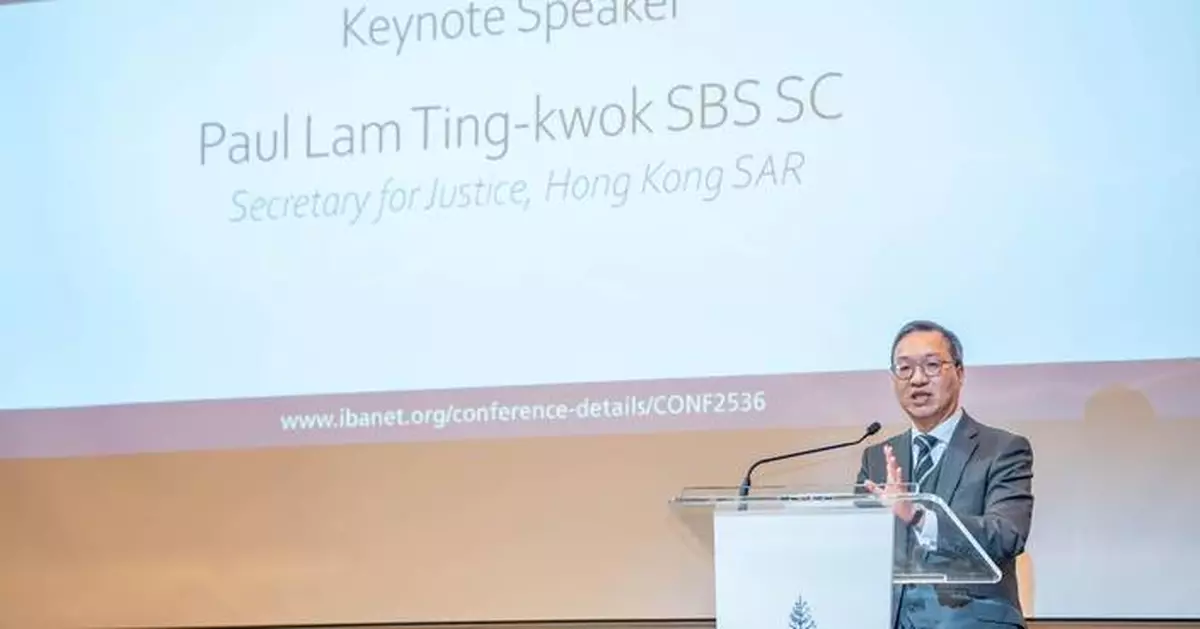
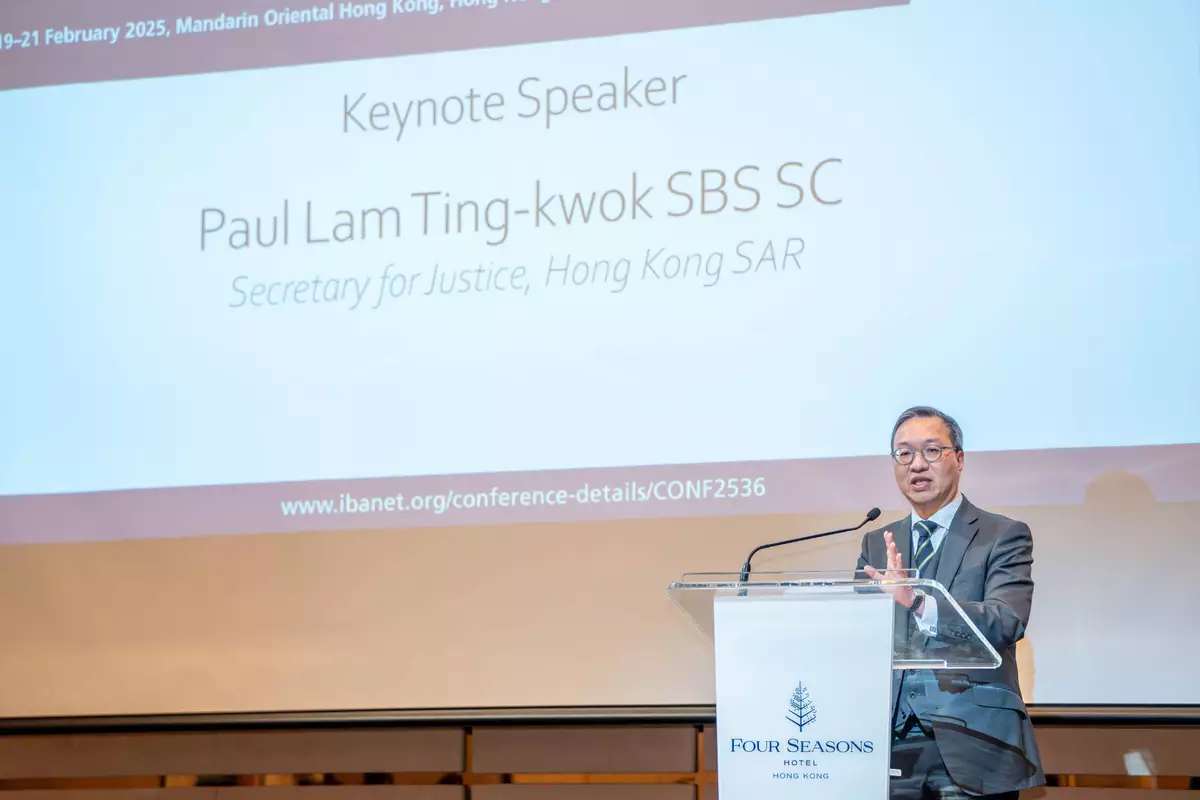
Speech by SJ at 8th IBA Asia Pacific Regional Forum Biennial Conference
Following is the speech by the Secretary for Justice, Mr Paul Lam, SC, at the 8th IBA Asia Pacific Regional Forum Biennial Conference today (February 20):
Mr Menzer (Vice-President of the International Bar Association (IBA), Mr Jorg Menzer), Mr Dhillon (Co-Chair of the IBA Asia Pacific Regional Forum Mr Dinesh Dhillon), Mr Liu (Co-Chair of the IBA Asia Pacific Regional Forum Mr David Liu), Winnie (Secretary of the IBA Asia Pacific Regional Forum and co-chair of the conference, Ms Winnie Tam, SC), other friends from the IBA, distinguished guests, ladies and gentlemen,
Good evening. I wish to begin by thanking the organiser, in particular, my good friend Winnie, for inviting me to this dinner. I also wish to congratulate the conference co-chairs and the conference organising committee for hosting this eighth edition of the International Bar Association Asia Pacific Regional Forum Biennial Conference. I was told that more than 360 persons coming from 36 jurisdictions have signed up for the conference. Apart from 20 jurisdictions in the Asia Pacific region (including the Mainland and Hong Kong), we have friends coming from South Asia, Central Asia, Europe, North and South America, as well as Africa.
In 2008, Hong Kong hosted the IBA Asia Pacific Forum with the theme "New focus of international business: Asia, the centre stage". Time flies. As at today (February 20, 2025), what had been described as the "new focus" back in 2008, 17 years ago has become the "main focus".
In these circumstances, the theme of this conference is most pertinent, namely "Vibrant Asia - Land of opportunity and promise". This theme, of course, applies to Hong Kong, being one of the major international cities in Asia. But I wish to be more specific tonight by spending the next 15 minutes or so to convince you why, from the legal perspective, Hong Kong is a land of opportunity and promise.
The short answer is that, as we always say, Hong Kong serves as the "super connector" and "super value-adder" between China and the rest of the world. We perform such roles by making use of our unique strengths and advantages under the principle of "one country, two systems". One of these unique strengths and advantages is that we have very strong rule of law based on our common law system. You may wonder: there are many jurisdictions in the world including Asia, which practise the common law; what is so special about Hong Kong's common law system? My answer is that there are at least six key characteristics of our common law system which, when combined together, have rendered our legal system unparalleled.
First, our legal system is very stable. Hong Kong is the only common law jurisdiction in China. The continuation of the common law system is guaranteed by various provisions in the Basic Law which implements the fundamental national policy of "one country, two systems". It is most significant to note that, in his speech delivered on July 1, 2022, at the celebration of the 25th anniversary of the establishment of the Hong Kong Special Administrative Region (HKSAR), President Xi Jinping made it crystal clear that the principle of "one country, two systems" is a good policy that must be adhered to in the long run. Equally important is that he mentioned the common law twice in his speech. Apart from acknowledging the contribution of the common law to the success of Hong Kong since China's resumption of sovereignty over Hong Kong on July 1, 1997, he said that "The Central Government fully supports Hong Kong in its effort … to maintain the common law ...". More recently, on December 20, 2024, at the celebration of the 25th anniversary of Macao's return to the motherland, President Xi repeated that "one country, two systems" is a good system that sustains the long-term prosperity and stability of Hong Kong and Macao. He also pointed out that the values embodied in the principle of "one country, two systems", namely, peace, inclusiveness, openness and sharing are relevant to not only China but also the whole world.
Second, our legal system is very credible and reliable. In particular, we have an utmost reputable and independent judiciary. The Basic Law provides that our courts shall enjoy the independent power of adjudication and also that our Court of Final Appeal (CFA) shall enjoy the power of final adjudication. There are also express provisions which guarantee judicial independence. For example, judges in Hong Kong are appointed on the recommendation of an independent commission, with the only criteria considered being their judicial and professional quality. Non-permanent judges from other common law jurisdictions of the highest calibre have been invited to sit on our CFA. The most recent appointee, former Chief Justice of the Federal Court of Australia, Mr Justice Allsop, came to Hong Kong last week to hear his first case. The judgments of our courts, in particular those of the CFA, are often cited in other common law jurisdictions. All court hearings, subject to very few exceptions, are conducted openly; and court judgments are always published. These measures enable people to see that judges have in fact discharged their duties independently without any improper interference. A strong piece of evidence, which I will mention with great reluctance, is that in litigation involving the Government, the Secretary for Justice was, on some occasions, not the successful party. The integrity and quality of our judiciary is never in doubt.
Third, our legal system provides a very safe and secure environment. Fundamental human rights and freedoms based on international standards set by the International Covenant on Civil and Political Rights and the International Covenant on Economic, Social and Cultural Rights, as well as private property rights, are fully protected by Hong Kong law. Our law enforcement agencies and regulatory bodies, such as the Police, the ICAC (Independent Commission Against Corruption), the SFC (Securities and Futures Commission), always enforce the relevant laws strictly and fairly. In this respect, it is very important to note that we have consistently been ranked as one of the least corrupt places in the world. According to the Corruption Perceptions Index 2024 released by Transparency International very recently on February 11, 2025, Hong Kong ranks 17 out of 180 jurisdictions, well ahead of many Western developed countries such as the United States and the United Kingdom.
Fourth, our legal system is very user-friendly. It is the only bilingual common law system using both English and Chinese. This is important because English is the linqua franca of the international business community. Our laws (both substantive and procedural) are aligned with prevailing international practices, and hence are familiar to the international community. For example, our Arbitration Ordinance is based on the United Nations Commission on International Trade Law Model Law. In the latest World Competitiveness Yearbook 2024 published by the International Institute for Management Development in June 2024, Hong Kong ranked first in "Business legislation".
Furthermore, we strive to update our laws continuously to ensure that they will meet the demand of the latest developments and trends around the world. Let me give two examples. We have just completed a consultation in relation to the proposed amendments to the Copyright Ordinance to cater for the fast development of AI generated works. Second, a draft legislation is now being considered by our Legislative Council which aims at creating a regulatory regime for the issuance and offers of stablecoins.
Fifth, our legal system is well connected to both the Mainland and other parts of the world. With the strong support of the Central Government, Hong Kong has signed nine mutual legal assistance arrangements in civil and commercial matters with the Mainland covering three main areas: first, procedural assistance on, for example, service of judicial documents and taking of evidence; second, arbitration-related assistance; and third, reciprocal recognition and enforcement of civil and commercial judgments. These MLA (mutual legal assistance) arrangements give Hong Kong an advantage that is unavailable in other jurisdictions.
In this respect, it is necessary to mention the Guangdong-Hong Kong-Macao Greater Bay Area (GBA), which consist of nine cities in the Guangdong Province, the HKSAR and the Macao SAR. The population of the GBA has exceeded 86 million; its size is similar to Croatia; its total GDP has already exceeded Australia and is among the top 10 in the world. It is the home of giant tech companies such as Tencent and BYD. Great efforts have been made to harmonise the rules and regulations in the three different legal territories in the GBA. For example, to promote and facilitate the use of mediation to resolve civil and commercial disputes in the GBA, there is now a uniform set of rules on mediation and also a consolidated panel of GBA mediators. Furthermore, important measures have been introduced to give business entities the option to use Hong Kong law in their contracts, and choose Hong Kong as the place for arbitration when they set up their businesses in the GBA. Just last Friday (February 14), the Supreme People's Court and the Ministry of Justice of the People's Republic of China announced that Hong Kong-invested enterprises registered in any of the nine Mainland cities in the GBA may choose Hong Kong as the seat of arbitration. And for enterprises registered in Shenzhen or Zhuhai, they may also choose to use Hong Kong law as the governing law of their commercial contracts. These additional options will certainly create more demands and, hence, opportunities for legal practitioners in Hong Kong.
Sixth and lastly, we have very strong legal professionals and dispute resolution institutions with high expertise and vast experience in providing legal and dispute resolution services involving Mainland and international elements. A very important point is that, while most of our lawyers are very good at handling international legal issues, at the same time, they are also proficient in both Chinese and English, and have intimate knowledge of the Chinese culture and business practices. According to the latest statistics updated to February 20, 2025, published by the Law Society of Hong Kong, 299 law firms have overseas offices, and 86 have representative offices in the Mainland. Because of these strong Mainland and international connections, by engaging a Hong Kong lawyer or law firm, the client would in effect be able to obtain a one-stop legal service regarding different jurisdictions.
Our dispute resolution bodies are of course very popular and well regarded worldwide. According to the statistics published by the Hong Kong International Arbitration Centre (HKIAC) (the main arbitral institution in Hong Kong), in 2024, 352 new arbitration cases were submitted to the HKIAC, with the total amount in dispute reaching approximately US$13.6 billion. Both figures represent a record high for the HKIAC. Parties from 53 jurisdictions participated in these arbitrations. In 86 per cent of these cases, at least one of the parties was not from Hong Kong; and in 14.5 per cent of these cases, neither party came from Asia. These figures demonstrate and reinforce Hong Kong's status as a world class leading and popular international arbitration centre.
As there are many friends from the Mainland and other countries here tonight, I wish to stress that we adopt a very open policy and welcome lawyers from other jurisdictions to practise here in appropriate circumstances. As a matter of fact, there are already 83 foreign law firms and 1 571 foreign registered lawyers practising in Hong Kong. On the other hand, King's Counsel from England come to Hong Kong from time to time on an ad hoc basis to appear in difficult and complex litigations.
Turning to arbitration, we place no restriction at all on the nationalities or professional qualifications of the parties, legal advisers or arbitrators to participate in arbitral proceedings in Hong Kong. As a further step to facilitate people from other places to take part in arbitrations in Hong Kong, starting from next month, individuals participating in arbitrations in Hong Kong may do so without the need to obtain any employment visa. These individuals include not only to parties to the arbitration, arbitrators and counsel, but also expert and factual witnesses, tribunal secretaries, and tribunal-appointed experts. And it does not matter that the seat of arbitration is indeed somewhere else so long as the arbitral proceedings take place physically in Hong Kong.
While I am very confident that Hong Kong's legal system is unparalleled, and provides abundant opportunities to legal practitioners from not just Hong Kong but also the Mainland and other parts of the world, we recognise that there is no room for complacency. Therefore, we will spare no effort to further promote Hong Kong as an international legal and dispute resolution services centre as well as a capacity building centre. I am excited to say that the signing ceremony of the international treaty regarding the establishment of the International Organization for Mediation (IoMED) will take place in Hong Kong later this year. The establishment of the IoMED is the result of successful negotiations between China and a number of friendly states. Its headquarters will be located in Hong Kong, and it will be the world's first intergovernmental international legal organisation dedicated to resolving international disputes of different natures through mediation.
In addition, the Department of Justice established the Hong Kong International Legal Talents Training Academy last November which aims at providing capacity building programmes, organising practical training courses, and international exchange programmes to promote sharing of knowledge and experience among legal talents in the region and beyond.
I think I have said enough, and it is time for you to enjoy your well-deserved dinner. To my dear friends coming from overseas, I do hope that, apart from taking part in this conference, you will have some spare time to explore our wonderful city. Seeing is believing. I am very confident that you will be convinced that Hong Kong has remained to be a very open and vibrant society full of energy, hopes and opportunities, as is always the case.
I wish you all a very pleasant evening. Thank you.
Speech by SJ at 8th IBA Asia Pacific Regional Forum Biennial Conference Source: HKSAR Government Press Releases