The assets of China's banking and insurance sectors expanded steadily last year, official data released Friday showed.
The total assets of the Chinese banking industry stood at 444.6 trillion yuan (around 61.32 trillion U.S. dollars) at the end of 2024, up 6.5 percent year on year, according to the China Banking and Insurance Regulatory Commission.
The total assets of the insurance sector amounted to 35.9 trillion yuan (about 4.95 billion U.S. dollars), with a growth of 13.9 percent from the beginning of last year.
In 2024 alone, the primary insurance premium income in China's insurance industry jumped 5.7 percent year on year to 5.7 trillion yuan (roughly 786.1 billion U.S. dollars), showed the commission. Meanwhile, the expenditure on claims and benefits reached 2.3 trillion yuan (around 317.2 billion U.S. dollars), up 19.4 percent from a year ago.
The commission also reported that the balance of non-performing loans stood at 3.3 trillion yuan (about 455.11 billion U.S. dollars) at the end of the fourth quarter 2024, dropping 97.7 billion yuan (around 13.47 billion U.S. dollars) from the end of the previous quarter.
In addition, the non-performing loan ratio of China's commercial banks came in at 1.50 percent at the end of December 2024, down 0.05 percentage points from the end of September 2024.

China banking, insurance sectors' assets up in 2024
U.S. stocks ended slightly lower on Monday, with modest declines across major benchmarks as investors monitored rising oil prices amid renewed uncertainty in the Middle East.
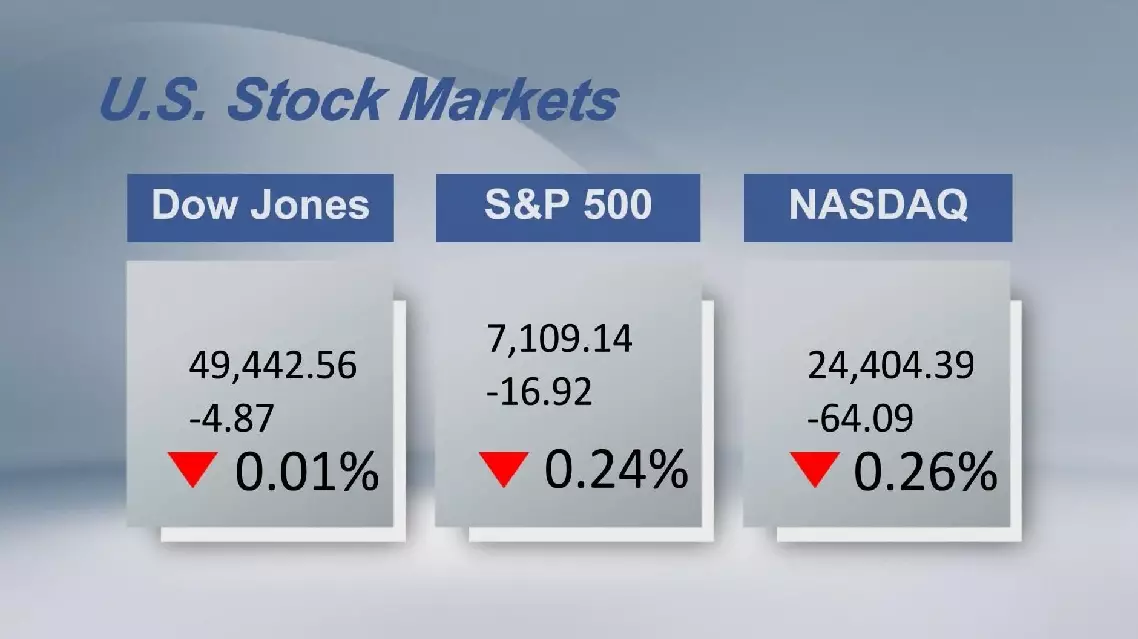
The Dow Jones Industrial Average fell by 0.01 percent to 49,442.56. The S and P 500 sank 0.24 percent to 7,109.14. The Nasdaq Composite Index shed 0.26 percent to 24,404.39.
Six of the 11 primary S and P 500 sectors closed higher, led by materials and financials with gains of 0.56 percent and 0.34 percent, respectively. Communication services and health care were the main laggards, declining 1.41 percent and 0.93 percent, respectively.
Traders remain cautious about pricing in a worst-case scenario for the ongoing conflict, even as stocks have recovered from near-correction territory to all-time highs in recent weeks.
Oil prices jumped sharply on Monday. West Texas Intermediate crude for May delivery surged 6.87 percent to settle at 89.61 U.S. dollars per barrel on the New York Mercantile Exchange. Brent crude for June delivery gained 5.64 percent to settle at 95.48 dollars per barrel on the London ICE Futures Exchange.
While investors continue to monitor developments in the Middle East, attention is expected to gradually shift back to fundamental factors, according to Scott Welch, chief investment officer at Certuity.
"It is important to remember that the market was not cheap before the war started, and the recent rally has only brought us back slightly past breakeven for the year," he said. "We expect investors will soon once again turn their attention to more fundamental issues -- valuations, earnings potential, inflation, the economy, the labor markets, and Fed policy."
Shares of most of the "Magnificent Seven" technology giants ended lower on Monday. Tesla, which is scheduled to report quarterly results on Wednesday, declined 2.03 percent.
Marvell Technology rose nearly 6 percent to an all-time high after a report over the weekend said the chipmaker was in talks to design new custom artificial intelligence chips for Google.
U.S. stocks close lower as oil prices surge on renewed Mideast tensions