A researcher team stationed at the Xuebao Mountain National Nature Reserve in southwest China's Chongqing Municipality has succeeded in reviving the critically endangered Sichuan thuja, an evergreen tree once thought to be extinct.
Conservationists are now ensuring the endangered flora species' survival and exploring ways to maximize its ecological benefits.
Deep in the lush forests of Xuebao Mountain, the Sichuan thuja clings to cliffs at elevations of 700 to 2,100 meters. Millions of years ago, it thrived during the Cretaceous period, but climate change and human activity pushed it to the brink of extinction.
In 1998, international conservationists declared the species "extinct in the wild." A year later, however, a local botanist rediscovered it. Since then, a dedicated research team and a newly established nature reserve have worked to protect and restore this living relic.
"First, we conducted a detailed survey of the flora species' density and habitat. Around 10,000 plants remain while still being classified as endangered. To ensure its survival, large-scale breeding efforts are helpful to increase its density and restore its natural regeneration ability," said Yang Quan, director of the Administrative Affairs Center under the nature reserve.
Due to difficulties in obtaining Sichuan thuja seeds, artificial propagation faced major challenges. However, in October 2012, the reserve achieved a breakthrough by successfully producing seeds on a large scale.
The 450 pounds of seeds collected led to the cultivation of 400,000 young plants, paving the way for more advanced propagation techniques.
Yang said his team applied biological stimulation and nutrient supplementation to promote root growth and seedling cultivation, ultimately developing a scalable propagation method.
Technological advancements have significantly improved the survival rate of artificially propagated Sichuan thuja. And the research team has cultivated 2.7 million seedlings, with 750,000 returned to the wild.
Encouragingly, some propagated trees at the conservation base have begun producing seeds. Building on this progress, the team continues to refine conservation strategies while exploring ways to maximize the species' ecological benefits.
"After years of research, we've confirmed that Sichuan thuja has strong ecological value, with excellent drought and cold resistance. We are now figuring out to introduce it to areas suffering from desertification and fragile ecosystems to aid ecological restoration," Yang said.
With support from the Chongqing Forestry Bureau and research institutions, the reserve has conducted adaptive planting trials in 26 locations across Yunnan Province also in southwest China, Inner Mongolia in north China, and Gansu in northwest China. Over 2,000 seedlings have been transplanted, with monitoring showing a survival rate exceeding 75 percent.
"Protecting this flora species plays an irreplaceable role in biodiversity conservation. The research team is now calculating its carbon sequestration value, aiming to introduce it to the carbon trading market. This will help advance China's ecological restoration efforts," said Wang Shuxiang, deputy director of the Chongqing Forestry Bureau.
Years of conservation efforts have steadily increased Sichuan thuja numbers in the wild, reversing its critically endangered status in China. This success not only provides a model for sustainable species protection but also offers valuable insights for global biodiversity conservation.
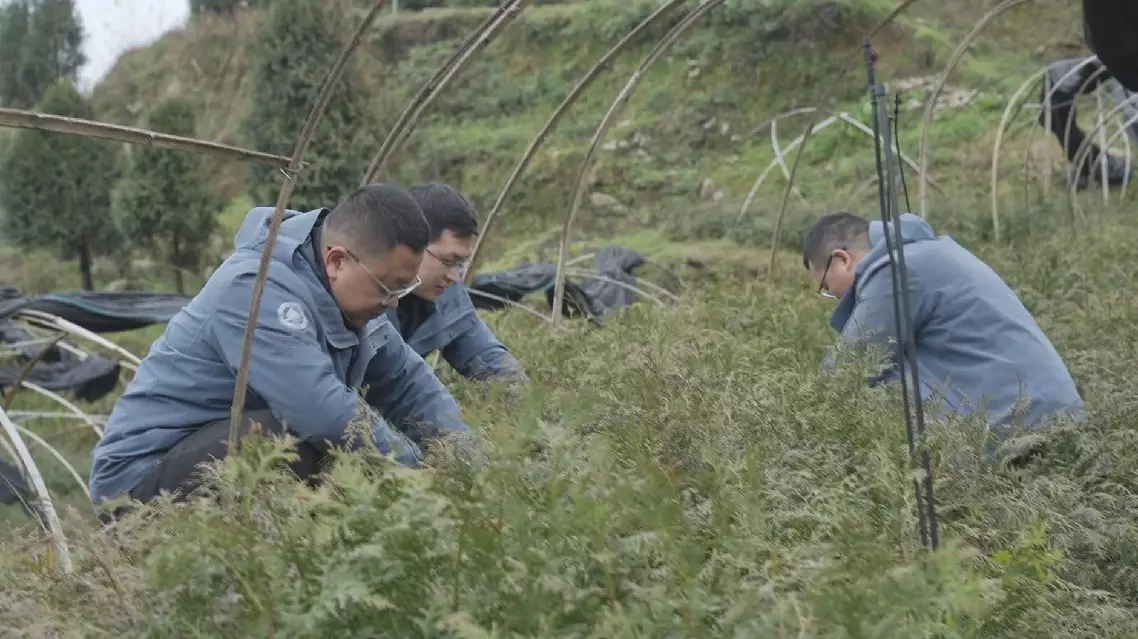
Nature reserve in southwest China revives critically endangered thuja species