BALTIMORE (AP) — Despite documented problems with the evidence against him and an earlier request from prosecutors to clear his record, Adnan Syed will remain convicted of murder, according to court papers filed Tuesday night.
The decision from Baltimore prosecutors comes ahead of a scheduled hearing Wednesday morning where a judge will consider whether to reduce Syed’s sentence, but this means the conviction itself is no longer in question.
It’s the latest wrinkle in an ongoing legal odyssey that garnered a massive following after being featured in the “Serial” podcast over a decade ago.
Syed’s attorneys recently filed the request for a sentence reduction under Maryland’s Juvenile Restoration Act, a relatively new state law that provides a potential pathway to release for people serving long prison terms for crimes committed when they were minors. That request is supported by prosecutors.
Meanwhile, Baltimore State’s Attorney Ivan Bates announced Tuesday that his office is withdrawing a previously filed motion to vacate Syed’s conviction in the 1999 killing of his high school ex-girlfriend, Hae Min Lee, who was found strangled to death and buried in a makeshift grave.
“I did not make this decision lightly, but it is necessary to preserve the credibility of our office and maintain public trust in the justice system,” Bates said in a statement.
Syed’s attorney Erica Suter issued a statement late Tuesday, criticizing the move and reasserting Syed’s innocence.
“Tonight, the state’s attorney got it wrong,” Suter said. “His decision to withdraw his office’s motion to vacate Adnan’s conviction ignores the injustices on which this conviction was founded. We will continue to fight to clear his name through all legal avenues available to him.”
The original motion to vacate — which was filed by Bates’ predecessor Marilyn Mosby — won Syed his freedom in 2022. But his conviction was reinstated following a procedural challenge from Lee’s family. The Maryland Supreme Court ordered a redo of the conviction vacatur hearing after finding that the family didn’t receive adequate notice to attend in person.
Since the prosecutor’s office changed hands in the meantime, the decision of whether to withdraw the motion fell to Bates.
Instead of asking a judge to again consider Syed’s guilt or innocence, Bates chose a different path. He supported Syed’s motion for a reduced sentence — without addressing the underlying conviction.
Bates said that since his release in 2022, Syed has demonstrated he is a productive member of society whose continued freedom is “in the interest of justice.” He said the case “is precisely what legislators envisioned when they crafted the Juvenile Restoration Act.”
The legislation was passed amid growing consensus that such defendants are especially open to rehabilitation, partly because brain science shows cognitive development continues well beyond the teenage years. Syed was 17 when Lee was killed.
Now 43, he has been working at Georgetown University’s Prisons and Justice Initiative and caring for aging relatives since his release, according to court filings. His father died in October after a long illness.
Bates was facing a Friday deadline to decide on the motion to vacate.
After reviewing the motion filed by his predecessor, Bates concluded that it contained “false and misleading statements that undermine the integrity of the judicial process,” he said in a statement Tuesday.
Bates wrote in an executive summary released Tuesday that his decision “does not preclude Mr. Syed from raising any new issues that he believes will support his innocence in the proper post-trial pleadings.”
“However, properly shifting this burden back to Mr. Syed will re-instill the adversarial nature of proceedings that are the hallmark of the truth-seeking function of our criminal justice system,” the summary says.
Attorneys for the victim’s family had argued that prosecutors should address the integrity of Syed’s conviction before the court considered reducing his sentence. Prosecutors “should not be allowed to duck the issue by hiding behind” his motion for a reduced sentence, attorneys wrote in a recent filing.
Syed has maintained his innocence from the beginning, but many questions remain unanswered even after the “Serial” podcast combed through the evidence, reexamined legal arguments and interviewed witnesses. The series debuted in 2014 and drew millions of listeners who became armchair detectives.
Rife with legal twists and turns, the case has recently pitted criminal justice reform efforts against the rights of crime victims and their families, whose voices are often at odds with a growing movement to acknowledge and correct systemic racism, police misconduct and prosecutorial missteps.
When prosecutors sought to vacate Syed’s conviction in 2022, they cited numerous problems with the case, including alternative suspects and unreliable evidence presented at trial. A judge agreed to vacate the conviction and free Syed. Prosecutors in Mosby’s office later chose not to refile charges after they said DNA testing excluded Syed as a suspect.
Even though the appellate courts reinstated his conviction, they allowed Syed to remain free while the case continued.

FILE - Adnan Syed, right, and his mother Shamim Rahman, follow attorney Erica Sutter, not in the photo, to talk with reporters outside Maryland's Supreme Court in Annapolis, Md., Oct. 5, 2023, following arguments in an appeal by Syed, whose conviction for killing his ex-girlfriend more than 20 years ago was chronicled in the hit podcast "Serial." (AP Photo/Susan Walsh, File)
GARY, Ind. (AP) — Tens of thousands of residents in northwest Indiana were in survival mode Thursday as they endured a ninth day without power, throwing out spoiled food, lining up for hot meals and searching for places to charge their phones.
In Gary, Indiana, schools remained closed after the deadly Aug. 11 storm downed trees and power lines. Residents turned to social media to find open laundromats and working Wi-Fi, while others sought food, diapers and cleaning wipes for low-income neighbors.
Meanwhile, heavy rains in central Ohio brought flash flooding that covered roadways Thursday morning in Columbus, the state capital, where emergency crews rescued motorists from stranded cars and saved a 12-year-old boy who was swept off a bridge.
Northern Indiana Public Service Co. said 68,000 customers were still without power as of Thursday morning, the majority of them in Lake County beside the Illinois border. The utility said it has restored power to 306,500 others since Aug. 11. But power is not expected to be fully restored until Tuesday in some places, including Gary.
Courtney Page-Tan, an Indiana University Indianapolis professor who studies community resilience, said health concerns grow each day of a prolonged outage. With many people using generators, poor ventilation can lead to carbon monoxide poisoning. In addition, those reliant on medical devices risk having them lose their charge, while refrigerated food once safe to eat could pose health risks as it spoils.
“Nine days is a long time for a community to be without power,” Page-Tan said.
Shatiya Hardin, a hair stylist in Gary for 25 years, has been unable to open her salon since the storm. She said residents in her lower-income neighborhood initially took the outages in stride. But now patience is wearing thin.
“We’re always in survival mode in Gary. And I think that’s probably why it wasn’t so much of an uproar because the first few days, it was like, ‘OK, we’re used to this .... but this is the second week now," Hardin said. "It’s not OK for us to continually be in survival mode, doing the best that we can.”
More than a week after the initial storm, many residents in East Chicago, Indiana, who lost power regained it, but then lost it again. Kevin Mejia, who has a community Facebook page, was in that category Thursday.
“If I make one post, I get 500 comments,” Mejia, 30, said. “A lot of people have been reaching out to me for food: ‘Hey, I threw out hundreds of dollars in groceries.’ Elderly people don’t know who to turn to.”
He’s been sleeping on the floor because his mattress is too warm. With no power, his window air conditioners are silent.
Raydia Martin, assistant director of the Flourish Community Hub at Flourish Church in Gary, said the “silver lining” has been the response from volunteers and community groups.
“We thrive best, you know, as humans on certainty and predictability,” Martin said. “So for something so devastating to happen so quickly, it definitely takes a toll on people mentally. Just not knowing what’s coming next, where the next meal is going to come from, and when this is all going to be over. We need to have a light at the end of the tunnel."
The utility, NIPSCO, has called the destruction “unprecedented and widespread,” and said crews from around the country have arrived to help repair downed wires, broken poles and damaged equipment. Illinois, which is served by a different utility, recovered sooner from the same storm.
"No service territory is the same,” said Melody Birmingham, an executive at NIPSCO’s parent company.
The power outages have also disrupted the start of the school year for thousands of children.
Gary's school district, with about 4,300 students, started its school year in early August but has been closed since Aug. 13 and will remain closed through at least Friday, officials said.
Portage Township Schools had to cancel its Aug. 12 start of classes because of the storm and now is planning an Aug. 25 launch of the academic year. Officials this week said there are “existing safety concerns regarding trees down across several properties and damage that needs to be repaired.”
Page-Tan said school closures can have significant consequences for vulnerable families.
“For a lot of households that live paycheck to paycheck, if they are missing work because they’re unable to find childcare, it can be detrimental to the stability of a family,” she said.
About 250 miles (400 kilometers) southeast of Gary, heavy rains drenched Columbus, Ohio, with more than 3 inches (7 centimeters) of rain in 12 hours, Columbus Mayor Andrew Ginther said.
Two women who were on foot and trapped in a flooded creek were rescued, Fire Division Lt. Nick Davis said. He also reported that first responders saved the life of a 12-year-old bicyclist who was swept off a bridge in high water.
The city was still cleaning up from severe weekend thunderstorms when the heavy rains struck midweek.
“We’ve been all hands on deck supporting residents since last week,” Ginther said Thursday morning at a news conference. “We’re going to be focused on recovery, even with this curveball from Mother Nature.”
Rico reported from Atlanta and White from Detroit. Dylan Lovan in Louisville, Kentucky, contributed.

Shatiya Hardin uses a flashlight as she looks around her basement after power outages at her house in Gary, Ind., Thursday, Aug. 20, 2026, more than a week after a deadly storm passes through the area. (AP Photo/Nam Y. Huh)
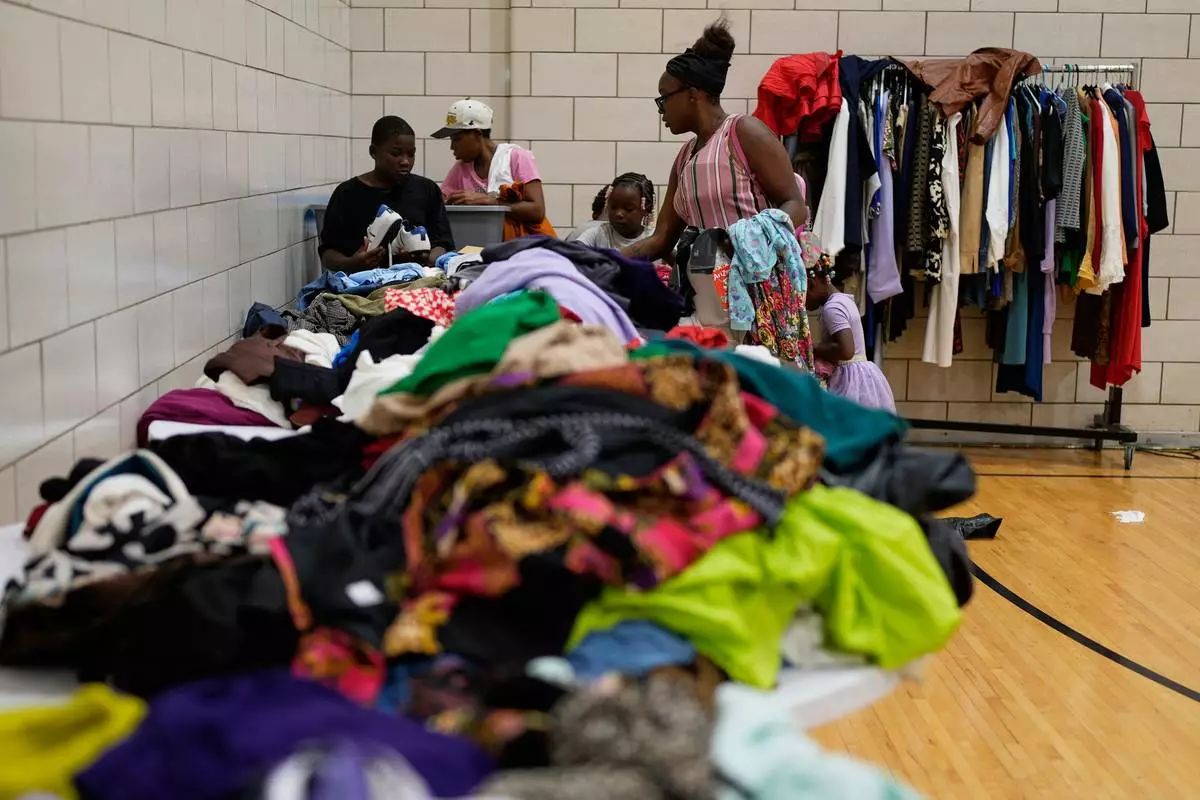
People look through donated clothes at City Life Center in Gary, Ind., Thursday, Aug. 20, 2026, more than a week after a deadly storm passed through the area. (AP Photo/Nam Y. Huh)

A woman sits inside the City Life Center as she waits for food in Gary, Ind., Thursday, Aug. 20, 2026, more than a week after a deadly storm passed through the area. (AP Photo/Nam Y. Huh)

Tyanna Borom wipes her tears while holding a free boxed lunch at City Life Center in Gary, Ind., Thursday, Aug. 20, 2026, more than a week after a deadly storm passed through the area. (AP Photo/Nam Y. Huh)
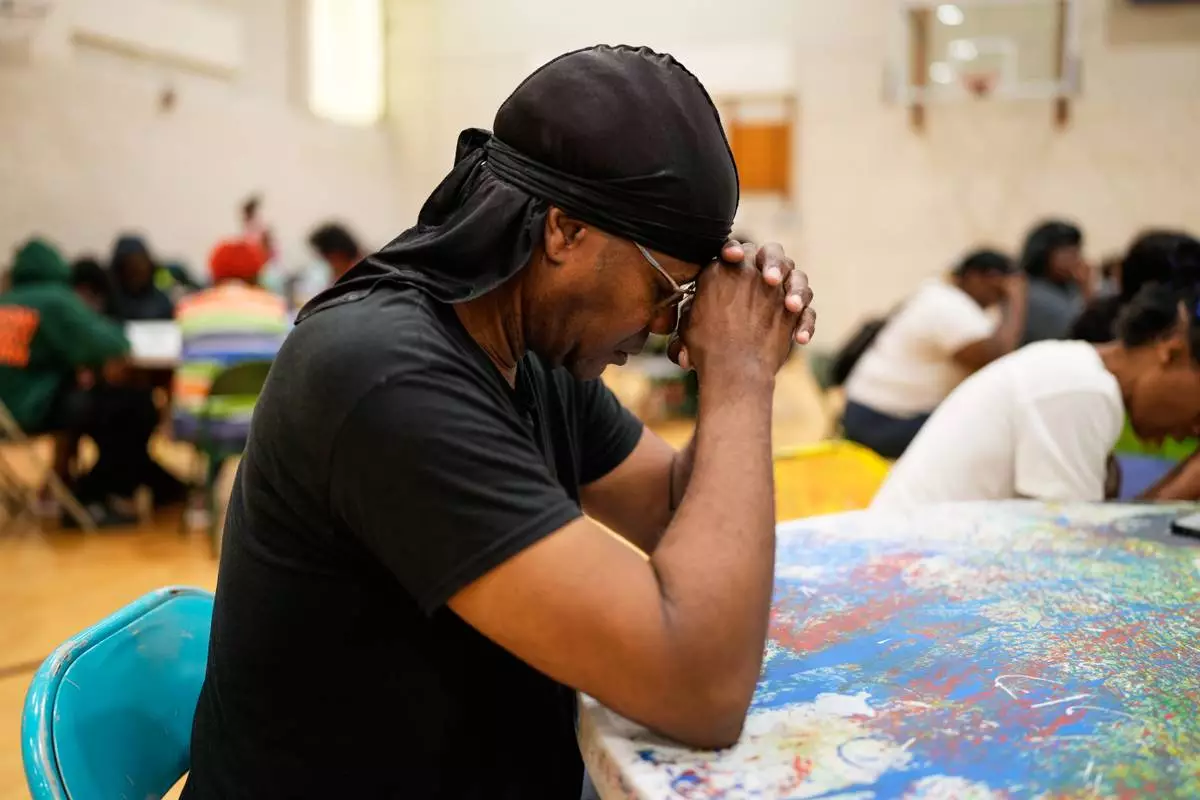
A person prays before receiving a free boxed lunch at City Life Center in Gary, Ind., Thursday, Aug. 20, 2026, more than a week after a deadly storm passed through the area. (AP Photo/Nam Y. Huh)