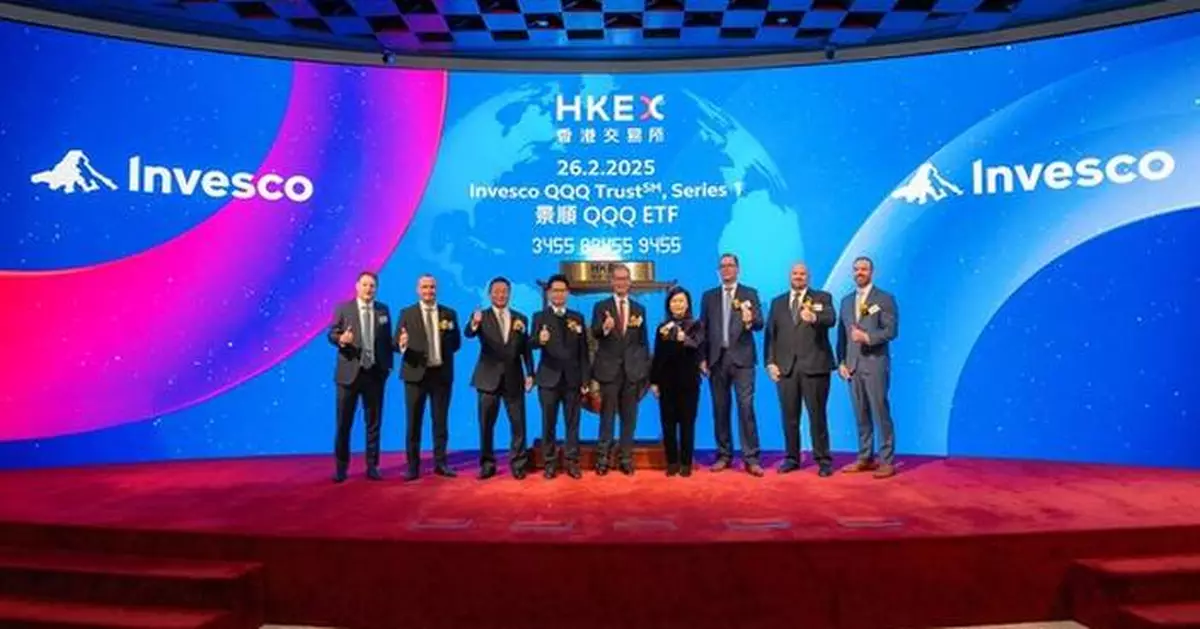
First cross-listing of Invesco QQQ outside of North America; QQQ is the second most traded US ETF
Important Information
- The Trust seeks to track the investment results, before fees and expenses, of the Nasdaq-100 Index® ("Index").
- Investors should note the equity market risk, concentration risk of investing in the US market and in companies in the technology sector, technology sector risks, passive investment risk, trading risks, trading hours different risk, foreign exchange risks, multi-counter risks, reliance on market maker risks, termination risk and general investment risk.
- The Trust may be subject to tracking error risk, which is the risk that its performance may not track that of the Index exactly.
- Payment of distributions out of capital or effectively out of capital amounts to a return or withdrawal of part of an investor's original investment or from any capital gains attributable to that original investment and may result in an immediate reduction in the Net Asset Value ("NAV") per share of the Trust ("Share").
- All Shares will receive distributions in the base currency (USD) only. In the event that a Trust Shareholder has no USD account, the Trust Shareholder may have to bear the fees and charges associated with the conversion of such distributions from USD to HKD or RMB or any other currency.
- NAV and trading price of the Shares can be volatile and could go down substantially.
- Investors should not base their investment decision on this material alone.
HONG KONG, Feb. 26, 2025 /PRNewswire/ -- Invesco, a leading global asset management firm, announced today that its flagship Invesco QQQ Trust Exchange Traded Fund (Invesco QQQ ETF) has been approved for sale in Hong Kong by the Securities & Futures Commission and cross-listed on the Hong Kong Stock Exchange (HKEX), commencing trading as of market open under the symbol "3455". Invesco QQQ, one of the best-performing large-cap growth funds[1], is the flagship fund of Invesco's US$762 billion ETF business, the fourth largest ETF provider globally[2].
With approximately US$318.9 billion in assets under management (AUM)[3], Invesco QQQ is the world's fifth largest ETF and second most traded ETF in the US[4]. The launch marks the first cross-listing of Invesco QQQ outside of North America and represents a milestone in the expanding market for ETFs in Hong Kong. By trading on HKEX - one of the world's leading exchanges - investors around the region will have a highly efficient method of accessing the deep liquidity and price transparency of Invesco QQQ, in a convenient time zone.
Invesco QQQ is the most liquid ETF to access the performance of the Nasdaq-100 Index®, which tracks the 100 largest non-financial companies listed on the Nasdaq. Companies in the Nasdaq-100 Index spend between 600-1,200% more on research and development compared to companies residing in broad-based US large cap equity indexes[5]. Investors will also be able to invest in their preferred currency, with USD, HKD and RMB counters available.
"We are honored to bring our flagship ETF - Invesco QQQ - to Hong Kong, offering local investors a valuable opportunity to access the innovative, forward-thinking companies included in the Nasdaq-100 Index," remarked Andrew Lo, Chief Executive, Asia Pacific at Invesco. "Hong Kong has long been a key hub for Invesco's APAC business, which makes it the ideal location for Invesco QQQ's first cross-listing outside of North America. We believe Hong Kong's unique position in Asia Pacific, as well as its well-established financial infrastructure, will enable us to strategically connect our stakeholders and investors in the region with this important large-cap growth strategy."
Invesco QQQ has mirrored the evolution of global technology and innovation since its launch in 1999. Of the 22 companies that have been a part of Invesco QQQ since inception, many were in the early stages of development in 1999 and have since scaled up successfully. The average market cap of companies included in Invesco QQQ was US$200 billion in 1999, growing to US$1.39 trillion at the end of 2024[6]. Many of the constituents of Invesco QQQ include the leading names in global technology, and the index regularly extends to companies beyond the technology sector that capture future growth opportunities.
"Invesco QQQ ETF has a track record of strong performance over its 25-year history, offering investors access to innovative, growing companies with strong fundamentals," said Brian Hartigan, Global Head of ETFs and Index Investments at Invesco. "Together with Nasdaq, we are pleased to continue to break new ground together through this cross-listing in Hong Kong."
Invesco QQQ is a unit investment trust designed to track the investment results, before fees and expenses, of the Nasdaq-100 Index. It holds all the stocks included in the Nasdaq-100 Index and trades on the Nasdaq stock exchange under the ticker symbol QQQ.
"We believe this cross-listing will bring immense benefits to Asia Pacific investors, most notably access to local trading lines during market hours and settlement in international currencies. These advantages will further drive the expansion of Hong Kong's ETF landscape," Mr. Lo added. "This cross-listing demonstrates our commitment to leveraging our innovative, global investment expertise to investors in Asia Pacific."
 |
[1] Based on total return over the past 15 years by Lipper, as of December 31, 2024. |
[2] In total assets under management (AUM), per Invesco, as of December 31, 2024. |
[3] In total AUM, per Invesco, as of December 31, 2024. |
[4] Based on AUM and average daily volume traded, per Bloomberg, as of December 31, 2024. |
[5] Refers to the S&P 500, Nasdaq US 500 Large Cap Index, and other indexes comprised of the largest few hundred companies listed in the US weighted by market cap. |
[6] Based on simple weighted average of individual companies in the Nasdaq-100 Index. |
[1] Based on total return over the past 15 years by Lipper, as of December 31, 2024.
[2] In total assets under management (AUM), per Invesco, as of December 31, 2024.
[3] In total AUM, per Invesco, as of December 31, 2024.
[4] Based on AUM and average daily volume traded, per Bloomberg, as of December 31, 2024.
[5] Refers to the S&P 500, Nasdaq US 500 Large Cap Index, and other indexes comprised of the largest few hundred companies listed in the US weighted by market cap.
[6] Based on simple weighted average of individual companies in the Nasdaq-100 Index.
About Invesco
Invesco is an independent investment management firm dedicated to delivering an investment experience that helps people get more out of life. NYSE: IVZ; www.invesco.com.
Important information
All data are sourced from Invesco dated January 31, 2025, unless otherwise stated.
Investment involves risks. Past performance is not indicative of future performance. Investors should read the relevant prospectus for details, including the risk factors and product features. This material has not been reviewed by the Securities and Futures Commission and is issued by Invesco Hong Kong Limited.
Nasdaq®, Nasdaq-100® and Nasdaq-100 Index®; and QQQ® are registered trademarks of Nasdaq, Inc. The information contained above is provided for informational and educational purposes only, and nothing contained herein should be construed as investment advice, either on behalf of a particular security or an overall investment strategy. Neither Nasdaq, Inc. nor any of its affiliates makes any recommendation to buy or sell any security or any representation about the financial condition of any company. Statements regarding Nasdaq-listed companies or Nasdaq proprietary indexes are not guarantees of future performance. Actual results may differ materially from those expressed or implied. Past performance is not indicative of future results. Investors should undertake their own due diligence and carefully evaluate companies before investing. ADVICE FROM A SECURITIES PROFESSIONAL IS STRONGLY ADVISED.
© 2025. Nasdaq, Inc. All Rights Reserved.
Where Andrew Lo and Brian Hartigan have expressed opinions, they are based on current market conditions and are subject to change without notice. These opinions may differ from those of other Invesco investment professionals.
** The press release content is from PR Newswire. Bastille Post is not involved in its creation. **

Invesco QQQ ETF approved for sale, cross-lists on Hong Kong Stock Exchange
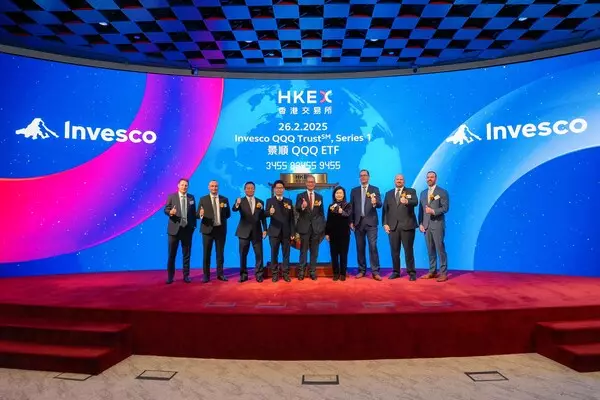
Invesco QQQ ETF approved for sale, cross-lists on Hong Kong Stock Exchange