The year 2025 is widely predicted to mark the start of mass production for commercial humanoid robots, and Chinese manufacturers have increased output and lowered prices to gain a competitive advantage in the industry.
Standing at 1.7 meters tall, weighing 69 kilograms, and capable of walking at 0.8 meters per second, a batch of newly assembled humanoid robots are undergoing motion tests at a manufacturing facility in Shanghai's Lin-gang New Area.
The company, Shanghai Zhiyuan Innovation Technology, or AgiBot, began building its production line last July and completed it in January -- a feat accomplished in just six months.
"These are our flagship model products, which have just rolled off the line after testing. We currently produce 15 humanoid robots daily. Cumulatively we have turned out more than 1,500, or nearly 2,000 robots in total," said Zhong Tao, production manager of the company.
Many core components of humanoid robots are similar to those used in new energy vehicles, enabling the synergy of supply chain resources between the two industries, according to Zhang Shaozheng, manufacturing general manager of the company.
"In terms of industrial chain, we have actually made use much of some related new energy industries, like motors and reducers they often use. It is because of these very mature supply chains that we are able to realize mass production of humanoid robots in such a short period of time," Zhang said.
At another humanoid robot factory in the city, the Shanghai Kepler Robot Company, engineers have optimized designs and processes to reduce production costs of components.
"By renovating the techniques, we have reduced the machining time for a single nut from 20 hours to just two hours. There should be 14 specifications for 28 joint modules. But now, we have optimized the combination and streamlined them to four rotational specifications and four linear specifications to reduce costs through an intensive approach. The overall costs for a joint model has been slashed by 50 percent," said Zhang Minliang, hardware research and development director of the company.
As Chinese manufacturers lead the charge in the mass production of humanoid robots, the home-produced humanoid robots' prices have already fallen from more than one million yuan (about 137.774 U.S. dollars) per unit to less than one million yuan, with further declines anticipated.
"In Europe and the United States, their labor costs are relatively higher, so we will go to overseas markets to compete with global giants. We have actually secured quite a lot of pre-orders in the European and U.S. markets," said Hu Debo, CEO of the company.
"When the production reaches a certain scale, like several thousand or tens of thousands, the cost will be far lower than that of a family car, definitely within 200,000 yuan per robot," said Peng Zhihui, co-founder of the Shanghai Zhiyuan Innovation Technology.
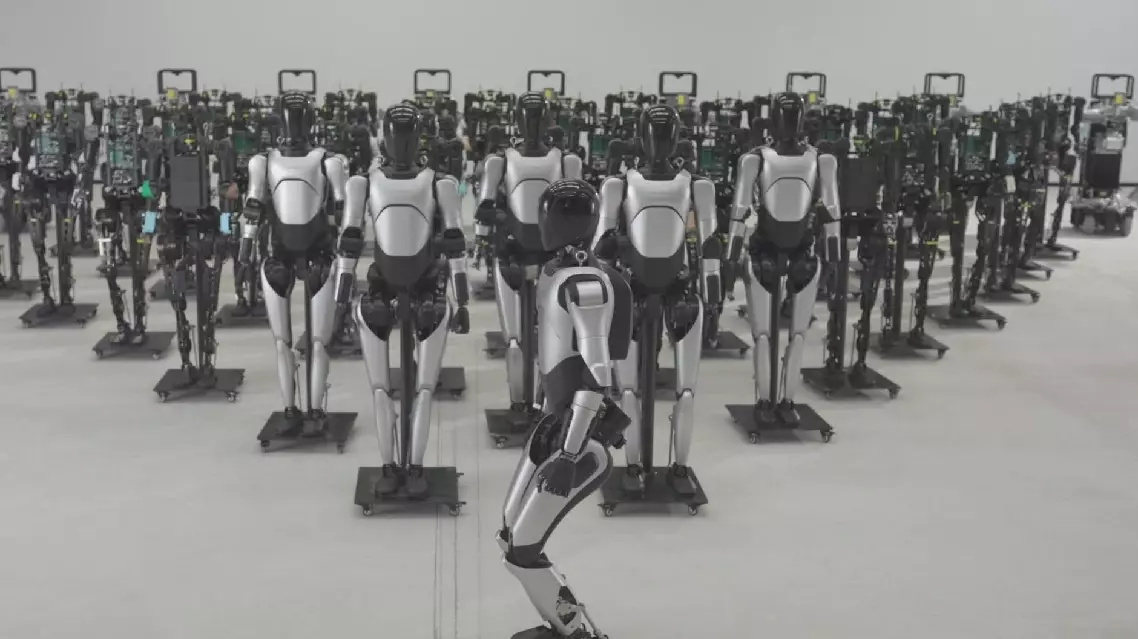
Chinese humanoid robot producers begin commercial production