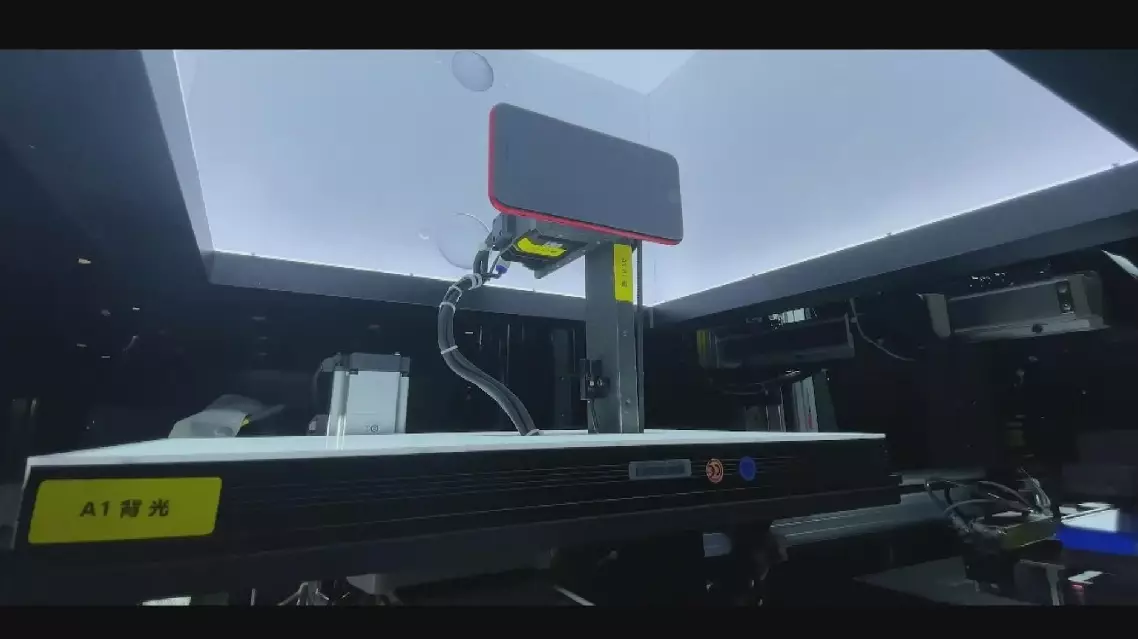
As China's trade-in program is in full swing, the country's recycling industry has been growing.
Data showed that both the amount of recycling and disposal scale have increased significantly. In 2024, the amount of home appliance recycling has risen by 14.83 percent year on year.
"In 2024, China's waste electrical and electronic products recycling market exceeded 150 billion yuan (about 20.59 billion U.S. dollars). The total units of discarded home appliances are expected to surpass 200 million this year," said Zhu Liyang, president of China Association of Circular Economy.
Each year, there are 600 million to 700 million discarded phones in China. Most of them will be disposed by specialist agencies.
They will undergo comprehensive checkup, and those with good quality will then be circulated to secondhand markets.
"Every day, we can dispose over 80,000 telephones. Their service life has been greatly extended," said Yang Yuxi, head of Beijing Branch with a mobile phone recycling company.
Some consumers may worry about the possible leak of their private information via secondhand markets.
But they can rest assured, as not only will their information being wiped with professional software, but their used phones will be physically dismantled by specialized disposal enterprises.
Then, useful parts and materials will then be collected by recycle agencies for reuse, Yang said.
"We will melt down all the electronic chips in each discarded mobile phone and turn them into available resources. In the future, we will form a nationwide mobile phone safe recycling disposal model, and then eventually establish a national safe recycling and terminal resources reuse platform for electrical and electronic products," said Ke Yanchun, general manager of China Resources Recycling Group's Technology Innovation and Digital Intelligence Department.
China's recycling industry flourishes amid trade-in program
The International Monetary Fund (IMF) has lowered its global economic growth forecasts for 2026 to 3.1 percent in the World Economic Outlook (WEO) report published on Tuesday, while keeping its projection for 2027 at 3.2 percent.
This marks a deceleration from the estimated 3.4 percent growth achieved in 2025. Before the outbreak of the Middle East conflict, the bottom-up forecasts for global growth would have been 3.4 percent in 2026 and 3.2 percent in 2027.
The forecast incorporates the impact of the war and assumes that it will be limited in duration, intensity and scope, with disruptions fading by mid-2026.
Under the reference forecast, global headline inflation is expected to increase to 4.4 percent in 2026 and decline to 3.7 percent in 2027.
If the conflict and the ensuing spike in oil prices last longer, global economic growth in 2026 will fall to 2.5 percent, while global inflation will climb to 5.4 percent, according to the report.
In extreme cases, global economic growth in 2026 could drop to two percent, the report warned.
To be specific, the U.S. economy is projected to grow by 2.3 percent in 2026 and 2.1 percent in 2027, although higher trade barriers introduced since April 2025 are expected to continue to weigh on activity.
In the euro area, growth is projected to decline from 1.4 percent in 2025 to 1.1 percent in 2026 before edging up to 1.2 percent in 2027. The forecasts for 2026 and 2027 are each 0.2 percentage point lower than those compared in the January 2026 WEO Update.
The 2026 growth forecast for emerging market and developing economies is revised down by 0.3 percentage point, to 3.9 percent, while the outlook for advanced economies remains broadly unchanged. With risks still tilted to the downside since the January 2026 WEO Update, the IMF suggested a comprehensive policy package combining domestic measures with coordinated international actions to strengthen resilience and foster adaptability.
It also stated in the report that "trade restrictions play a limited role in correcting imbalances but can worsen output," and urged countries to cooperate and take coordinated actions to restore stability to international economic relations.
IMF lowers global growth forecast for 2026 to 3.1 pct