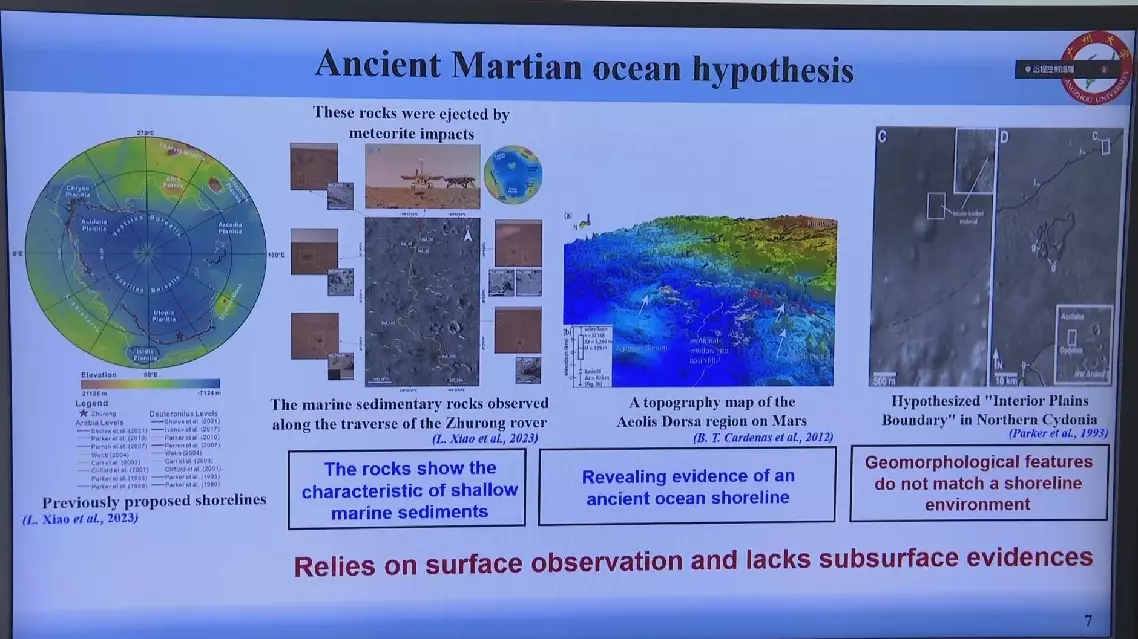
Chinese researchers say they have found evidence suggesting that a massive ocean might have once existed on Mars in ancient times after studying data obtained by China's first Mars rover Zhurong, which landed on the red planet back in May 2021.
During its Mars mission, the ground-breaking rover carried out key geology detection work with a ground-penetrating radar to investigate the underground structure and possible subterranean ice deposit on Mars, with a research group saying the collected data reveals evidence of an ancient ocean on Mars.
Research results have shown that the sedimentary structures of soil ranging from a depth of 10 to 35 meters at the northern hemisphere of Mars shares high similarity to coastal sediments on Earth, showing that oceans once existed in the middle and lower latitude areas of Mars. "This discovery indicates that the region once had a stable and sustained large body of water, rather than a temporary melting event. Liquid water is one of the essential conditions for life, and the finding suggests that Mars may once had an environment suitable for the origin and development of life. In particular, the coastal sediments we found provide strong evidence that the water body existed for an extended period," said Liu Hai, Deputy Dean of the School of Civil Engineering and Transportation, Guangzhou University, who is one of the leading scientists of the research project.
Liu noted that various factors over a long passage of time have resulted in the vanishing of the ocean. Despite excitement around the findings, Liu stressed that proof of living organisms on the planet at any point in its history remains inconclusive.
"There are multiple possible reasons for Mars losing its oceans, including the weakening of its magnetic field, which led to solar wind stripping the Mars atmosphere, and reduced activity in its planetary core. These factors likely contributed together to Mars' transition from a warm, humid environment to a cold, arid planet. Based on current research findings, there is no definitive evidence proving that life once existed on Mars," he said.
The new findings now offer a solid foundation for further geological investigations on Mars, according to Liu, who added that this can now play a big role in future manned missions.
Given the existence of ancient Martian oceans, Liu said some of the water likely moved underground in the form of ice as the planet cooled, which he believes could serve as a key water resource supply for future Mars bases.
Liu said research teams will continue analyzing data obtained by the Zhurong rover to further understand the planet's geological make-up.
"Our next step is to focus on analyzing ground-penetrating radar data of the Mars' subsurface detected by the Zhurong rover. This will provide richer underground scattering information and allow for a more detailed understanding of the geological structure of Mars' subsurface," said Liu.
The Zhurong rover successfully landed in Mars' southern Utopia Planitia May 2021, and had traveled 1,921 meters by May 2022 on the red planet, collecting abundant scientific data.
Chinese researchers find past evidence of "sustained body of water" on Mars
The U.S.-Israeli war against Iran reached its 100-day mark on Sunday, with peace remaining elusive in the Middle East region.
On Feb 28, the United States and Israel launched coordinated military strikes against Iran, hitting multiple locations including the capital Tehran, Isfahan, and Karaj. Iran's then-Supreme Leader Ali Khamenei and several high-ranking officials were killed in the airstrikes.
In retaliation, Iran's Islamic Revolution Guard Corps (IRGC) launched missiles and drones attack at U.S. military bases in the Middle East and Israeli targets on the same day.
According to information released by various sources, over the ensuing weeks, the U.S. military struck over 10,000 Iranian military targets, while the Israeli military hit several thousand Iranian targets. Iran launched 100 waves of retaliatory "Operation True Promise-4" strikes. The conflict spread to more than 10 countries across the Middle East.
After over a month of intense fighting, the United States and Iran announced a temporary ceasefire on April 8. Both sides held their first round of talks in Pakistan on April 11 and 12, but no substantive breakthrough was achieved.
In subsequent negotiations, the two countries engaged in intense discussions over issues including Iran's nuclear program and highly enriched uranium, the lifting of sanctions, the unfreezing of Iranian assets, and the reopening of the Strait of Hormuz. To date, no peace agreement has been reached.
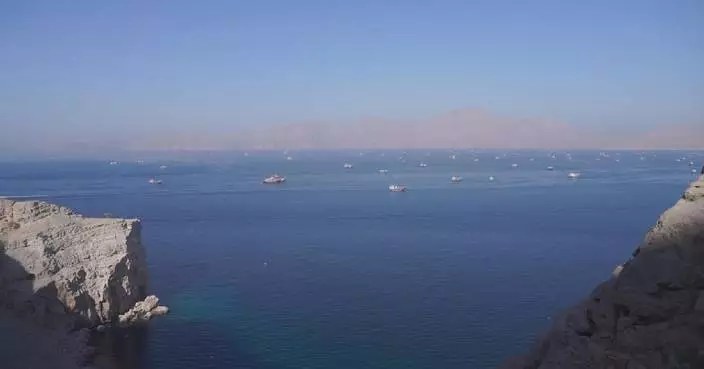
On Feb 28, the IRGC announced a ban on any vessels passing through the Strait of Hormuz, bringing traffic to a halt on one of the world's most critical energy waterways. On May 30, Iran declared full operational and administrative management over shipping in the strait, requiring all commercial vessels, oil tankers, and other civilian ships to navigate designated routes and obtain prior permission from the IRGC Navy.
On the U.S. side, after the first round of U.S.-Iran talks ended without a breakthrough, the U.S. Central Command announced on April 13 that, effective that day, it would impose a blockade on all maritime traffic entering or leaving Iranian ports. The standoff between the United States and Iran over navigation rights in the Strait of Hormuz continues to this day.
As negotiations continue to stall, sporadic military clashes have begun to occur between the United States and Iran since last month, with the frequency of clashes intensifying since late May.
Since May 30, the United States has launched multiple strikes against Iranian targets along the coast of the Strait of Hormuz, while Iran has retaliated by repeatedly hitting U.S. military bases across the Middle East.
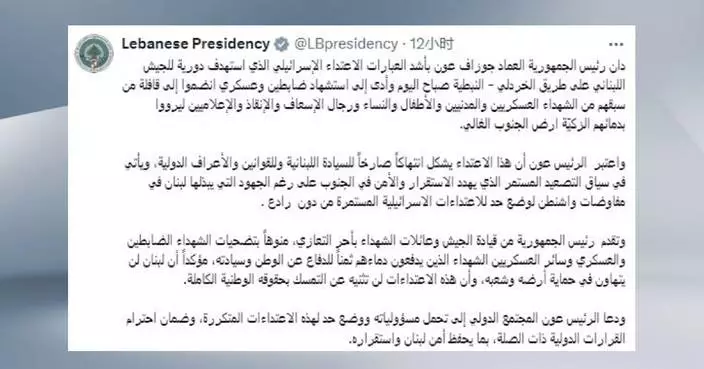
Following the U.S.-Israeli strikes on Feb 28, the Hezbollah group in Lebanon announced on March 2 that it had begun striking Israeli targets, reigniting the Lebanon-Israel conflict. The Israeli military launched airstrikes on multiple locations in Lebanon and carried out a ground invasion, taking control of large swaths of southern Lebanon.
On April 17, Lebanon and Israel, through U.S. mediation, announced a 10-day temporary ceasefire, which was subsequently extended several times. However, the Israeli military has continued operations in Lebanon.
Iran said the ceasefire agreement with the United States also covers Lebanon, and that the United States and Israel will be held accountable for any violations of the ceasefire.

US-Israeli war against Iran reaches 100-day mark