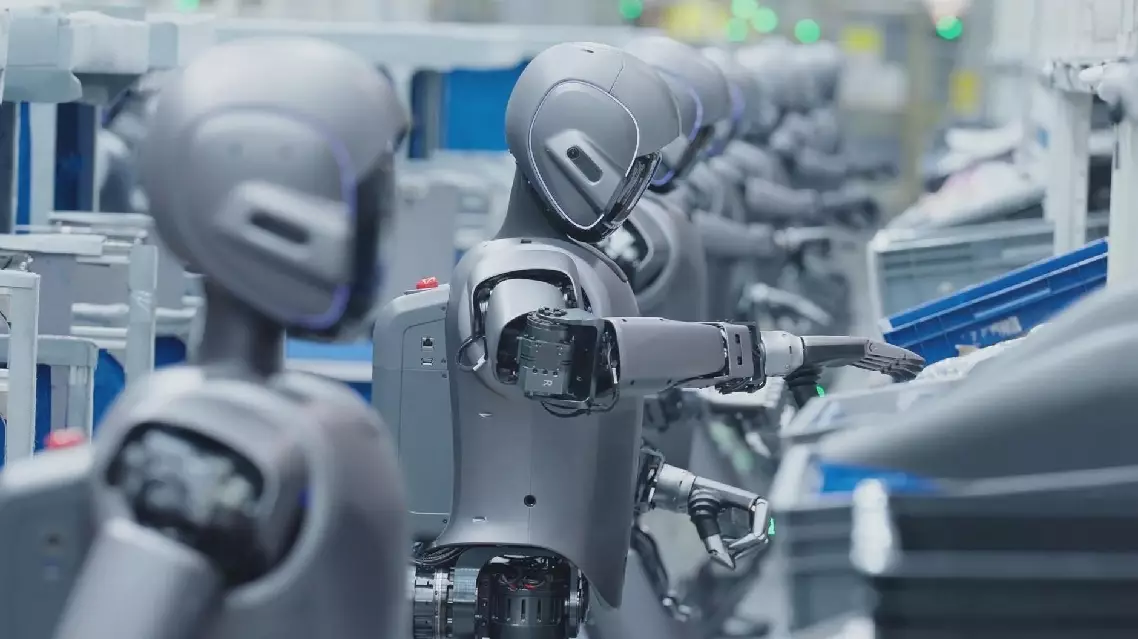
The southern Chinese technology powerhouse of Shenzhen is doubling down on the development of artificial intelligence (AI) and robotics with a 10 billion yuan (around 1.37 billion U.S. dollars) fund aimed at accelerating innovation and maintaining its global dominance in the fast-evolving sector.
The initiative will focus on AI software, hardware, and embodied intelligence, further cementing Shenzhen's reputation as a key robotics hub.
The tech industry in China is going through a period of unprecedented growth and development, with agile humanoid robots becoming increasingly capable of a wide range of application scenarios, while the country's AI industry has been energized by the emergence of a new cost-effective model released by Chinese start-up DeepSeek, which has made global waves since its release earlier this year.
"We're in an era of human-AI coexistence. Breakthroughs in large language models are propelling us toward General Artificial Intelligence," said Michael Tam, chief brand officer of UBTECH Robotics.
The city's thriving ecosystem, home to over 51,000 robot-related enterprises, generated an industrial output of almost 180 billion yuan (around 24.6 billion U.S. dollars) last year, and a key factor behind Shenzhen's robotics success is its highly integrated supply chain.
For businesses based in Bao'an District, 80 percent of robotics components are sourced within a 50-kilometer radius, reducing costs by 30 percent, according to a 2023 white paper on the industrial development of robotics in Shenzhen.
This strong ecosystem allows for rapid prototyping and production, with vendors capable of delivering critical parts, such as sensors, within a week.
"You can see, this is our latest six-axis force and torque sensor. And now we are providing this product for more than 20 industrial robot companies," said Wang Guo'an, CEO of Hypersen Technologies (Shenzhen), as he showed off the latest product.
The government's investment will also help enhance crucial research and development into this rapidly growing sector. Local universities and institutes are fostering talent through policies that encourage young researchers from diverse fields to contribute to robotics projects, helping drive new innovations.
"Robotic science is developing rapidly. So Shenzhen universities and institutes, they encourage the PI (principal investigators) policy, which is very friendly to this subject. They do have attract a large number of the young researchers with the background in robotic projects, as well as different backgrounds, to join the robotic project team," said Tan Weijia, executive secretary general of Shenzhen Robotics Association.
Tech hub Shenzhen looks to cement dominance in AI, robotics sector with 10-bln-yuan fund