China's ecologically critical wetlands received a significant boost during the 14th Five-Year Plan period (2021-2025) and now cover 55.6 million hectares of the country, according to data released by the National Forestry and Grassland Administration.
With a focus on wetland conservation and restoration nationwide, China has implemented more than 1,000 wetland protection projects, restoring about 290,000 hectares of wetlands between 2021 and 2025.
Under its tiered wetland management system, 82 wetlands in China have been designated as of international importance, while 80 wetlands, of national importance, and 1,205 wetlands, of provincial importance.
The total number of international wetland cities in China has risen to 22, the highest in the world.
China is now home to 903 national wetland parks, around 90 percent of which are open to the public free of charge, attracting approximately 320 million visits each year.
Notable progress has also been made under a special action plan for mangrove protection and restoration. By June this year, 9,200 hectares of new mangroves had been planted nationwide, achieving the targets set for the 14th Five-Year Plan ahead of schedule, making China one of the few countries in the world with a net increase in its coastal mangrove forest coverage.
The eradication of invasive smooth cordgrass has also been completed across about 97,333 hectares of wetlands.

China makes notable progress in wetland protection in 2021-2025 period
Researchers from the Center for Excellence in Brain Science and Intelligence Technology (CEBSIT) under the Chinese Academy of Sciences (CAS) have made new progress in invasive brain-computer interface clinical trials, with the second successful case involving a paralyzed patient.
According to the research team, the patient suffered a spinal cord injury in 2022 that resulted in high paraplegia. After more than a year of rehabilitation, only head and neck movement was possible. In June this year, the patient underwent implantation of a BCI system.
Following two to three weeks of training, the patient was able to control electronic devices such as a computer cursor and a tablet. To meet further needs, researchers expanded the application from two-dimensional digital screens to three-dimensional physical devices. An intelligent wheelchair and a robotic dog became new control targets.
This shift required the system to not only decode simple intentions such as "left" or "right," but also to deliver continuous, stable, and low-latency precise control to cope with complex real-world environments and interactive tasks.
According to an expert, as the patient became more proficient, the level of mental concentration required was significantly reduced.
"The experience is very close to how we normally control our own bodies. Once you are very skilled, it doesn't require much mental effort -- just like being able to chat while driving," said Zhao Zhengtuo, researcher from CEBSIT.
To achieve this, the team made multiple technical breakthroughs.
At the data source level, they developed high-compression, high-fidelity neural data compression technology and innovatively combined different compression methods. This allows effective information to be extracted efficiently even in noisy neural signal environments, improving overall brain-control performance by 15 to 20 percent.
The team also replaced traditional calibration methods with an "online recalibration" technology that silently and continuously fine-tunes decoding parameters in real time to maintain high system performance. Control speed has also been significantly improved, with intentions and actions now almost synchronized.
Notably, the research team has partnered with a local federation for persons with disabilities to enable the patient who can control a computer via the BCI to participate in online data annotation work, such as verifying the accuracy of AI recognition in vending machines. This makes the patient China's first paraplegic to earn income through labor using a brain-computer interface.
Researchers revealed that a third patient has now had a BCI implanted for nearly two months. Future applications will focus on more refined movements.
"[The next step is] to use the intention of finger movements to control robotic fingers to interact with the external world," said Poo Mu-ming, scientific director of CEBSIT, and also a CAS academician.
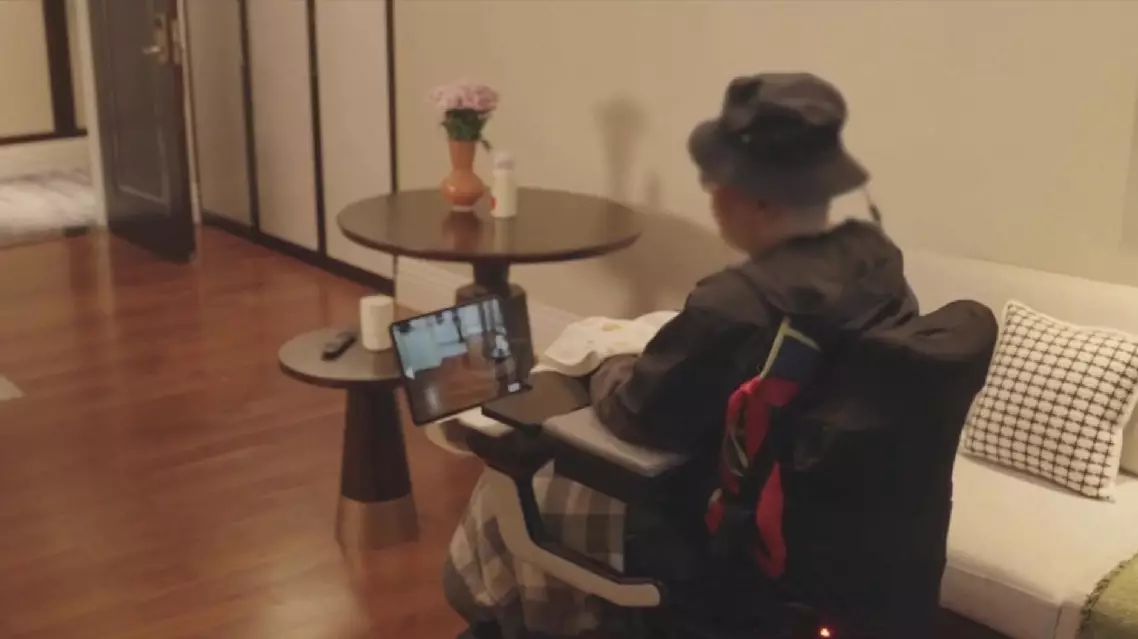
Chinese researchers complete 2nd successful case in invasive brain-computer interface trial in Shanghai