Skip to Content Facebook Feature Image

Hangzhou fosters growth of China's innovative-driven firms

China

China

China

Hangzhou fosters growth of China's innovative-driven firms

2025-03-05 19:33 Last Updated At:03-06 00:57

Hangzhou, a thriving tech city in eastern China, is rapidly becoming an innovation hub, with the concept of the 'Six Little Dragons' emerging as a symbol of the country's most forward-thinking startups.

Led by the entrepreneurial vision of DeepSeek, these six companies have garnered widespread public attention both locally and internationally, all of which are headquartered in Hangzhou, the capital of the economic powerhouse province of Zhejiang.

In 2011, Huang Xiaohuang started his software business Manycore in Silicon Valley in the United States. But in the same year, he decided to move back to China.

Huang said that he had been in touch with several cities before moving back, but he finally chose Hangzhou.

"The local government has really been supportive for startups. Like Shangcheng district, they gave us 1.5 million yuan in funding and they didn’t even ask for any return like shares," said the founder of Manycore.

Developing a successful startup requires a team of professionals. Manycore, now boasting a workforce of over 1,000 employees, comprises 45 percent research staff, many of whom are overseas returnees.

Wang Renhan, a renowned research algorithm expert of SpatialVerse and Manycore, is a prime example, having chosen to make Hangzhou his second home.

"There are a lot of opportunities in Hangzhou, especially in high technology and research aspects. I have been living in different places around the world, but Hangzhou is a great place that has nice weather all year long," said Wang.

Harris Tong, a property consultant, is from Hong Kong, but he has been living in Hangzhou for over two decades.

He has not only been helping companies to find office locations in the city, but sometimes has also facilitated contact between companies and the local government.

"What sets the Hangzhou government apart is their thoughtful services and efficient processes that go to create an excellent business environment. The government also actively encourages young innovators and are willing to bear the trial-and-error costs," said Tong, general manager, of the Zhejiang Region of Cushman and Wakefield.

Manycore is the largest software provider in China's spatial design industry by revenue. It has clients in over 200 countries and regions. With the idea of "six little dragons" now famous, Manycore is receiving more job applications.

"Some graduate students from Harvard, Stanford, MIT, they are also submitting their resumes to our company. That’s really amazing," said Huang.

Financial support, a favorable business environment, and a nice living environment - Manycore's story explains why Hangzhou incubates so many high-tech firms.

Hangzhou has developed itself as an important hub in the internet and tech industries, driving advancements in e-commerce, AI and digital transformation.

Hangzhou fosters growth of China's innovative-driven firms

Hangzhou fosters growth of China's innovative-driven firms
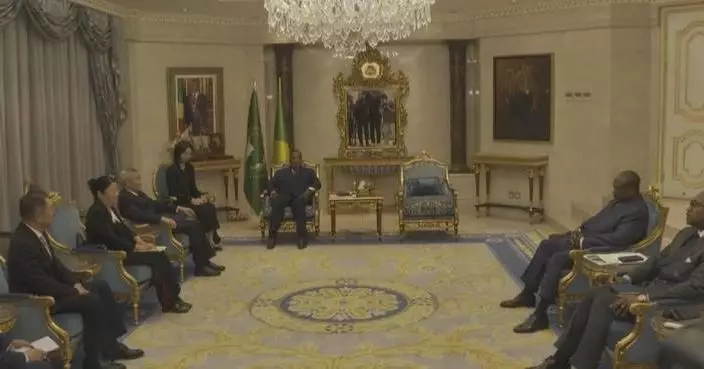
The Navy of Iran's Islamic Revolution Guards Corps (IRGC) said that the Strait of Hormuz has been blocked since Saturday evening and will not reopen until the United States lifts its naval blockade on the waterway.

In a statement carried by its official news outlet Sepah News, the IGRC said that the move came after the United States violated its commitments under the two-week ceasefire, which took effect on April 8, and failed to end its naval blockade against Iranian vessels and ports.

The IRGC Navy called on all vessels and their owners to follow official updates via its channel and VHF Channel 16, the international maritime distress, safety, and calling frequency. The statements by U.S. President Donald Trump hold no credibility in the strait and the Gulf, it added.

The IRGC warned that no vessel should move from its anchorage in the Gulf or the Gulf of Oman, and any approach to the strait would be deemed "cooperation with the enemy" and targeted accordingly.

Tehran's political leadership echoed the IRGC's firm position. Parliament Speaker Mohammad Bagher Ghalibaf asserted that the Strait of Hormuz is under Iran's control, revealing that during previous negotiations, Iran had firmly countered U.S. attempts to carry out minesweeping operations, which Tehran viewed as a ceasefire violation.

He said the situation had come close to conflict, but the U.S. had eventually backed off.

Calling the U.S. maritime blockade "reckless and ignorant," Ghalibaf warned that passage through the strait would certainly be restricted if Washington does not lift the blockade.

Underpinning these public announcements, Iran's Supreme National Security Council on Saturday affirmed the country's resolve to exercise control and supervision over traffic through the Strait of Hormuz until the war is definitively ended and lasting peace is achieved in the region.

For its part, the United States pressed ahead with its own military measures.

The U.S. Central Command (CENTCOM) said in a statement on Saturday that the U.S. military is imposing a maritime blockade on ships entering and exiting Iranian ports and nearby coastal areas. Since the blockade began on April 13, 23 ships have complied with U.S. directions to turn around.

Meanwhile, the U.S. military is preparing in the coming days to board Iran-linked oil tankers and seize commercial ships in international waters, The Wall Street Journal reported on Saturday, citing U.S. officials.

The move will enable the U.S. to take control of Iran-linked vessels around the world, including ships carrying Iranian oil that are already sailing outside the Persian Gulf and those carrying arms that could support Tehran, the report said.

Iran's IRGC says Strait of Hormuz blocked, demands end to US naval blockade

Iran's IRGC says Strait of Hormuz blocked, demands end to US naval blockade

Recommended Articles