Jeffrey Sachs, a renowned American economist and professor at Columbia University, has expressed confidence in China's economic outlook despite U.S. tariffs, emphasizing that the fundamentals of China's economy remain strong, driven by its technological advancements and skilled workforce.
As China's annual "two sessions", referring to the third session of the 14th National People's Congress (NPC) and the third session of the 14th National Committee of the Chinese People's Political Consultative Conference (CPPCC), unfold in Beijing, global analysts are closely watching for new policies and measures to help navigate the complex challenges facing the world's second-largest economy.
In a recent interview with China Global Television Network (CGTN), Sachs shared his insights on China's economic outlook.
"On the whole, I think the Chinese economy is strong, and it's strong because of its underlying technological base, the skill of the workforce, and its global reach. So, while all large and complex economies have their relative ups and downs, even their business cycles, we should understand that China's economy is strong, continuing to advance rapidly based on cutting-edge technologies and being the world's major trading partner for most of the countries of the world. So, in this sense, I think the fundamentals are strong," said Sachs.
Sachs' remarks came at a time when U.S. President Donald Trump has signed an executive order to raise tariffs on all Chinese imports from 10 percent to 20 percent. Some experts have warned that this could pose significant challenges to China's economy.
However, Sachs remains optimistic, pointing out that China has been diversifying its trade partnerships in recent years, reducing its reliance on the U.S. market.
"There are weaknesses, and that is pressure on the Chinese economy that has come from the protectionism of the United States. The U.S. already ten years ago started to make steps to try to impede China's economic growth. This has had some effect. This means that China has to find other markets, other than the U.S. to rely on in part for its expanding exports in the world. And this is part of the challenge in 2025. Am I optimistic? Yes. China can do this and I believe it will do this," he said.
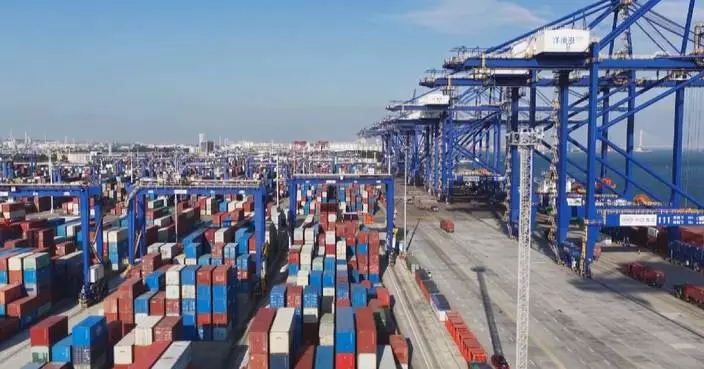
In fact, official data indicates that China's trade with Belt and Road Initiative (BRI) partner countries has been booming. In 2024, the total trade in goods between China and its BRI partner countries reached 22.1 trillion yuan (about 3.04 trillion U.S. dollars), marking a 6.4 percent increase from the previous year. For the first time, BRI countries accounted for more than half of China's total foreign trade value.
Similarly, trade between China and ASEAN countries saw a year-on-year growth of 9 percent in 2024, with the two regions continuing their status as each other's largest trading partners for the fifth consecutive year.
Beyond trade, Sachs highlighted China's leadership in technological innovation as a key driver of its long-term economic growth.
He pointed to the nation's strides in areas such as 5G technology, solar energy, modular nuclear reactors, and electric vehicles, noting that these innovations not only contribute to China's economic strength but also bolster its competitive advantage on the global stage.
"These are the sources of China's medium-to-long-term growth. China is a world leader in zero carbon energy. It's a world leader in long-distance power transmission. It's a leader in batteries and electric vehicles. It's a leader in 5G. It's a leader in fourth-generation nuclear power. China needs these, the world needs these. Being in the forefront of these technologies is a good thing. It is China's competitive advantage," said Sachs.

US economist upbeat about China's economic outlook despite US tariffs