China's hosting of the 2030 International Congress of Mathematicians (ICM 2030), the world's largest mathematics conference, will help encourage more young students across the country devote themselves to the mathematics field, according to Shing-Tung Yau, a former prize winner at the prestigious event
Yau, who won the event's coveted Fields medal back in 1982, is now helping lead China's bid to host the ICM in 2030, aiming to inspire young students to take the lead in global math research.
In an interview with the China Global Television Network (CGTN), Yau, who is also a professor at China's acclaimed Tsinghua University, said that he has seen the country's efforts in cultivating talent paying off, as there has been a rise in world-class math students from China.
"China has trained their students far better now than before. We have almost, I would say, the world's best high school students and undergraduate students in mathematics. And they are able to study within China themselves. So a major event like ICM happening in China, especially in Beijing city, it will be great encouragement for them to develop their own way to learn how mathematicians should behave in China," he said.
China faces competition from both Japan and the UK who are also bidding to host the grand event. However, Yau is quite confident that his team will win the right to host the ICM competition.
With China seeking to pull out all the stops on developing homegrown talent, Yau also noted that many Chinese students have a passion for math, while the country has been investing more in basic science.
"We have about, each year, 3,000 young talents, I mentioned, these 12-year-old students all over the country. There are 3,000 young students of that age who show strong interest to come into mathematics. So after five years we are talking a large number of good students. So these are one of the major differences between us and England or Japan. And beyond that, the country is getting richer in investing into basic science," he said.

China hosting ICM 2030 would inspire world-class math students: renowned mathematician
Scientists in Peru and Chile are racing to reverse the sharp decline of Humboldt Penguins, a warm-climate species uniquely adapted to the Pacific coast, as climate change and avian influenza threaten its survival.
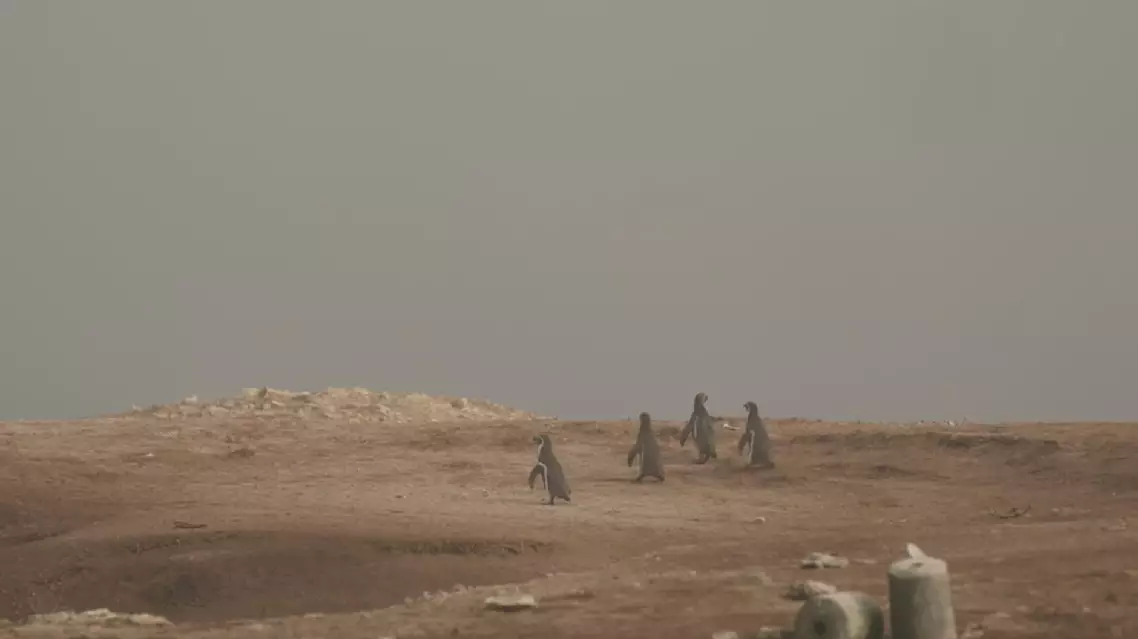
Peru and Chile are home to the Humboldt penguin, named after the cold water current which flows from Antarctica up the Pacific coast of both countries. It is one of the very few penguin species in the world that lives in a warm climate. Scientists call them a sentinel species -- thermometers of the overall health of the ecosystem.
The penguins nest in Punta San Juan, a small national reserve in southern Peru. They are one species among many marine predators that rest and reproduce here in huge numbers. Biologist Susana Cardenas leads a team that is monitoring and researching these animals and birds. What the researchers have seen in recent years is a dramatic population decline in all species, but particularly penguins, and they are trying to find out why.
"In the last few years, we've seen a decline in the Humboldt penguin population. So, we can go back to 2022 in Punta San Juan, there were about 2,500 Penguins -- that was the size of our colony. And then, well, we had avian influenza that has hit wildlife really hard in Peru and in different places of the world," said Cardenas.
But the impacts didn't stop there for the penguins, which are classed as having vulnerable conservation status, Cardenas explained.
"After that, unfortunately, an El Nino in March of 2023 started and the marine conditions changed and the food availability was not the same. And the penguins, they were getting ready for their breeding season and that's when the marine conditions changed and they did not come back to breed," she said.
In Punta San Juan, penguin numbers dropped from 2,500 to 400 just as Peru's population plummeted from 15,600 to 5,000 all across the birds' range in Peru and Chile, according to Cardenas. That's why continuous data collection is key to maintain the decades of research.
Interns like Sandra Alcantara keep a daily count of the number of nesting penguins and chicks.
"I come here at 6 a.m. to conduct a penguin census. I count all the penguins in a specific age group: adults, juveniles, fledglings, and chicks. Right now, we're in the breeding season, so most of them are adults. So far, I've only seen two juveniles. As the weeks go by, I'll be able to see chicks and then, later on, fledglings," said Alcantara.
The penguins naturally make burrows in the guano, sea bird droppings which build up over decades. Field coordinator Kevin Farfan checks to see if there are any birds in the burrows.
"We are now observing in real time a gradual increase in the number of adult individuals resulting from successful reproduction -- a rise that is slow but steady -- and that gives us great cause for celebration," he said.
These animal populations, while apparently abundant in Punta San Juan, are also highly sensitive to change. Without the tireless dedication of these scientists and volunteers, Peru and the world could lose one of its iconic birds.
Researchers work to reverse population decline of Humboldt penguins