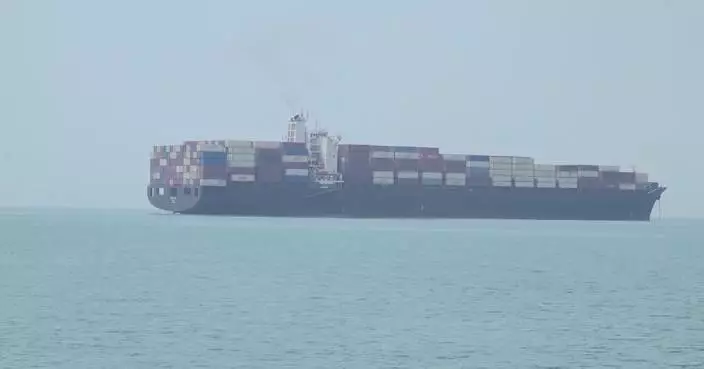
U.S. tariff hikes are expected to have a delayed but significant impact on logistics services in Canada after the country's manufacturing industry takes an immediate hit, according to a shipping industry professional.
After a one-month deferment, U.S. President Donald Trump's order to impose a 25-percent tariff on goods imported from Mexico and Canada went into effect on Tuesday, March 4.
In an interview with China Global Television Network (CGTN), Cole Zhang, general manager of TC International Logistics in Vancouver, Canada, said that the industry is making preparations to deal with the impacts of the tariffs, even though businesses in this sector may not be hit as quickly as others.
"We are a logistics company focused on the freight forwarding businesses. So the hike of the tariffs from the U.S. to Canada, it actually may not affect us right away. It will have a delayed effect, and it will affect the manufacturing companies first in Canada. From what we are going to predict, there are going to be effects on the logistics business in three areas. The first area is the ground transportation trucking companies within the USA and Canada, which focus on moving the cargo between the USA and Canada, and they rely on the higher volume of trade of the exchange of goods between the USA and Canada every day. So this sector is going to be affected the most and the first," Zhang said.
He highlighted that beyond tariffs, new U.S. policies directly target small shipments between the two countries.
"There's also an executive order signed by Donald Trump about suspending the minimum exemption for packages and cargo that's less than 800 dollars in value. This actually has also a very significant effect on shipments that are being shipped in small packages across the borders between the USA and Canada. And actually a lot of the small businesses in Canada, and the U.S. as well, rely on this method to enjoy tax-free small package shipping. And this is also actually made out a big part of logistics right now in this area," said the company manager.
Zhang noted that Trump administration policies may impact overall travel between the two countries, which could in turn affect the shipping industry.
"Travel between the USA and Canada is expected to reduce, because more and more Canadians realize that they need to focus on their own services, their own businesses. So the reduction of the travelers to the U.S. will reduce the number of flights between the USA and Canada and thus this will reduce the capacity for air freight businesses in the logistics business," he said.
To mitigate the impact of U.S. tariff hikes, Zhang noted that Canadian businesses may turn to alternative sources for imports, particularly in industries such as automotive and electronics.
"We expect our customers in Canada to choose to import goods from other countries to replace their suppliers from the USA. For example, for the auto industry and other electronic industries, weeks back, Canadian companies (planned) to import more from Japan, Korea, southeast Asian countries. And for us, we need to develop more trade lanes and reduce our reliance on businesses within North America. The second thing is that we also need to increase our cooperation with our customers in Mexico, because this is also a country we work with. They also import a lot from other Asian countries. So we need to try to reduce our rely, as I said, with USA, but focus more with Canada and Mexico," said Zhang.

US tariffs to have delayed impact on Canadian shipping sector: industry insider