Skip to Content Facebook Feature Image

Asia's business aviation sector on rise

China

China

China

Asia's business aviation sector on rise

2025-03-08 21:15 Last Updated At:21:37

Asia's business aviation sector is rapidly expanding, driven by a rising population of ultra-high-net-worth individuals and increased corporate demand for private and flexible air connectivity across the region.

This increasing demand is expected to unlock significant opportunities for growth and innovation.

At the inaugural Business Aviation Asia Forum and Expo in Singapore, industry leaders gathered to discuss the sector's potential and evolving trends.

Paul Desgrosseilliers, general manager of ExecuJet Haite, who has spent two decades in China's business aviation industry, shared his insights on the market over the years.

"It's all about where the investment opportunities are at any given time, you know, GDP being highly correlated to where the business aviation is growing. Where there's high levels of growth, there's usually high levels of growth in our industry as well," said Desgrosseilliers.

In recent years, Southeast Asia has become the growth hub. The latest report shows the region has 273 business jets in total. Countries like Vietnam, which didn't have any aircraft in 2020, now have nine business jets. Singapore has a fleet size of 83 after a net increase of 11 in 2024.

"Some of this is a Chinese story. Some of it is Chinese companies expanding their reach. They're investing in Indonesia, investing in Malaysia, and investing in Thailand, you know, and they have to utilize business aviation to get to these sites, but eventually, the aircraft are coming back into China. You know, the home headquarters is more likely than not in Beijing or in Shenzhen. So the traffic, you know, is flowing all over the region," said Desgrosseilliers.

This cross-border expansion is reflected in the numbers: flights between China and Vietnam saw a 30-percent year-on-year increase in 2023-2024, with flights to Indonesia growing by 25 percent.

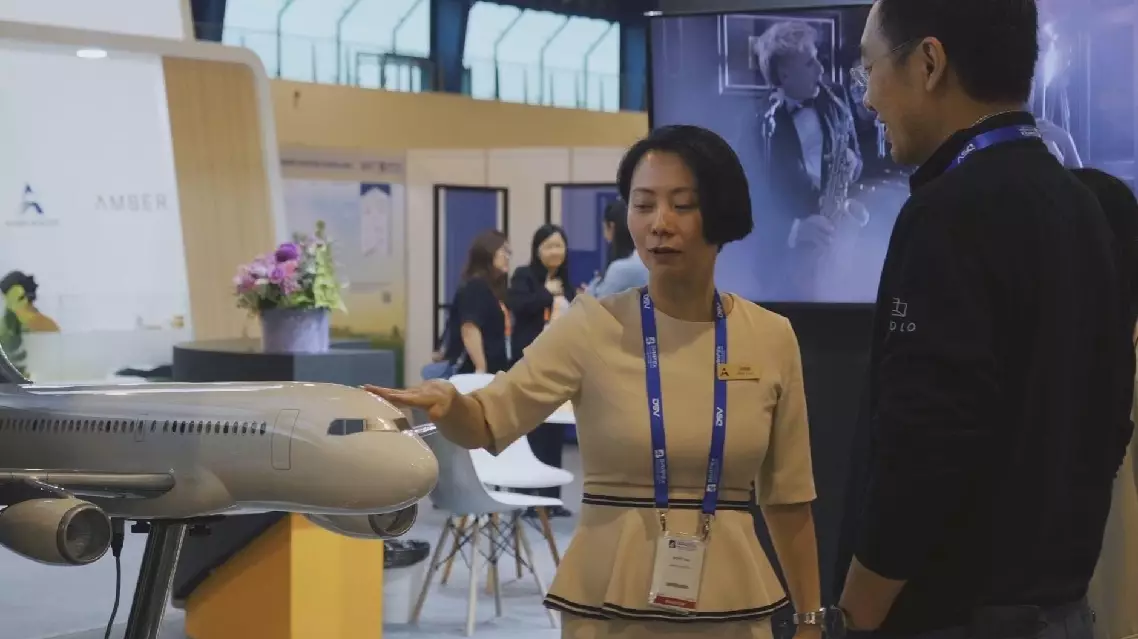
To meet the rising demand, innovative solutions are emerging. Amber Aviation launched its fractional lease program in April 2022 in China and is now expanding into Southeast Asia.

"We started doing the fractional lease program out of China in 2022, April. That was our kind of the when we launched the fractional lease program, and now we're trying to grow beyond China and go into Southeast Asia to capture more of this market," said Jeff Chiang, director of sales and business development of Amber Aviation.

Despite the progress, industry insiders note that Asia's business aviation sector is still catching up. The Asia-Pacific region had around 1,200 business jets by the end of 2022, compared with the United States' fleet of 15,000 to 20,000 jets.
Asia's business aviation sector on rise


Asia's business aviation sector on rise

The recent 2026 Zhongguancun Forum (ZGC Forum) Annual Conference in Beijing has impressed international guests with its focus on deeper integration of technological and industrial innovation, highlighting how China's innovative advances are reshaping daily life.

The five-day forum, themed "Full Integration Between Technological and Industrial Innovation," wrapped up in Chinese capital on Sunday after bringing together more than 1,000 participants from over 100 countries and regions around the world.

More than 560 cutting-edge achievements were unveiled at the event, ranging from embodied intelligent robots and brain-computer interfaces to breakthroughs in quantum applications and 6G research and development.

The venue for the forum also showcased a number of these innovative creations to visitors, who were able to enjoy a fresh cup of coffee prepared by a humanoid barista, as well as be throughly entertained by robots performing dances or even playing piano.

Given the presence of these advanced humanoid robots, international participants shared the common view that innovation is no longer confined to laboratories but is now permeating every aspect of daily life.

"The deepest impression is actually to see how much AI is across everywhere," said Anders Karlsson, vice president of Elsevier, a global leader providing advanced information and decision support to accelerate progress in science and healthcare worldwide.

"The Zhongguancun Forum has become a very international window on innovation. We can find out annually how innovation is driving [and a key] component of growth of this wonderful country," said Vincenzo Lipardi, president and co-founder of SPICI, an Italian company assisting businesses and startups with strategic consulting services.

"As a scientist and as a worker of the United Nations system, I'm really pleased to see integration of science, technology and sustainability," said Shahbaz Khan, director of the UNESCO Regional Office for East Asia.

One of the forum's key themes was around opening up and striving for greater cooperation, which demonstrated to the wider world that China's innovation aims to break down barriers and share opportunities, so as to enable the global community to advance together.

"It's my first time attending the forum. And I'm very surprised that you have a very high level of innovation. China is open to ideas. Openness is the way to make innovations," said Prof. Hussein Sherief, a member of the International Committee for Scientific and Technical Data (CODATA).

Int'l guests hail integration of technology, innovation at Beijing forum

Int'l guests hail integration of technology, innovation at Beijing forum

Recommended Articles