Germany's conservative bloc, the Christian Democratic Union (CDU) and the Christian Social Union (CSU) and the Social Democratic Party (SPD) on Saturday announced their intention to enter formal coalition negotiations, following the conclusion of exploratory talks.
The talks, which lasted for over a week after the federal election on Feb 23, produced a paper outlining the basis for the two parties to form a coalition government.
CDU leader and likely the next Chancellor Friedrich Merz Saturday told a press conference that agreements had been reached in a number of key policy areas including migration, finance, and economic issues.
Regarding migration, the parties agreed on the possibility of rejecting asylum seekers at land borders, as well as strengthened border controls.
They also agreed to reform the social benefits system for the unemployed.
According to the announcements, the two parties would also focus on reducing energy costs to boost the country's economy.
Earlier this week, the CDU/CSU and the SPD announced an agreement on a 500 billion euro (542 billion U.S. dollars) package to provide infrastructure investments, as well as a plan to exempt defense spending from constitutionally enshrined debt brake.
In the German federal parliamentary election, the CDU/CSU took the lead in votes, the far-right Alternative for Germany (AfD) came in second, and the SPD ranked third.
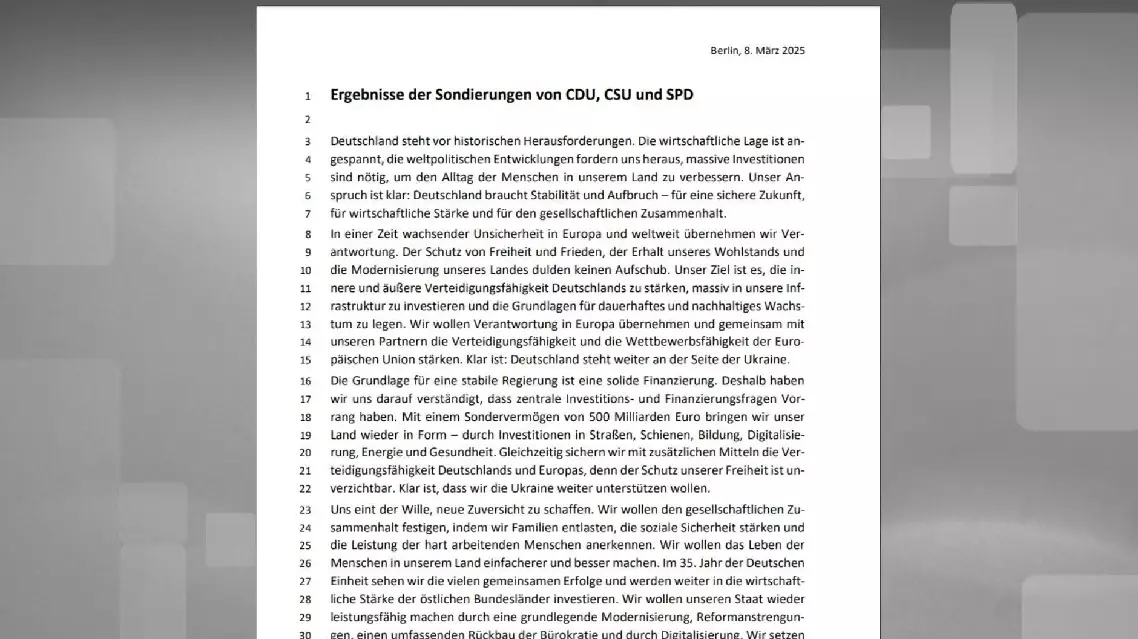
Germany's CDU/CSU, SPD agree to begin coalition negotiations
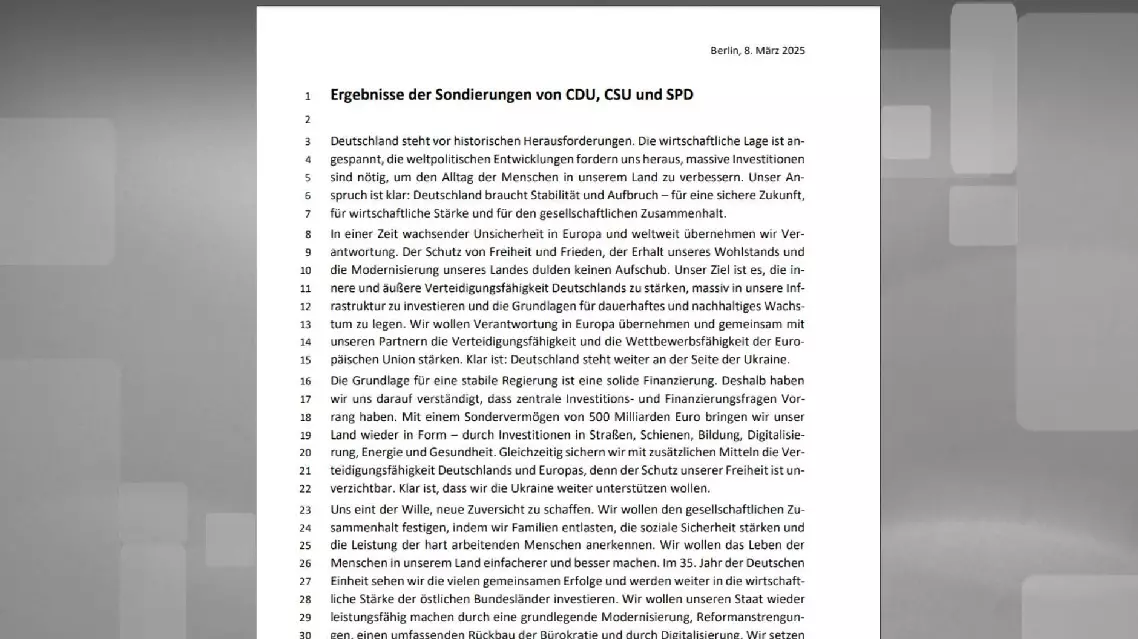
Germany's CDU/CSU, SPD agree to begin coalition negotiations
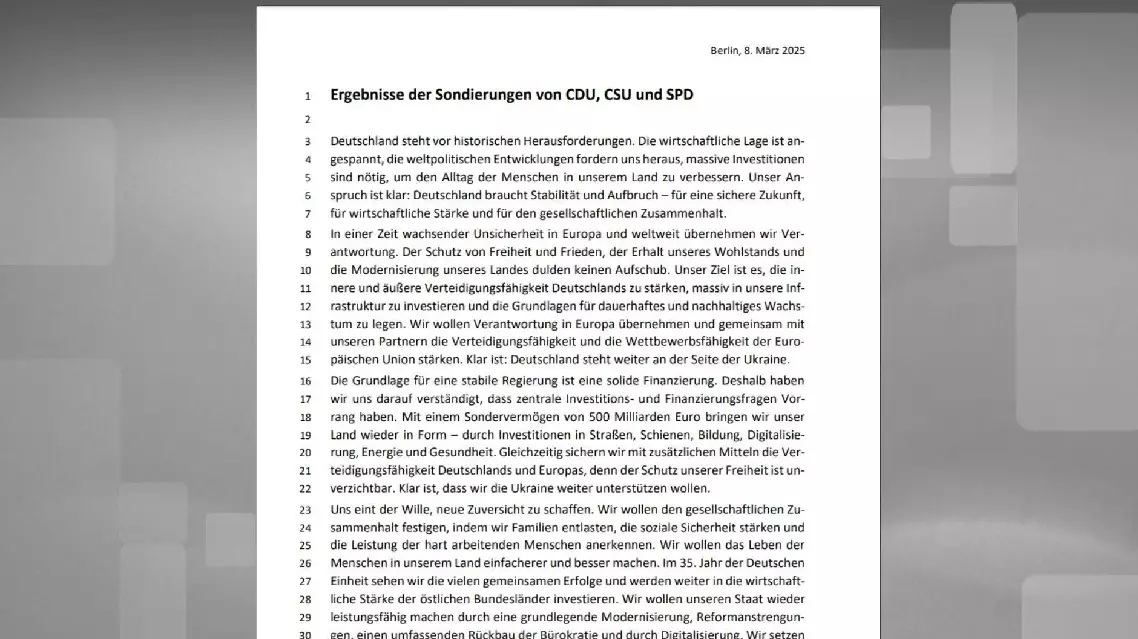
Germany's CDU/CSU, SPD agree to begin coalition negotiations
China's first two-tonne-class tethered balloon entered trial operation in a major power transmission project on Monday, providing a brand-new solution for transportation in power grid construction projects in high-altitude and ecologically sensitive areas, according to the State Grid.
The project is a massive ultra-high voltage (UHV) power transmission line that will carry clean energy from Xizang Autonomous Region in southwest China across thousands of kilometers to the Guangdong-Hong Kong-Macao Greater Bay Area in south China.
At the construction site, a large balloon with a diameter of 25 meters and a volume of 8,000 cubic meters slowly rose into the air.
As multiple mooring lines were simultaneously extended and retracted, the heavy construction materials suspended beneath the balloon were lifted off the ground and moved smoothly along a predetermined route toward the mountainous work site.
"This is our newly developed load-bearing tethered balloon. We have just completed a maximum load test of two tonnes at an altitude of 4,000 meters. Next, we will conduct a hoisting operation for power supply materials over a straight-line distance of 500 meters and a vertical drop of 120 meters," said Qin Jian, researcher at the Transmission and Transformation Engineering Technology Research Institute of the State Grid Electric Power Engineering Research Institute.
A heavy-lift tethered balloon involves launching a helium-filled balloon into the air and connecting it to the ground with one or several cables.
By adjusting the cable, the balloon's altitude and horizontal position are controlled to facilitate the transport of materials at high altitudes.
The balloon can travel up to 800 meters and carry a maximum load of two tonnes, with a positional accuracy of within 0.5 meters.
As the construction of new power grids is extending more rapidly into high-altitude, remote mountainous and ecologically sensitive areas, the transportation of materials for transmission projects has become a major challenge constraining construction progress.
Traditional road construction for transportation have long cycles and significant ecological disruption, while drones, though agile and flexible, face limitations in scenarios requiring heavy loads or prolonged continuous transport.
Tethered balloon transport technology effectively overcomes these difficulties.
"The construction section where this technology is applied is located in an uninhabited mountainous area at an altitude of over 4,000 meters. Many tower sites are situated on steep ridges inaccessible by road, making this the section with the highest altitude, most treacherous terrain and most challenging operations in the entire project. The two-tonne tethered balloon is better suited to high-altitude conditions characterized by thin air and strong winds, and its load capacity and stability can better meet transportation requirements," said Feng Tao, project manager of the State Grid Henan Power Transmission and Transformation Company.
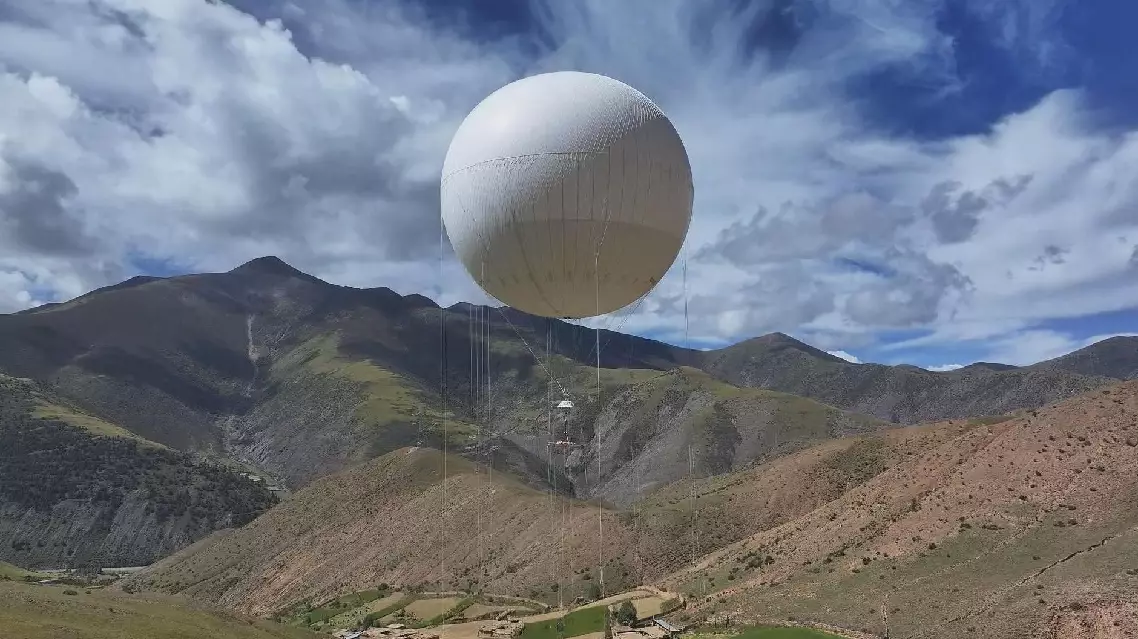
China puts first 2-tonne tethered balloon into operation