Dongshan County in east China's Fujian Province is developing a low-altitude economy by using drones in various scenarios to improve management efficiency and reduce costs.
Low-altitude economy refers to the economic activities and industries centered around manned and unmanned aerial vehicles operating in the airspace usually within 1,000 meters above the ground.
At a forest farm in Dongshan, 36 fully automated droneports have been newly set up, enabling high-precision camera drones equipped with artificial intelligence (AI) edge computing technology to patrol the forest.
"The AI chip acts like a brain [for such a drone], enabling real-time monitoring of the entire forest area. If it detects potential fire hazards, it can quickly identify them and directly upload the results to the cloud," said Zhu Shengli, a co-founder of the I-KINGTEC Company, the tech-provider of the drones.
With the help of these industrial drones, the efficiency of the patrolling is significantly improved.
"It would take us at least half a day if we patrol the forest on foot, but a drone can finish patrolling in just half an hour," said Yang Xiaoxuan, a staff member of the Forest Protection Station of the Dongshan County Bureau of Natural Resources.
Forest patrolling is just one of the drone applications in Dongshan. With the support of AI-enhanced drones, the county has developed an intelligent aerial network that can be applied across various sectors. Fishermen can use this network to more accurately identify fish locations, while power grid workers can use it for electricity network planning.
"We can use the drone as if we have someone on-site. It can help design the power supply points to be connected to the grid and plan the routes for power lines, reducing construction time by about 35 percent," said Lin Huichen, director of the UAV Demonstration Project of State Grid Dongshan County.
The drones are also benefiting local tourism industry. Visitors to the county can rent a drone to have their photos and videos taken for their trips.
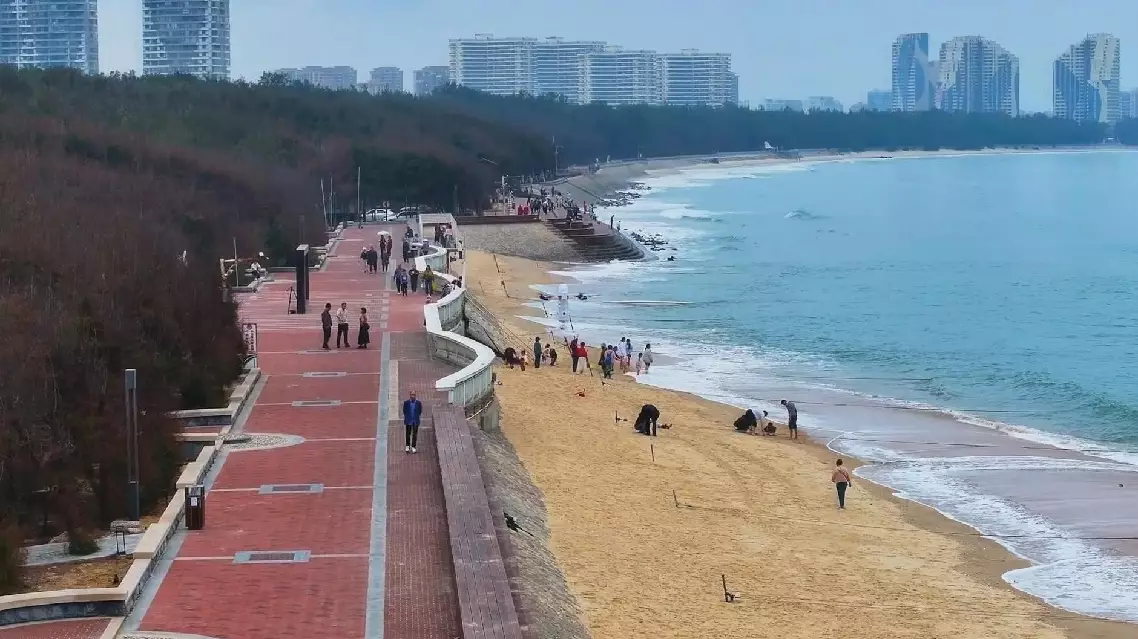
The drones flying over the scenic spots not only provide photography services for tourists but also record data that can be used in the urban planning of the county.
"Here we can see clearly continuous changes we are making in developing the nighttime economy in Nanmen Bay. We have added many new shops and economic entities. With the optimization of the entire system, we will provide warmer and more customized services for both residents and visitors in the area," said Chen Bin, deputy secretary of the Dongshan County Committee of the Communist Party of China (CPC).
"We are using drones to work as forest rangers, inspectors, traffic police officers, and city management officers in the air. In fact, the creation of these roles has helped reduce costs and improve efficiency in the governance of our county," said Zhu.
China's low-altitude economy is taking off with an impressive speed. The Civil Aviation Administration of China estimates that the country's low-altitude market will soar from 500 billion yuan (about 69.12 billion U.S. dollars) in 2023 to 1.5 trillion yuan in 2025 and further up to 3.5 trillion yuan in 2035.
Low-altitude economy boosts high-efficiency management in east China county