As the automotive industry experiences unprecedented transformation, the integration of intelligent and interconnected technologies is reshaping vehicle testing in China.
With the rapid growth of market demand, a wave of innovations driven by artificial intelligence is propelling the sector into a new era. This year, more than 20 automotive manufacturers have announced collaborations with DeepSeek, culminating in a significant emphasis from the government on the importance of developing intelligent connected new energy vehicles.
Data from the China Association of Automobile Manufacturers revealed that total auto output reached more than 2.1 million units last month, up 39.6 percent year on year, while sales climbed 34.4 percent year on year to nearly 2.13 million units. It's also highlighted the continued strong performance of new energy vehicles, with sales surging 87.1 percent year on year to 892,000 units in February, accounting for 41.9 percent of total new vehicle sales last month. This burgeoning demand underscores the necessity for more efficient vehicle inspections to ensure safety and reliability. At the forefront of these developments is the China Automotive Engineering Research Institute (CAERI) in Chongqing, a vital hub for the national automotive industry. Here, over 20 innovative laboratories focusing on cutting-edge automotive information technologies have recently become operational, including a wireless communication testing lab.
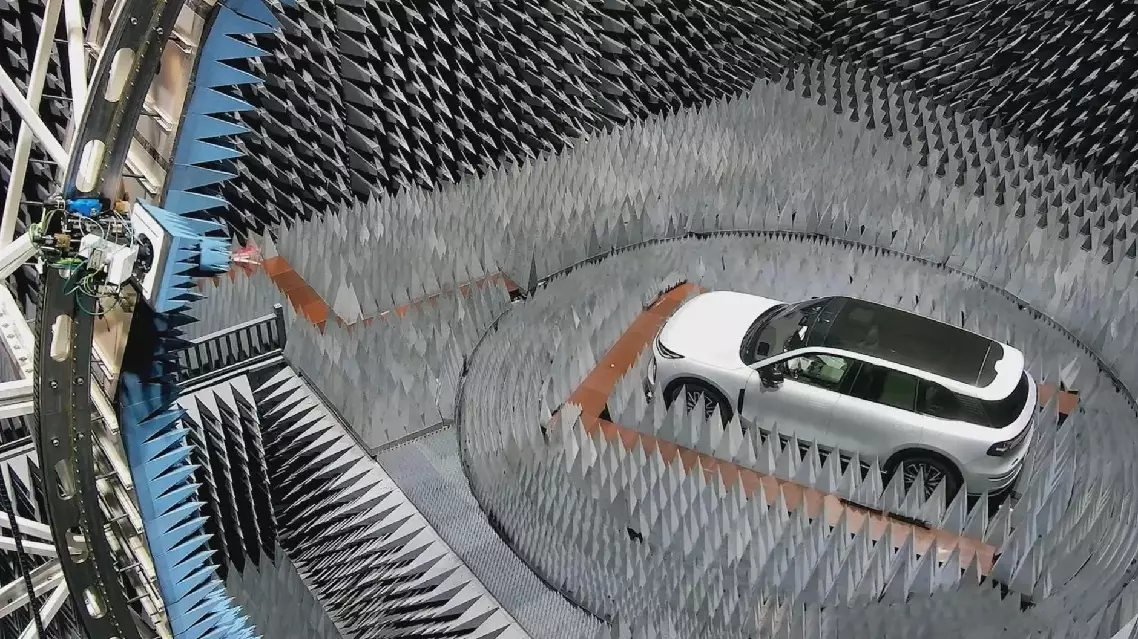
This facility is equipped with thousands of conical absorbers made from special materials designed to absorb electromagnetic waves, ensuring the precision of testing. The lab can evaluate both the reception and transmission performance of vehicles by utilizing probes and turntables to simulate real-world communication scenarios.
An intelligent connected vehicle testing ground in Chongqing has reported a 30 percent year-on-year increase in the number of intelligent vehicle models being tested this year. This facility can accommodate a wide array of complex and challenging testing scenarios for intelligent connected vehicles.
"We previously conducted field tests with about a dozen typical scenarios. Now, by employing simulation methodologies, we have expanded our testing scenarios to nearly 10,000. Our testing subjects have also diversified from just adults, children, and bicycles to include various delivery tricycles, trucks, and freight vehicles," said Huang Junfu, an expert in intelligent driving and active safety assessment.
The innovative equipment utilized at these testing sites is developed in-house, tailored to the unique traffic characteristics of China. This shift away from reliance on imported technologies has resulted in a remarkable reduction in testing costs, decreasing expenses by 60 percent to 70 percent. Such advancements enable the swift application of intelligent driving technologies to a broader range of affordable vehicle models.
China's automotive testing enters smarter era amid soaring demand
China's automotive testing enters smarter era amid soaring demand