Chinese and foreign astronomers have unveiled the first three-dimensional (3D) map of the properties of interstellar dust in the Milky Way, which will provide critical support for precise astronomical observation, and for studies in the areas of astrochemistry and galactic evolution.
The research was led by Zhang Xiangyu, a Chinese doctoral student at Germany's Max Planck Institute for Astronomy, in collaboration with his advisor, Dr. Gregory Green. It was based on data from China's Large Sky Area Multi-Object Fiber Spectroscopic Telescope (LAMOST) and the European Space Agency's Gaia space observatory, and its findings have been published as the cover story of the latest issue of the Science academic journal on Friday.
The interstellar medium -- the matter and radiation in the space between stars -- is crucial for the Milky Way's material cycle and star formation. Most elements heavier than hydrogen and helium in the interstellar medium exist as solid dust particles. Dust absorbs and scatters starlight, making distant stars appear dimmer and redder in a phenomenon known as "extinction." Most astronomical observations require extinction correction, Zhang said.
By integrating precise stellar parameters from LAMOST with low-resolution spectroscopic survey data from Gaia, astronomers compiled the first comprehensive catalog detailing the absorption and scattering from interstellar dust for over 130 million stars. Using this catalog, they have successfully constructed a 3D map of dust distribution and properties across the Milky Way, reaching distances of up to 16,308 light-years away.
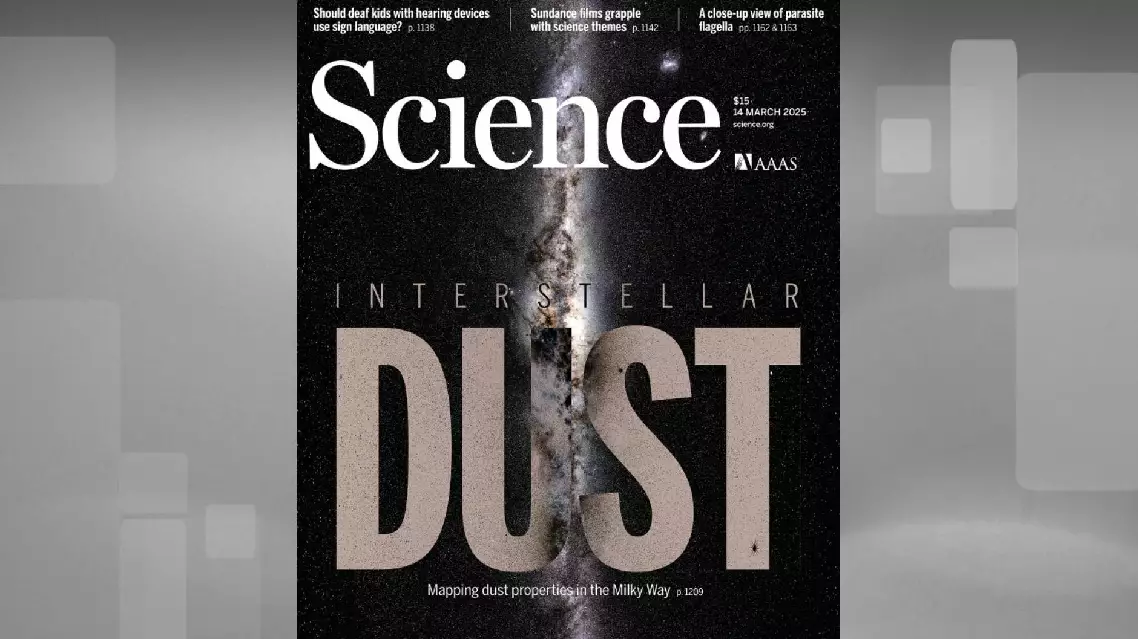
Astronomers unveil 1st 3D map of Milky Way interstellar dust properties
China's fiscal operations remained stable and orderly in 2025, with satisfactory budget execution, according to a fiscal policy execution report released by the Finance Ministry on Tuesday.
China's general public budget revenue hit 21.6 trillion yuan (about 3.14 trillion U.S. dollars) last year, with tax revenue registering positive growth, said the report.
Expenditure in the national general public budget totaled 28.7 trillion yuan, ensuring spending in key areas such as social security and employment, education, and healthcare.
In compliance with the requirement for Party and government offices to tighten their belts, budgets for spending on official overseas visits, official vehicles, and official hospitality decreased by 5 percent compared to that in 2024, ensuring more effective use of government funds.
In terms of measures to boost consumption, efforts were made to expand the scope of consumer goods trade-in program, and provide interest subsidies for consumer loans, according to the report.
Data showed that by the end of 2025, the balance of personal consumption loans from 23 lending institutions approached nearly 6 trillion yuan, an increase of over 500 billion yuan, or 10.2 percent, compared to that in 2024.
The institutions issued more than 2 trillion yuan in loans to over 1.4 million entities in the service sector, supporting them in upgrading consumer infrastructure, and enhancing their service supply.
In terms of efforts to increase investment, the ceiling for new local government special-purpose bonds was set at 4.4 trillion yuan in 2025, an increase of 500 billion yuan from the previous year, the report said.
These funds were primarily channeled into sectors such as transportation infrastructure, government-subsidized housing projects and urban renewal projects, and infrastructure for forward-looking, strategic emerging industries.
In total, more than 48,000 projects were supported and over 300 billion yuan was used as project capital.
Furthermore, the proactive fiscal policy in 2025 played a vital role in fostering the deep integration of sci-tech and industrial innovation, advancing urban-rural integration and regional coordination, and ensuring and improving people's livelihoods, according to the report.
China's fiscal operations remain stable, orderly in 2025: report