China Media Group (CMG) on Thursday convened a high-profile dialogue in Dakar, Senegal, bringing together leaders from politics, business, academia, and media to delve into how Chinese modernization could unlock new opportunities for Africa.
The event is part of CMG's "China in Spring Time: Sharing Opportunities with the World" Global Dialogue series.
Around 70 representatives from China and Senegal exchanged insights on how Chinese modernization can provide opportunities and inspiration for Africa's development.
Speaking via video link, CMG President Shen Haixiong emphasized that no country can tackle global challenges alone.
"Open-source sharing" should replace "closed operation" and "win-win cooperation" should replace "decoupling", said Shen, adding that China cannot be separated from the world in achieving development, and the world also needs China for prosperity.
Aldiouma Sow, Ministerial Adviser to the President of Senegal, emphasized the timeliness of the dialogue hosted by CMG, highlighting Africa and China's collaboration not only in the economic and trade sectors, but also in cultural and people-to-people exchanges.
Sow noted that Senegal and China share common values, including a vision of building a human community with a shared future, supported by the global initiatives proposed by Chinese President Xi Jinping, which hold great significance for Senegal and other African nations.
Other African attendees also expressed the hope that China could strengthen cooperation with the continent to help promote Africa's economic development.
"China's presence in Africa basically cuts across three key areas - political cooperation, economic cooperation and cultural cooperation. China relates with African countries as equals, as partners in development. China, for now, is a major economic player in the world. You cannot rule China out as far as global economy is concerned. And China is trying its best to share that progress with countries in Africa, and that's a good way to go," said Fyneface Onengiyeofori, Head of English Desk of the African Union of Broadcasting.
"We need to organize such events more often. They are very useful for mutual understanding and people-to-people contact. We believe that our Chinese friends will help African countries to get out of poverty and develop our own economy and industry. Nowadays, more and more Chinese-funded companies are setting up in Africa, which will boost our economy and industry. We hope that we can strengthen our cooperation with China in all aspects, which will help young people to understand more about the development of China," said Assane Mbengue, president of the Federation of China-Africa Friendship Associations (FAACA).
Meanwhile, Senegalese university representatives engaged in discussions with attending guests on topics such as China's success in overcoming poverty and its efforts to promote Chinese modernization.
Attendees also watched the international promotional video for China's blockbuster animated film "Ne Zha 2" and highlights from CMG's documentary "Charting the Decade," which showcased China's transformation over the past ten years and explored how its experiences could inspire the world.
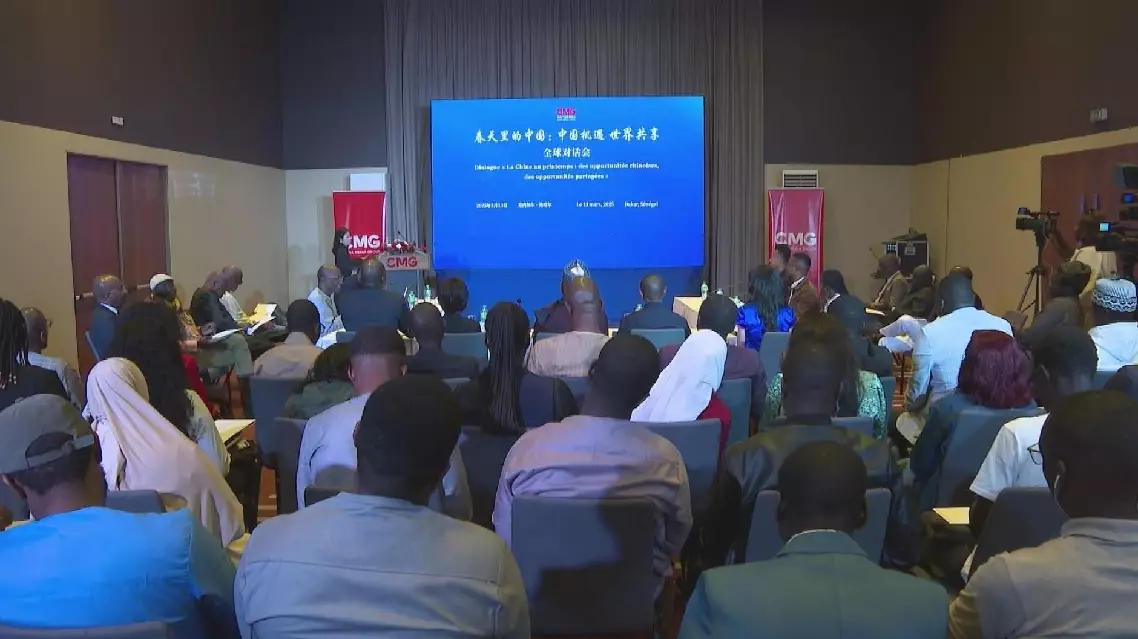
CMG hosts dialogue in Senegal to explore opportunities from Chinese modernization