Germany's fragile economic recovery is at risk amid the surging energy costs linked to the ongoing Middle East conflict, which will potentially trigger another recession, said Marcel Fratzscher, president of the German Institute for Economic Research (DIW).
Fratzscher made the comments in a recent interview with the China Media Group (CMG) following the release of the institute's spring 2026 growth forecast for Germany.
"We are cautiously optimistic of the German economy this year. We see a clear recovery in growth, with 1.0 percent of growth expected this year and 1.4 percent next year. For Germany, these are respectable growth figures. But our great concern is the ongoing U.S.-Israeli military strikes against Iran, which could hit German industry hard through higher energy costs and rising inflation. In an extreme scenario, if the war escalates further, this could mean another recession for Germany's economy," he warned.
Fratzscher identified U.S. tariff policies and geopolitical tensions as key uncertainties for German growth, stressing that for Germany and Europe, the fate of the Strait of Hormuz matters more than the duration of the conflict.
"For the economic impact on Germany and Europe, how long the war lasts is less important than what happens with the Strait of Hormuz. Will it be reopened and remain permanently open for oil and gas exports? If that succeeds, we assume prices could fall relatively quickly, meaning we won't continue to see the high prices for oil and gas that we have now. That would be a significant relief for the European economy and also for Germany," he said.
The ongoing tensions in the Middle East have already pushed up fuel prices in Germany. As Europe's largest economy, Germany's manufacturing sector relies heavily on stable energy supplies. Persistent high energy costs risk slowing business investment and consumer spending, potentially undermining Germany's fragile economic recovery.

Germany's fragile economic recovery at risk amid Middle East tensions: senior economist

Germany's fragile economic recovery at risk amid Middle East tensions: senior economist

Germany's fragile economic recovery at risk amid Middle East tensions: senior economist
Artificial intelligence is saving doctors in central China's Wuhan City a lot of time by doing tedious routine work, enabling them to focus on delivering more compassionate, accurate, and efficient care to their patients.
At the Central Hospital of Wuhan, AI assistants have been integrated into nearly 20 clinical scenarios, from reading pathology slides and writing medical records to guiding surgeons inside the operating room.
Tao Zhaowu, chief physician of the department of respiratory and critical care medicine at the hospital, said the AI program installed on his clinic computer can automatically generate medical records based on conversations between the doctor and the patient.
"Typing medical records used to take a lot of time. With AI's help, now I have more time to communicate with patients, more time to think about and assess their conditions, and then carefully develop more personalized treatment plans for them," Tao said.
At this smart hospital, pathology samples have been fully digitized. AI screens them first, identifying high-risk areas and generating preliminary assessments within seconds. This provides doctors with clear, focused views, enabling faster decision-makings.
Zhang Hongfeng, a director of the pathology department, said AI has increased their reading efficiency by 20 to 30 percent while helping prevent missed diagnoses.
"Before the deployment of AI in examinations of biopsy samples, patients had to take their biopsy samples from local hospitals to our hospital, wait for us to examine the samples with a microscope and write the report, and then take the report back to the local hospitals," Zhang said.
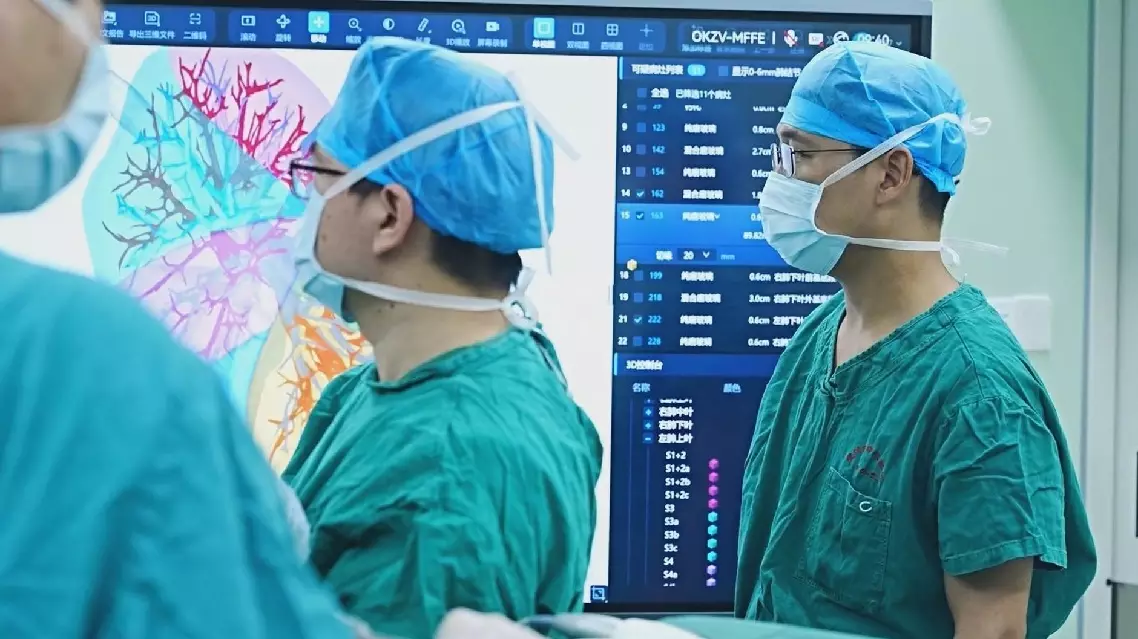
In the operating room, AI is giving surgeons capabilities they never had before. AI-powered 3D reconstruction technology generates digital maps of the patient's body. It gives surgeons what feels like X-ray vision, allowing them to precisely remove deep nodules.
"Before surgery, we use 3D reconstruction technology to transform 2D CT scans into 3D digital models. It's essentially a 'digital lung' -- a complete simulation of the patient's actual lung tissue," said Guo Jialong, a director of the department of thoracic surgery.
For hospital president Cai Wei, all of this is part of a much larger vision. The hospital is building a smart information ecosystem, creating a closed loop of intelligent care that extends from home to hospital and back again.
"After patients come to our hospital, the information management system helps arrange their tests efficiently and matches them quickly with the right specialists," Cai said.
AI improves healthcare for Wuhan hospital