Skip to Content Facebook Feature Image

China slams latest US 301 trade probe as typical act of protectionism

China

China

China

China slams latest US 301 trade probe as typical act of protectionism

2026-03-16 09:56 Last Updated At:13:29

China's Ministry of Commerce on Monday slammed the United States for launching the latest Section 301trade investigation aimed at 60 economies, including China, over the alleged failures to ban imports made with "forced labor", calling it typical act of protectionism that severely disrupts the international economic and trade order.

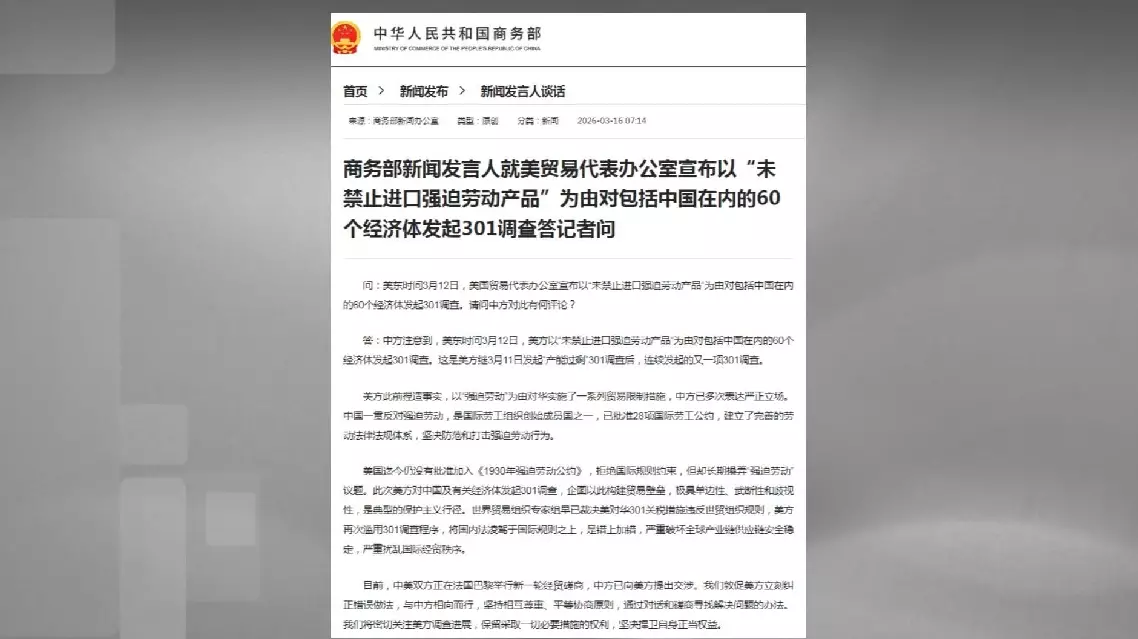
China has noted that on March 12 local time, the United States launched the new Section 301 trade investigation against the 60 economies on the grounds of "failing to prohibit the import of products made with forced labor," which came just one day after it launched another Section 301 trade investigation into 16 economies, including China, citing "overcapacity", a spokesperson from the ministry said.

The spokesperson condemned the United States for fabricating claims about "forced labor" to impose a series of trade restrictions on Chinese products, noting that China had repeatedly expressed its firm opposition to such measures.

The spokesperson reiterated that China has consistently opposed forced labor and is one of the founding members of the International Labour Organization.

China has ratified 28 international labor conventions and established a comprehensive legal and regulatory framework to resolutely prevent and combat forced labor, the spokesperson noted.

The spokesperson also criticized the United States for not ratifying the Forced Labour Convention (1930) and manipulating the forced labor issue to build trade barriers.

The new investigation, the spokesperson said, is unilateral, arbitrary, and discriminatory, amounting to a typical act of protectionism.

A World Trade Organization (WTO) panel has already ruled that the U.S. Section 301 tariffs against China violate WTO rules, the spokesperson said, adding that the United States is once again abusing the 301 investigation process and placing domestic law above international norms, which is a mistake on top of its mistakes, seriously undermining the security and stability of global industrial and supply chains and severely disrupting the international economic and trade order.

The spokesperson said that China has raised the issue with the United States at the ongoing trade talks in Paris, and urged the United States to immediately correct its wrongdoings, work with China in the same direction, adhere to the principles of mutual respect and equal consultation, and seek solutions through dialog and negotiation.

China will closely monitor the investigation's progress and reserves the right to take all necessary measures to defend its legitimate interests, said the spokesperson.
China slams latest US 301 trade probe as typical act of protectionism
China slams latest US 301 trade probe as typical act of protectionism


China slams latest US 301 trade probe as typical act of protectionism
China slams latest US 301 trade probe as typical act of protectionism
Germany's fragile economic recovery is at risk amid the surging energy costs linked to the ongoing Middle East conflict, which will potentially trigger another recession, said Marcel Fratzscher, president of the German Institute for Economic Research (DIW).

Fratzscher made the comments in a recent interview with the China Media Group (CMG) following the release of the institute's spring 2026 growth forecast for Germany.

"We are cautiously optimistic of the German economy this year. We see a clear recovery in growth, with 1.0 percent of growth expected this year and 1.4 percent next year. For Germany, these are respectable growth figures. But our great concern is the ongoing U.S.-Israeli military strikes against Iran, which could hit German industry hard through higher energy costs and rising inflation. In an extreme scenario, if the war escalates further, this could mean another recession for Germany's economy," he warned.

Fratzscher identified U.S. tariff policies and geopolitical tensions as key uncertainties for German growth, stressing that for Germany and Europe, the fate of the Strait of Hormuz matters more than the duration of the conflict.

"For the economic impact on Germany and Europe, how long the war lasts is less important than what happens with the Strait of Hormuz. Will it be reopened and remain permanently open for oil and gas exports? If that succeeds, we assume prices could fall relatively quickly, meaning we won't continue to see the high prices for oil and gas that we have now. That would be a significant relief for the European economy and also for Germany," he said.

The ongoing tensions in the Middle East have already pushed up fuel prices in Germany. As Europe's largest economy, Germany's manufacturing sector relies heavily on stable energy supplies. Persistent high energy costs risk slowing business investment and consumer spending, potentially undermining Germany's fragile economic recovery.

Germany's fragile economic recovery at risk amid Middle East tensions: senior economist

Germany's fragile economic recovery at risk amid Middle East tensions: senior economist

Germany's fragile economic recovery at risk amid Middle East tensions: senior economist

Germany's fragile economic recovery at risk amid Middle East tensions: senior economist

Germany's fragile economic recovery at risk amid Middle East tensions: senior economist

Germany's fragile economic recovery at risk amid Middle East tensions: senior economist

Recommended Articles