China's high-tech companies have made substantial progress in developing embodied AI robots, bringing them closer to functioning and feeling like humans.
Embodied AI robots integrate artificial intelligence into the physical bodies, allowing them to perceive, learn and dynamically interact with the environment like humans.
Relying on computation and logical reasoning, the robots can continuously learn, adapt and complete tasks by perception, action and environmental feedback, thus improving autonomy and practical application in real world.
China has made great efforts to develop embodied AI, highlighted it in this year's government work report.
The country aims to establish a preliminary innovation system for humanoid robots by 2025, with plans to have a secure, reliable industrial and supply chain system by 2027, when related products will be deeply integrated into the real economy.
A Beijing-based company has created an embodied AI robot capable of rapidly running in real outdoor environments.
Standing 171 cm tall and weighing 63 kg, this robot boasts 55 degrees of freedom and can achieve a running speed of 3.6 metre per second, setting a new world record for electric-driven humanoid robots.
"If a robot is to run quickly, it needs not only high joint torque and output torque, but also sufficient output speed. To achieve these two requirements simultaneously, the output power of its joints must be adequately high. In addition, for stable running, the robot's structural stability must be ensured, which includes maintaining a high level of rigidity in its structure," said Xi Yue, co-founder of the company.
In addition to running quickly and steadily, the robot is also capable of precise grasping. Its dexterous hands, about the size of human hands, can lift a weight of 20 kg using just four fingers.
Moreover, after undergoing extensive deep learning and training with a self-developed large model, the robot can also autonomously perform refined tasks such as picking up dumplings with chopsticks and handling a dice with hands. It can also apply the appropriate amount of force when grabbing delicate items, like glass cups, ensuring safe and careful operation.
"The ultimate goal is to allow robots to become a part of people's homes. If the robots' hands are dexterous enough, they will be able to better adapt and integrate perfectly in home environment where humans live. They will also be able to use all the tools like human and take on a wide range of tasks," said Xi.
Another company in Beijing has equipped its embodied AI robot with bionic muscles and skin to create a facial appearance. Through deep learning and training, the robot can activate its muscles and skin to display over 200 dynamic expressions covering six basic emotions.
"If the robot can express emotions, it will naturally be closer to humans. Why do we want to add this feature? First, for reception purposes. Second, we want it to serve in elderly care communities," said Li Mengwei, technical director at the company.
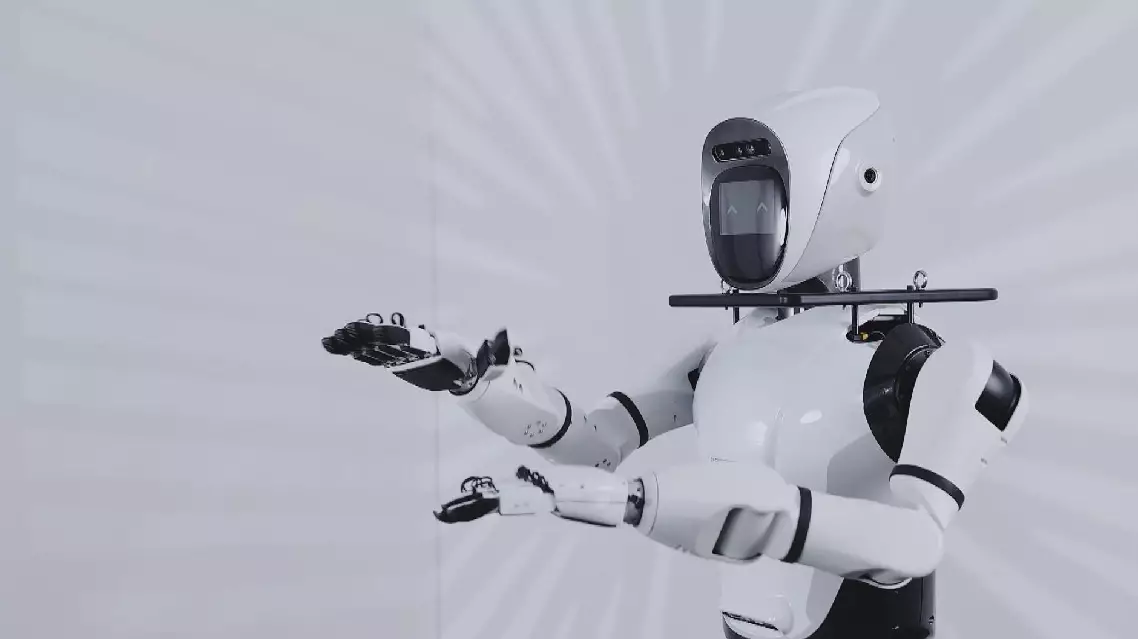
China advances embodied AI technology, bringing robotics closer to human-like flexibility