The Chinese-made historical documentary "The Sinking of The Lisbon Maru" highlights the harrowing human impact of war by focusing on the tragedy experienced by the victims and their families, while reinforcing the need for greater harmony in our world, according to a British author and historian.
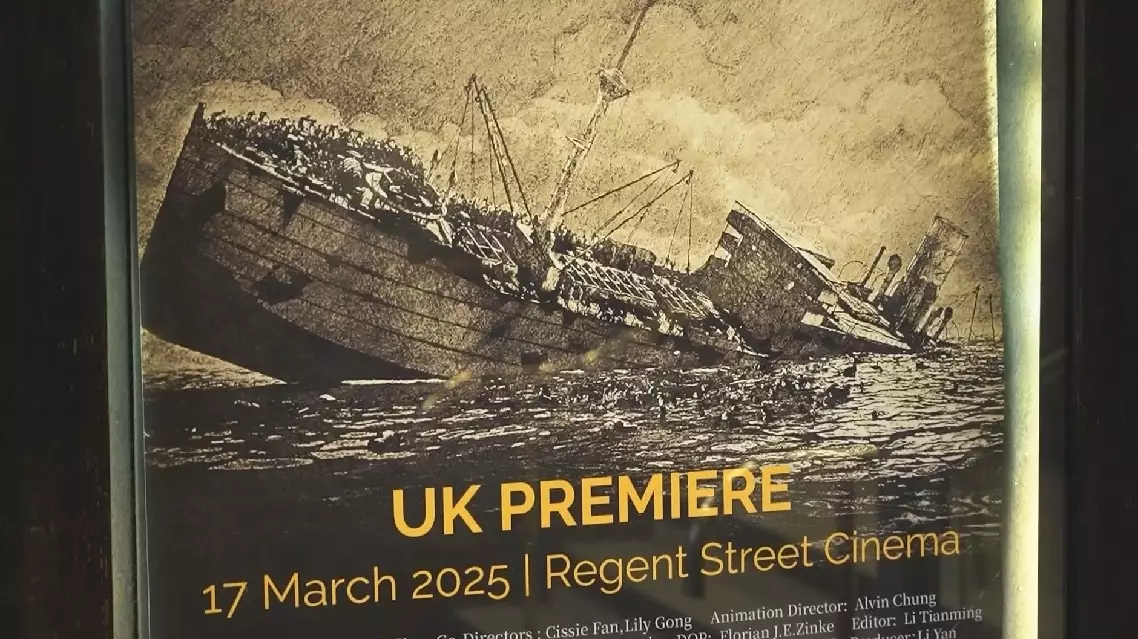
Released on the Chinese mainland last September, the documentary film made its much-anticipated UK premiere in London on Monday night. It documents the 1942 sinking of the "Lisbon Maru," an armed Japanese cargo ship, during World War II, and tells the story of how ordinary Chinese people helped save hundreds of British prisoners of war (POWs) who were left to drown by the Japanese fascists.
The Lisbon Maru had been transporting 1,816 British POWs from Hong Kong towards Japan, without bearing a sign indicating it was carrying POWs - a violation of the Geneva Convention.
After being struck by a torpedo launched by a U.S. submarine in waters near the Dongji Islands in east China's Zhejiang Province, Japanese soldiers cruelly battened the POWs down below deck, leaving them to drown and even shooting at them, leading to the deaths of 828 prisoners. Braving bullets, local Chinese fishermen helped rescue 384 POWs from the water.
In an interview with the China Global Television Network (CGTN) on Tuesday, Tony Banham, who wrote the book "The Sinking of The Lisbon Maru: Britain's Forgotten Wartime Tragedy", said that he only became truly aware of the devastating scale of the tragedy during his extensive information gathering process for the book, which was released back in 2006.
"When you say 1,816 men were on the ship, it's just a number. But when you start working through them, name by name, by name, by name, and you research into their families, their parents, their brothers, sisters and, for the older ones, wives and children, the scale of the tragedy just becomes enormous and really quite intimidating. It was no small thing. By the context of World War II, obviously there were bigger tragedies, bigger events, bigger battles, but you are talking here about something bigger than the Titanic. And yet in that context, it was considered to be just another disaster," he explained.
The documentary's director, Chinese filmmaker Fang Li, who is also an expert in geophysical exploration and marine technology, had become fascinated with the tale of the Lisbon Maru, and located the wreckage of the ship in 2016. He later interviewed many of the living witnesses and, alongside his crew, then traveled to the UK to visit the families of the POWs and to speak to many historians including Banham, where they uncovered many powerful stories connected to the tragic Lisbon Maru incident.
Through their research, Banham said that both he and Fang came to fully appreciate the human side of the tragedy, and how it has affected victims' families. He also said a key message conveyed in both his book and the film is of the human toll of war, and stressed the need to ensure greater understandings and harmony in our world.
"We both came to the conclusion that the story is about individual people and the families they came from. And the impact that war has on families, it doesn't matter if you're British or Chinese or whatever, the nationality is not the important thing -- the important thing is that when war comes, everybody is a victim. And we need to remember primarily that war has such a terrible impact on ordinary families. The key message from the book and the film is one of humanity. It's simply that families are families, people are people, and we should simply recognize that wars, and not just wars, but bad international relationships don't do anybody any good. Harmony is what works, and harmony should be the focus," he said.
Chinese-made WWII documentary highlights human impact of war, reinforces need for harmony: UK historian