WASHINGTON (AP) — The federal judge who ruled against Donald Trump's deportation plans and is now facing calls for his impeachment is no stranger to politically fraught cases — including ones involving the president.
In his 14 years on the federal bench, James “Jeb” Boasberg has resolved secret grand jury disputes that arose during the special counsel investigations into Trump, oversaw improvements after the Trump-Russia investigation in how the Justice Department conducts national security surveillance and handled his share of sentencings for rioters who stormed the U.S. Capitol on Jan. 6, 2021.
A former homicide prosecutor in the nation's capital who played basketball at Yale University, where he also earned his law degree, Boasberg has cultivated a reputation among colleagues as a principled jurist with bipartisan respect — he was appointed to the federal bench in 2011 by President Barack Obama but was named a decade earlier to a seat on the D.C. Superior Court by President George W. Bush.
As a nominee for the federal court, Boasberg was asked by then- Republican Sen. Jeff Sessions, who would later go on to become attorney general during Trump’s first term, if he believed judges should base their decisions on a desired outcome or solely on the law and facts.
“Judges should not work from a desired outcome in assessing the law and facts,” Boasberg wrote. “Instead, they should follow the law and facts to whatever outcome they dictate.”
Boasberg's position as chief judge of Washington's federal court gave him a unique window on special counsel Jack Smith's investigations into Trump as witness after witness arrived at the courthouse for secret grand jury testimony.
In that role, he was called upon to arbitrate closed-doors disputes over the scope of cooperation from witnesses like then-Vice President Mike Pence, who challenged a subpoena from prosecutors that sought to force his cooperation with Smith's team. Boasberg in 2023 issued a sealed opinion requiring the vice president to testify before the grand jury investigating Trump's effort to overturn the 2020 presidential election but also agreed that certain questions could be off limits.
Trump was indicted months later, but the case — and a separate one charging him with hoarding classified documents at his Mar-a-Lago estate — was dismissed by prosecutors after his presidential win last November.
Boasberg presided over dozens of cases against defendants charged with storming the U.S. Capitol after Trump lost the 2020 presidential election, often issuing sentences significantly more lenient than what prosecutors recommended and displaying a measured and patient approach.
Last year, he calmly listened to a Proud Boys extremist group member berate and insult him during a Jan. 6 sentencing hearing. The defendant, Marc Bru, called him a “clown” and a “fraud” presiding over a “kangaroo court.”
“I’m happy to let you say whatever you wish, but again, I haven’t interrupted you. The government hasn’t interrupted you. I have treated you with courtesy in all of these proceedings,” the judge told Bru before sentencing him to six years in prison.
And during the sentencing of Ray Epps, who became the target of right-wing conspiracy theories and death threats for his role in the Capitol riot, Boasberg bluntly described the violence as an “insurrection by supporters of the former president and not some violent act instigated by antifa or the FBI.”
Boasberg is also well-known among Trump allies for his role as a judge on the secretive Foreign Intelligence Surveillance Court during the period when the FBI was investigating whether Trump's successful 2016 campaign had colluded with Russia to tip the outcome of the election.
A Justice Department inspector general report identified multiple mistakes during the course of that investigation, including significant errors and omissions in applications that prosecutors submitted to the surveillance court to eavesdrop on a former Trump campaign national security adviser.
Later, as the surveillance court's presiding judge, Boasberg chided the Justice Department for having “breached its duty of candor to the Court with respect to those applications” and said the frequency and gravity of the errors during the Russia investigation had “called into question the reliability of the information proffered in other FBI applications.”
In response to the errors, he mandated that the Justice Department provide him with information about its efforts to implement reforms meant to improve the accuracy of warrant applications submitted to the surveillance court.
Though he's been critical of the FBI and its surveillance protocols, Boasberg has also drawn renewed scrutiny from Trump supporters over what they see as a lenient sentence of probation imposed in 2020 on an FBI lawyer who pleaded guilty to doctoring an email that the Justice Department relied on during the Russia investigation in its surveillance of Trump campaign adviser Carter Page.
The most contentious flare-up occurred over the weekend, when Boasberg issued an order blocking deportation flights under wartime authoritiesfrom an 18th-century law that Trump invoked to carry out his plans.
Trump issued a proclamation that the law was newly in effect due to what he claimed was an invasion by the Venezuelan gang Tren de Aragua. His administration is paying El Salvador to imprison alleged members of the gang.
After two deportation flights continued to El Salvador despite Boasberg's verbal order that they be turned around to the U.S., Boasberg convened a hearing on Monday to discuss “possible defiance” of his ruling by the Trump administration.
The Justice Department is pushing in court to have Boasberg removed from the case, and Trump escalated his administration's conflict with the judiciary on Tuesday in a social media post that called the judge an unelected “troublemaker and agitator" and urged his impeachment in capital letters.
The post drew a public rebuke from Supreme Court Chief Justice John Roberts, who said in a rare statement: “For more than two centuries, it has been established that impeachment is not an appropriate response to disagreement concerning a judicial decision. The normal appellate review process exists for that purpose.”
Associated Press writer Michael Kunzelman in Washington contributed to this report.
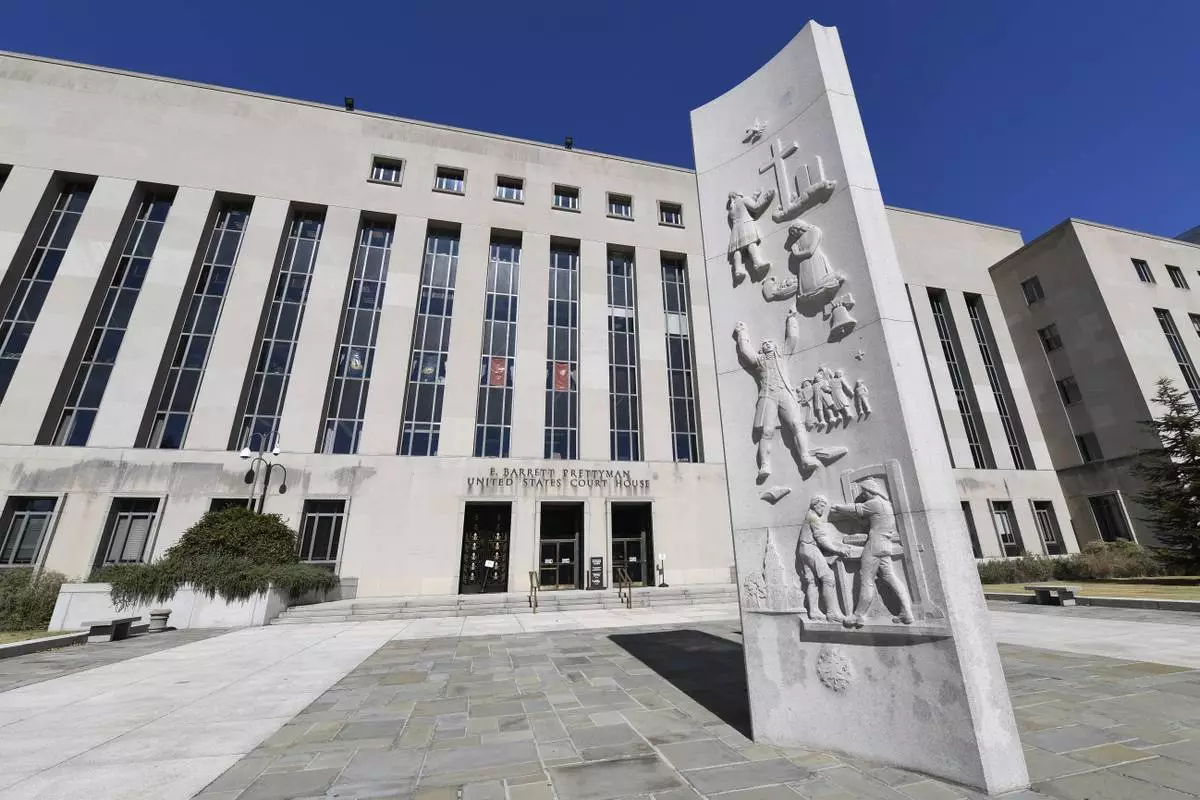
FILE - The E. Barrett Prettyman United States Courthouse in Washington, Oct. 11, 2019. (AP Photo/Susan Walsh, File)