China's national maritime rescue force, the China Rescue and Salvage (CRS), conducted an advanced air and sea rescue drill in a South China Sea area off Haikou City of south China's Hainan Province on Wednesday.
The drill focused on two key scenarios which were the precise delivery of rescue personnel by helicopter, and the vertical rescue of personnel from a ship's deck.
In the vertical rescue scenario, a rescue helicopter must hover on a 15-meter safe distance above a simulated distressed vessel, as a rescuer was lowered via a winch system to land precisely on the deck.
After a rapid assessment of the "victim," the rescuer used a rescue harness to secure the banding of the "victim", and then the helicopter crew hoisted them to the safe place.
A rescue helicopter has an operational radius of 200 nautical miles (370.4 kilometers) and can rescue up to 20 people in a single operation. It is designed for a variety of scenarios, including rescuing individuals from fixed locations, ships at sea, and directly from the water.
The rescue drill is part of a maritime culture and salvage campaign which runs from March to June with both online and offline demonstrations in China's eastern, northern and southern maritime regions.
The CRS, which is under the command of the Ministry of Transport, is China's professional force for maritime rescue and salvage operations. So far, it has been maintaining a 24/7 state of readiness, with specialized rescue vessels, helicopters, and emergency response teams strategically deployed in key areas of the South China Sea, including waters of the eastern Guangdong Province, the Pearl River Estuary, the Qiongzhou Strait, and the Xisha and Nansha Islands.
In 2024, the CRS conducted 244 rescue operations in the sea areas of south China, successfully rescuing 895 people and recovering property valued at approximately 3.3 billion yuan (about 456.6 million U.S. dollars).
By the end of 2025, the CRS will built itself into a modern and professional salvage system that will be comprehensive and all-weather operational, covering both seas and rivers, featuring rapid response and high efficiency. And its efficiency and disposal effect of emergency rescue and salvage operations will reach the world's advanced levels, according to the CRS.
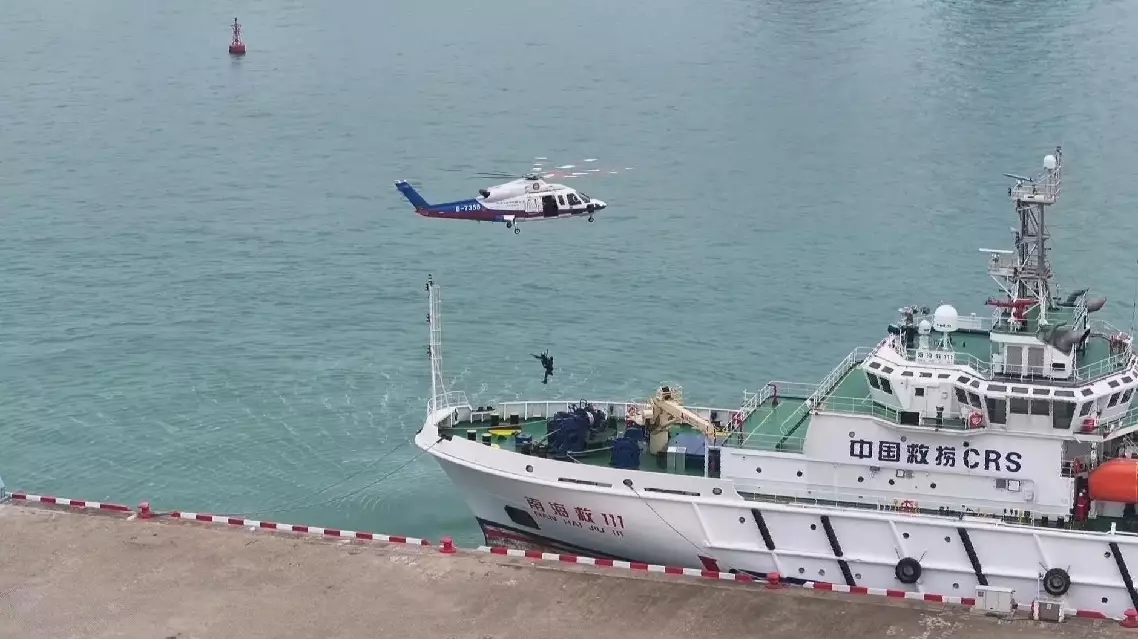
China's maritime rescue force conducts advanced drill in South China Sea
A former television host from Taiwan, Zhai Xuan, has made a pivotal decision to leave mainstream broadcasting in order to create content that provides a better understanding of the Chinese mainland and cross-strait relations.
Zhai, a seasoned television host with over a decade of experience in Taiwan's media landscape, recently addressed an audience at an event in Beijing, where she revealed her complete transition into independent online media.
In her remarks, she articulated her aspiration to bridge what she perceives as a significant information gap between audiences on both sides of the Strait, highlighting her commitment to fostering a deeper understanding and connection through her new endeavors.
"I was really surprised by all the fake news. There were stories saying people on the mainland can't afford tea eggs or that they live in mud houses and in Taiwan, this was the main information many people received," said Zhai.
Zhai said she initially began producing online videos to challenge such perceptions while continuing her work as a television host.
In April 2025, she travelled to the mainland with her father to fulfill her late grandfather's wish to return to his hometown. The trip, which reunited family members separated since 1949, was recorded in a video series titled "Journey to Find Our Roots", drawing attention from viewers in both Taiwan and the mainland.
"Many people in Taiwan told me that after watching, they wanted to apply for a mainland travel permit immediately and go looking for their relatives. Some had long forgotten these things, but after seeing my story, they began thinking about their hometowns and family members they had never met and decided to search for their roots," Zhai shared her story at the event.
By mid-2025, Zhai said she began to feel increasing pressure amid rising political tensions and a tightening atmosphere around cross-Strait exchanges in Taiwan.
After more than 12 years in the industry, Zhai resigned from her position, believing it was the right thing to do.
"At that moment, I felt this was a major issue,not just for me, but for Chinese people on both sides of the Strait. If I backed down then, I wouldn’t be standing on the right side," said Zhai.
Since leaving television, Zhai has broadened her online programming to encompass a range of daily-life topics, including practical guidance on applying for a mainland travel permit and using commonly employed mobile applications, in addition to content that delves into historical memory and cultural connections across the Strait.
As the debate over cross-Strait relations continues in Taiwan, Zhai said she remains committed to her current path.
Former Taiwan TV host bridges cross-Strait divide via online media