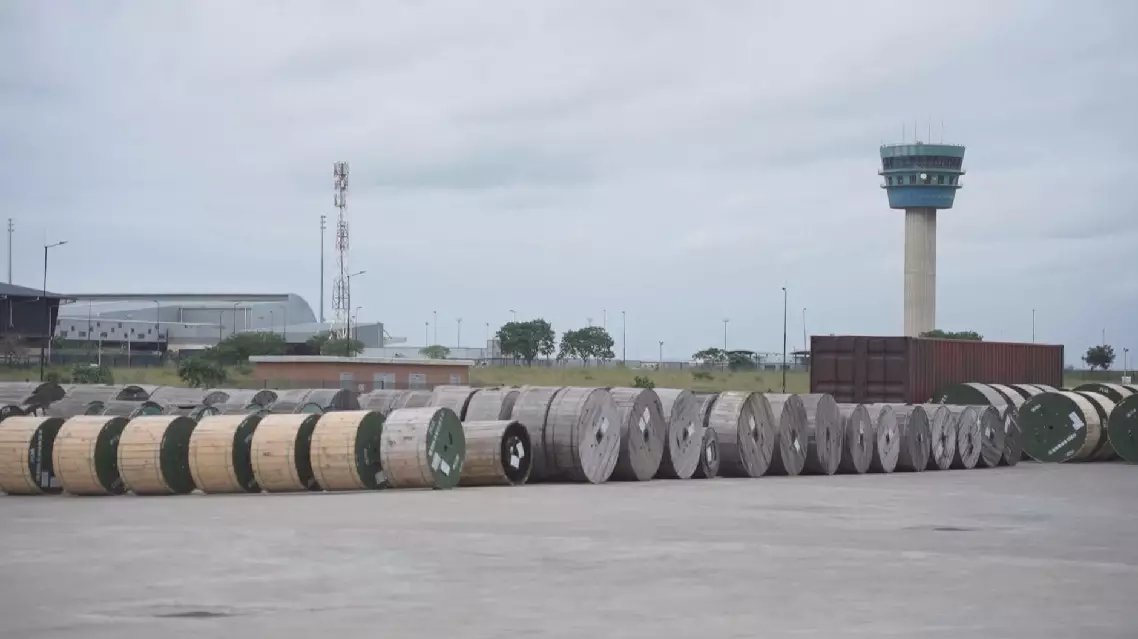
A Chinese-invested fiber optic cable manufacturing company in South Africa, in partnership with local firms, has become a backbone of the country's digital transformation after nearly a decade of investment.
The company Yangtze Optics Africa (YOA) manufactures fiber optical cables and provides residents with high-speed internet access. It contributes to local economic growth by creating jobs and digital skills that are in wide demand in the country and the African continent.
YOA is a joint venture between Chinese-owned Yangtze Optical Fibre, Cable Joint Stock Limited Company, and South Africa's Mustek Limited. In 2016, they invested 8 million U.S. dollars in a high-tech cable plant at Durban's Dube Trade Port.
On March 12, they doubled that investment, injecting an additional 160 million South African rands (about 8.7 million U.S. dollars) to expand the project as Africa's largest manufacturing facility of fiber optic cable north of Durban, meeting the growing demand for faster and more reliable internet in South Africa.
"With the opening up and the running of this new facility, we are going to increase the production capacity to 2.5 million kilometers per annum," said Zheng Bingkai, minister of Chinese Embassy in South Africa at the launch event.
At full speed, the factory can produce over 4,000 fiber kilometers of cable daily, and much of it is destined for Africa's telecom networks.
Notably, it's the young Africans leading the charge. Mechanical engineering graduate Mbalenhle Ngema is one of them. She started as an intern and is now a junior process engineer.
"When I came here, I didn't know much about fiber. So for me it was just like a blank page if I can place it like that. And from then onwards I learnt all the processes that take place at Yangtze, from the coloring process to the stranding process, to the tube process, to the shipping process," said she.
With youth unemployment at crisis levels in South Africa and much of the continent, programs like YOA's are giving young people a chance to build careers in future industries.
"Each and every year we have new students coming here whether it's concept training, whether it's internship or just multi-skills," said Mbalenhle.
However, fiber cable manufacturing is not just about creating jobs but also about improving connections. Cities may be linked up, but many rural and remote communities in the country are still left behind. Closing this digital divide is a priority.
Jan Bongaerts, senior vice president of Yangtze Optical Fiber and Cable Joint Stock Company, believes YOA's value in bridging the digital gap by producing cable locally in the factory and working with the government and industry partners.
"So I think by producing the cable here locally and being with our partners from DTI (Department of Trade and Industry) and with our industry partners, we can actually help to bridge that and get more people connected in South Africa and then Africa as a continent," he said.
South Africa's fiber revolution is still in its early days. It's helping to end the frustrations of slow, unreliable internet, but high-speed connectivity remains out of reach for too many.
Fibre also plays a critical role in linking Africa to the rest of the world through undersea cables that keep data flowing across continents. And with more investment in local manufacturing and skills development, industry experts say Africa's digital future is looking brighter.
China-invested fiber cable manufacturer boosts Internet connection, digital economy in South Africa